The best financial habits to develop are small, repeatable actions: tracking spending, saving on salary day, paying card bills in full, keeping an emergency fund and reviewing your money once a year. Habits matter because prices keep rising. Retail inflation in India rose to 5.54% in September 2026 from 4.83% in August, according to provisional MoSPI data released on 12 October 2026. Money that sits without a plan loses value every month.
Key Takeaways
- Group money habits by how often you do them: daily, weekly, monthly and yearly.
- Saving ₹100 a day becomes about ₹2.14 lakh in five years in a post office RD at 6.7%.
- Automation beats willpower: set transfers and SIPs to leave on salary day.
- RBI rules give every person one free full credit report a year from each credit bureau.
- Report an unauthorised debit within 3 working days to keep your liability at zero.
Table of contents
- Why financial habits matter more than income
- The 14 best financial habits to develop, from daily to yearly
- Worked example: what small habits add up to
- How to make a money habit stick
- Where to park habit money: latest safe rates
- Protective habits: credit reports and fraud
- Bad money habits to replace
- A 30-day starter plan and checklist
- Frequently asked questions
- The Bottom Line
Why the Best Financial Habits to Develop Matter More Than Income
Two people with the same salary can end up in very different places after ten years. The difference is rarely one big decision but hundreds of small ones: whether the savings transfer happens on the 1st or never, whether the card bill is paid in full, whether a sale becomes an impulse buy.
A habit is a decision you no longer have to make. Once saving or tracking becomes automatic, it does not depend on mood, motivation or a good month.
Indian investors already show how powerful a routine can be. AMFI’s monthly note for September 2026 shows 10.06 crore SIP accounts contributing a record ₹32,490 crore in one month, an average of about ₹3,230 per account. Most are not investing large sums; they repeat the same action every month. The sections below turn that idea into a full set of habits.
The 14 Best Financial Habits to Develop, From Daily to Yearly
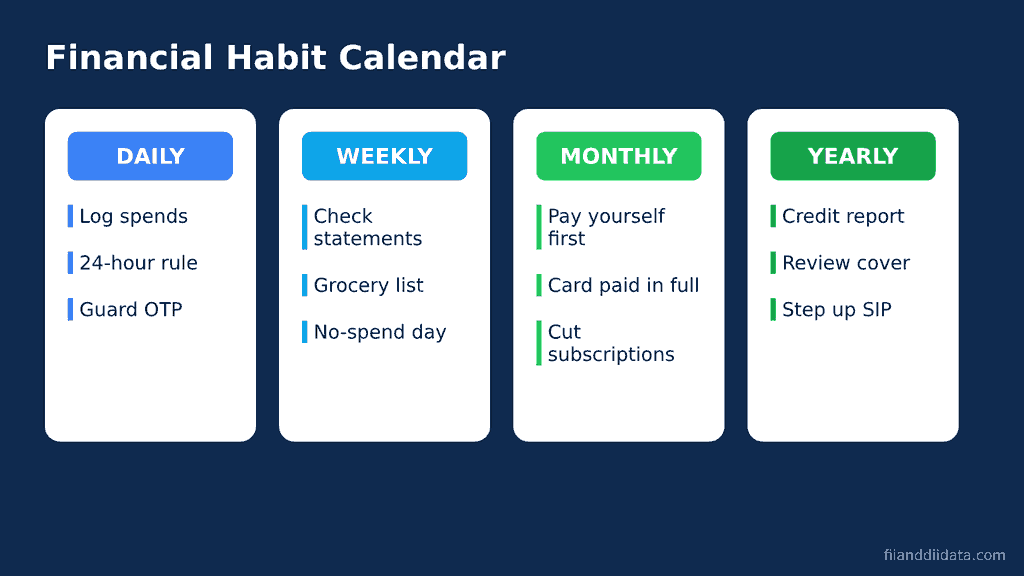
We group these habits by frequency, so you know exactly when each one happens.
Daily financial habits to develop
- Log every spend in under two minutes. Use a notes app, a spreadsheet or your bank’s spending tab. After a month you will see patterns that statements hide.
- Use a 24-hour rule for wants. For any non-essential purchase above a limit you choose, say ₹2,000, wait a day before you pay. Many impulse buys do not survive the wait.
- Guard your OTP, PIN and UPI PIN. Never share them, and never enter a UPI PIN to “receive” money. You only need a PIN to send money.
Weekly money habits
- Check bank and card alerts once a week. Ten minutes on a Sunday catches unknown debits and duplicate charges early.
- Shop for groceries with a list. Plan the week’s meals first, then buy only what the list needs.
- Keep one no-spend day. Pick a day each week with no discretionary spending at all.
Monthly habits
- Pay yourself first on salary day. Set a standing instruction or SIP date one or two days after your salary arrives, so savings leave before spending starts.
- Pay the credit card bill in full. Paying only the minimum due means interest on the unpaid balance. Set an auto-debit for the full statement amount.
- Top up the emergency fund. Until you hold three to six months of essential expenses, send part of every salary to this fund first.
- Audit subscriptions and auto-debits. Cancel anything you did not use last month.
Yearly habits
- Download your free credit report. Check it for loans you never took or wrong late-payment marks.
- Review insurance cover and nominees. Marriage, a child or a new loan changes the cover you need. Update nominees on every account.
- Step up SIPs with every pay rise and rebalance. Raise your SIP by a fixed share of each increment, and bring your equity and debt mix back to plan.
- Compare tax regimes before you file. Use the Income Tax Department’s calculator each year instead of choosing out of habit.
If you want the budgeting side in more depth, our guide on how to build a monthly budget in seven steps pairs well with these routines. Next, let us put numbers on what small habits are worth.
Worked Example: What Small Habits Add Up To
Take Neha, 27, who works in Jaipur. She finds ₹100 a day she can save by cutting food delivery and one unused subscription. That is about ₹3,000 a month. Here is what her habits are worth. All figures are illustrations, not recommendations.
| Habit | Calculation | Result |
|---|---|---|
| Save ₹100 a day | ₹100 × 365 days | ₹36,500 a year |
| Put ₹3,000 a month in a post office RD | 60 instalments at 6.7%, compounded quarterly | About ₹2,14,100 at maturity on ₹1,80,000 paid in |
| Keep the same ₹1,80,000 idle as cash | If inflation stayed at 5.54% for 5 years | Buying power of about ₹1,37,500 |
| Cancel three unused subscriptions | ₹199 + ₹299 + ₹499 a month | ₹997 a month, ₹11,964 a year |
| ₹3,000 SIP for 10 years, no step-up | Assumed 10% annual return | About ₹6.04 lakh on ₹3.6 lakh invested |
| Same SIP with a 10% step-up each year | Assumed 10% annual return | About ₹8.94 lakh on ₹5.74 lakh invested |
What the numbers tell us
The RD figure is our estimate of the standard quarterly-compounding method; the post office’s own maturity table may differ by a few rupees. The 10% equity return is only an assumption to show the effect of a step-up. Real returns vary and can be negative over short periods.
The bigger lesson is in the gap between rows. A plain savings habit protects money from inflation. A step-up habit adds almost ₹2.9 lakh to the final value over ten years with no change in Neha’s lifestyle, because it only uses part of each raise. That is why the yearly step-up sits among the best financial habits to develop. The hard part is sticking with it, which is what the next section covers.
How to Make a Money Habit Stick
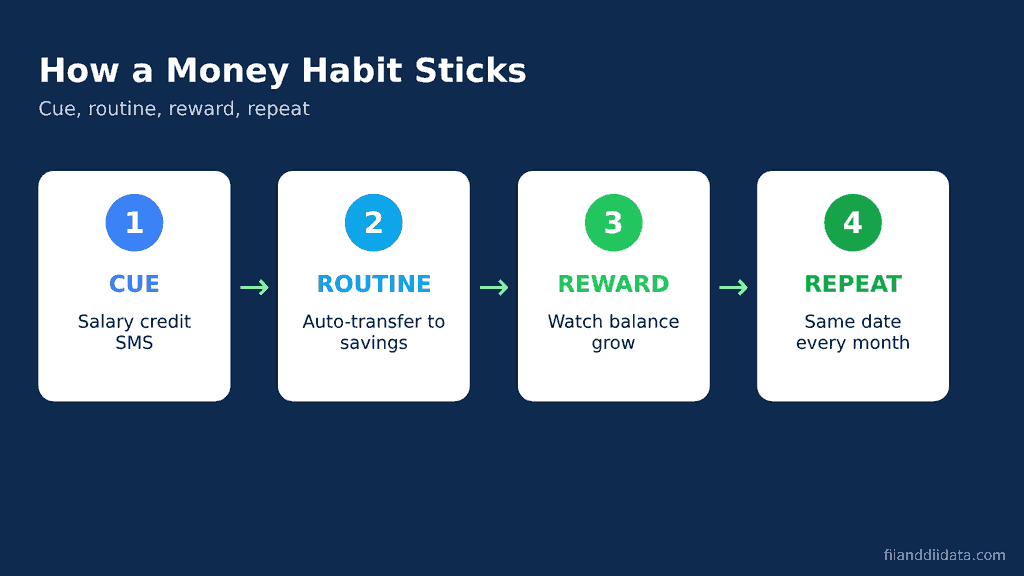
Knowing the right habit is easy; doing it for years is not. Behavioural research describes habits as a loop of cue, routine and reward. You can design each part on purpose.
- Tie the habit to a cue you already have. The salary credit SMS is the perfect cue for saving. Your Sunday chai can be the cue for a weekly statement check.
- Make the routine automatic. Standing instructions, SIP mandates and card auto-pay remove the need for willpower.
- Start smaller than you think. ₹500 a month that never stops beats ₹5,000 that stops in month three. Raise the amount once the habit is steady.
- Make the reward visible. Name your accounts by goal, such as “Emergency fund” or “Home deposit”, and watch the balance grow.
- Track a streak. Mark each month the habit happened. A broken streak is a signal to restart, not a reason to quit.
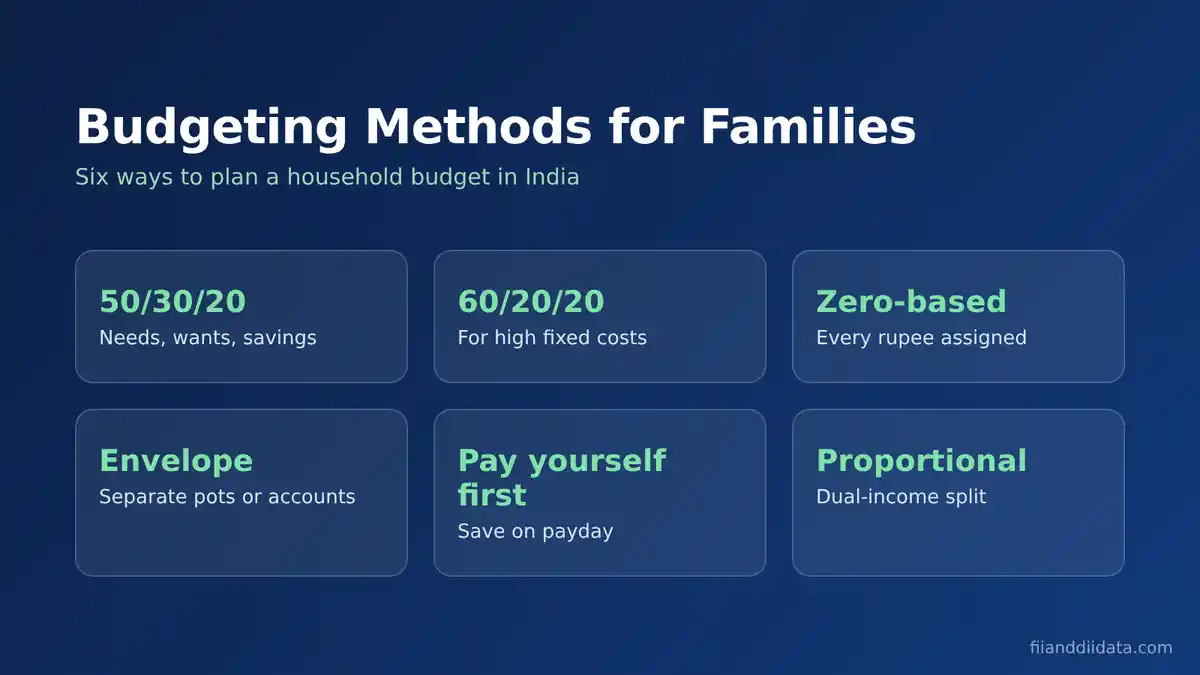
For more ways to save without feeling squeezed, see our steps to save money every month on an Indian salary. Once the habit runs, the next question is where that money should sit.
Where to Park Habit Money: Latest Safe Rates
Habit savings for the emergency fund and short-term goals should sit in safe, easy-to-reach places. The government kept small savings rates for October to December 2026 unchanged from the previous quarter. The rates below are from India Post.
| Scheme | Interest rate (per annum) | Fits which habit |
|---|---|---|
| Post Office Savings Account | 4.0% | Day-to-day buffer |
| Recurring Deposit (5 years) | 6.7%, compounded quarterly | Monthly saving habit |
| Monthly Income Account | 7.4% | Regular income for retirees |
| Public Provident Fund | 7.1%, compounded yearly | Long-term yearly habit |
| National Savings Certificate | 7.7% | Five-year fixed goal |
| Kisan Vikas Patra | 7.5% | Doubling money in 115 months |
| Sukanya Samriddhi Account | 8.2% | A daughter’s education |
| Senior Citizens Savings Scheme | 8.2% | Retirees needing income |
Bank deposits are another option. The Deposit Insurance and Credit Guarantee Corporation (DICGC) insures each depositor up to ₹5 lakh per bank, with principal and interest counted together. Rates are reviewed every quarter, so recheck them before you open a new deposit. Safe parking is only half of protection; the other half is guarding your credit and accounts.
Protective Habits: Credit Reports and Fraud
Two protective habits save more money than most investment tips. The first is checking your credit report every year. Under an RBI directive of 1 September 2016, every credit information company must give you one free full credit report, including your score, once in a calendar year. A wrong entry can raise the interest rate on your next loan, so catching errors early matters.
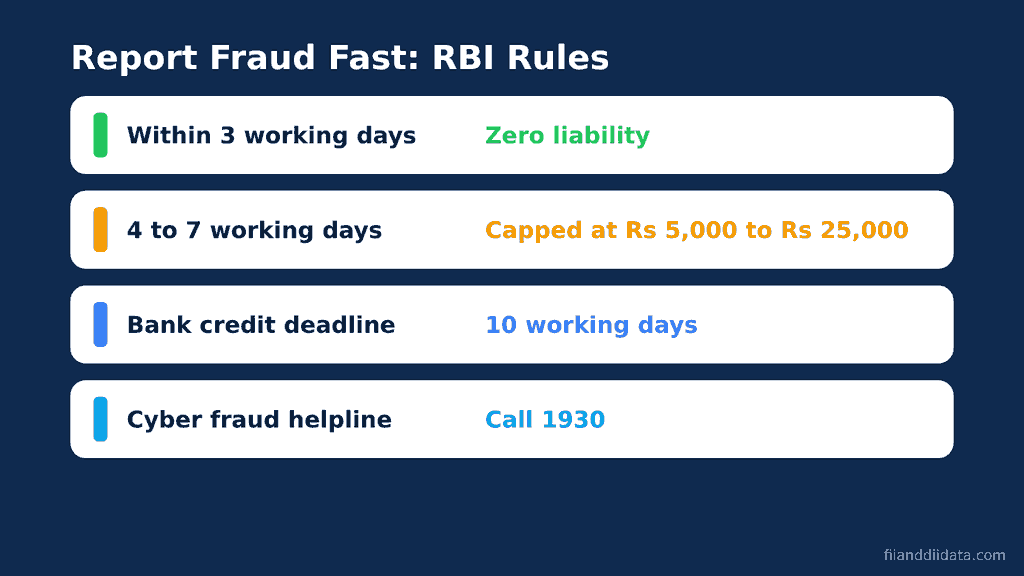
The second is reporting fraud fast. Under the RBI circular of 6 July 2017, your liability for an unauthorised electronic transaction caused by a third-party breach depends on how quickly you tell the bank.
| When you report | Your maximum liability |
|---|---|
| Within 3 working days | Zero |
| 4 to 7 working days, Basic Savings Bank Deposit account | ₹5,000 or the transaction value, whichever is lower |
| 4 to 7 working days, most savings accounts and cards with limit up to ₹5 lakh | ₹10,000 or the transaction value, whichever is lower |
| 4 to 7 working days, other current accounts and cards above ₹5 lakh | ₹25,000 or the transaction value, whichever is lower |
| Bank’s deadline to credit the disputed amount | 10 working days from your report |
If you shared an OTP or PIN yourself, the rules are different: you bear the loss until you report it. The government’s toll-free helpline 1930 and the cybercrime.gov.in portal also take online cyber complaints, as stated in a PIB release of 6 August 2024. Save 1930 in your phone today. Good habits also work best when bad ones go at the same time.
Bad Money Habits to Replace
| Bad habit | Why it hurts | Replace it with |
|---|---|---|
| Saving whatever is left at month-end | Usually nothing is left | Auto-transfer on salary day |
| Paying the card’s minimum due | Interest builds on the unpaid balance | Auto-pay of the full statement |
| Buy now, pay later for small wants | Many small EMIs crowd out savings | 24-hour rule and a wants budget |
| Ignoring statements | Fraud and wrong charges go unnoticed | Weekly 10-minute check |
| Spending the whole raise | Savings rate never improves | Step up SIPs with each increment |
| Investing on tips from social media | No goal, high risk of loss | Goal-based SIPs in diversified funds |
Our broader list of 12 money rules for Indian earners covers the order in which to fix these. Now let us turn everything into a plan for your first month.
A 30-Day Starter Plan to Build the Best Financial Habits
Trying all 14 habits at once usually fails, so add a few each week.
- Week 1: Start the daily spending log. Save 1930 in your phone. Turn on SMS and email alerts for every account and card.
- Week 2: Do your first weekly statement check. List every subscription and auto-debit, and cancel the ones you do not use.
- Week 3: Set a standing instruction for savings on salary day, even a small amount. Set card auto-pay to the full statement balance.
- Week 4: Download your free credit report. Check nominees on your main accounts. Write down one goal and its target amount.
Monthly habit checklist
- Did savings and SIPs leave on salary day?
- Was the card bill paid in full before the due date?
- Is the emergency fund still at or moving towards its target?
- Were there any unknown debits or new subscriptions?
When these feel routine, move on to a full plan with our guide to financial planning for beginners, and later a five-stage plan to build wealth from scratch. If you invest in shares, tracking FII and DII data helps you understand why markets swing, so a fall does not push you to stop your SIP.
Frequently Asked Questions
What are the best financial habits to develop in your 20s?
Track spending, save on salary day through an automatic transfer, build an emergency fund of three to six months of expenses, pay credit card bills in full, buy health and term cover early, and start a small SIP that you raise with every pay hike.
How long does it take to build a money habit?
There is no fixed number of days. Habits form faster when they are small, tied to a cue such as salary day, and automated. Start with one or two habits, keep them for a few months, then add more.
How much of my salary should I save each month?
A common guide is 20% of take-home pay under the 50/30/20 rule. If that is not possible yet, start smaller and raise the amount with each increment. Consistency matters more than the starting amount.
How often can I get a free credit report in India?
Under an RBI directive of 1 September 2016, each credit information company must give you one free full credit report, including your score, once in a calendar year. Checking once a year helps you catch errors early.
What should I do if money is debited from my account without permission?
Inform your bank at once and report the fraud on helpline 1930 or cybercrime.gov.in. Under RBI rules, reporting a third-party fraud within 3 working days keeps your liability at zero, and the bank must credit the amount within 10 working days.
The Bottom Line
The best financial habits to develop are not complicated. Track what you spend, save before you spend, pay card bills in full, keep a cash buffer, and review your credit, cover and investments once a year. Each habit is small on its own; together they decide where your money is in ten years.
Rates, rules and returns change, so recheck numbers from official sources each year. Your next step: tonight, set one standing instruction to move a fixed amount to savings the day after your next salary. For more guides on money and markets, visit our blog.
Sources: India Post, savings schemes interest rates (rates for October to December 2026); MoSPI, provisional CPI for September 2026 (12 October 2026, as reported by DD News); AMFI monthly note, September 2026; RBI, free annual credit report (1 September 2016); RBI, limiting customer liability (6 July 2017); DICGC, guide to deposit insurance; PIB, steps to deal with cyber frauds (6 August 2024).
Disclaimer: This article is for educational purposes only and is not investment advice. Please consult a SEBI-registered advisor before making investment decisions.