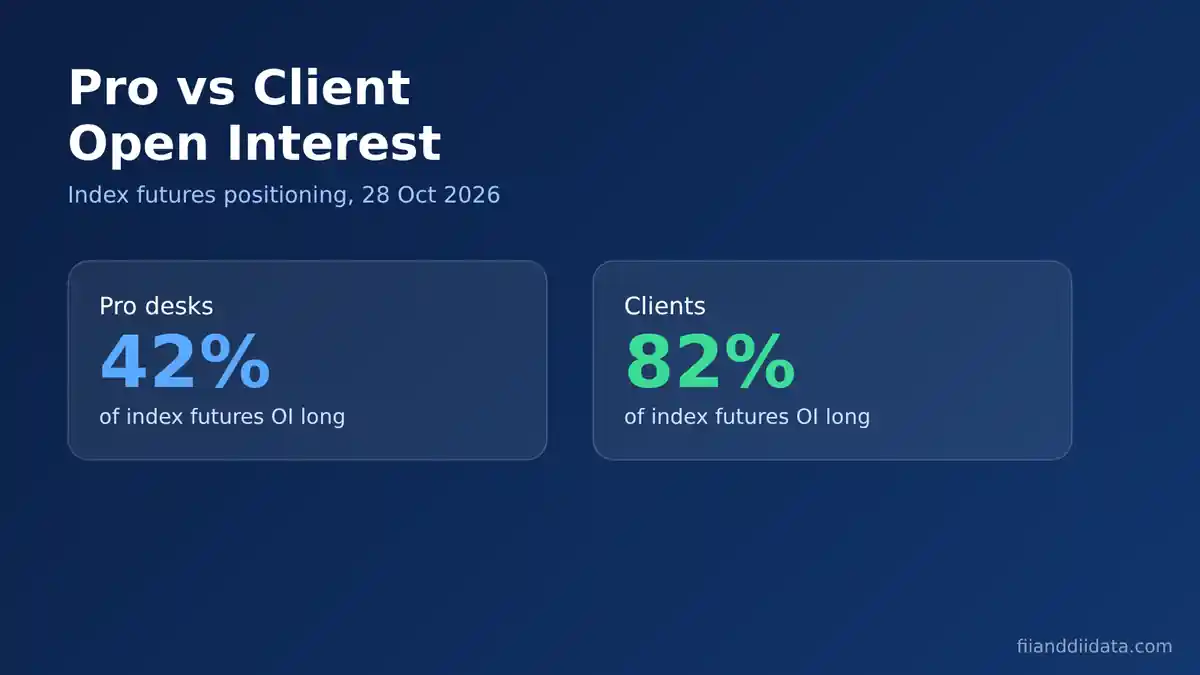
Pro vs client open interest compares how brokers trading their own money (Pro) and all other non-institutional accounts (Client) are positioned in NSE futures and options. On 28 October 2026, Clients held 81.9% of their index futures open interest on the long side, while Pros held just 42.4%. This guide explains what that gap means, how to read it yourself and where it often misleads traders.
Key Takeaways
- Pro is the proprietary book of brokers; Client is everyone who is not FII, DII or Pro.
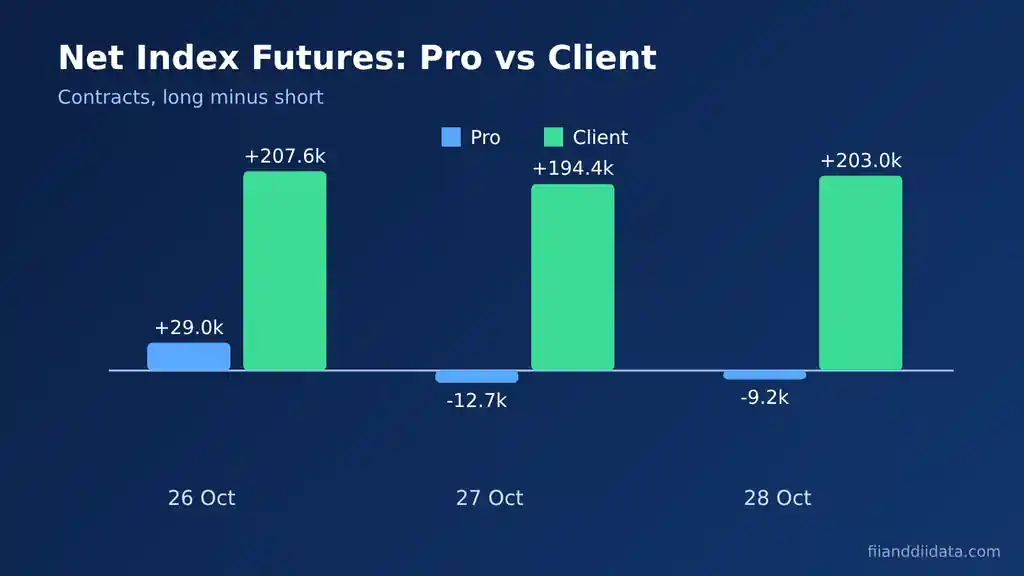
- On 28 October 2026, Clients were net long 2,03,020 index futures; Pros were net short 9,166.
- Pros run a small futures book but a large options book, so read both segments.
- SEBI’s FY26 study found 87.7% of individual F&O traders lost money, while proprietary traders made gross profits of ₹44,483 crore.
- The data is end-of-day, so use it to confirm a view over several sessions, not to time entries.
In this guide:
- What Is Pro vs Client Open Interest?
- Who Are Pro and Client Traders?
- 6 Key Differences
- Latest Data: 28 October 2026
- How to Read It: Worked Example
- How Traders Use It: 5-Step Checklist
- Common Mistakes
- What the SEBI Study Says
- FAQs
- The Bottom Line
What Is Pro vs Client Open Interest?
Open interest (OI) is the number of futures and options contracts that are still open at the end of a trading day. Every evening, NSE splits this total into four groups in its participant wise open interest file: FII, DII, Pro and Client. Each group gets a long column and a short column for index futures, stock futures, index calls, index puts, stock calls and stock puts.
Comparing the Pro row with the Client row is what traders call Pro vs Client open interest. It answers a simple question: are the trading desks of brokers positioned the same way as the wider public, or on the other side? If you are new to the file itself, start with our guide on what participant wise OI means, then come back here.
One rule makes the comparison easier. In futures, every long has a matching short, so the net positions of all four groups always add up to zero. If Clients are heavily net long, someone else, usually FIIs, must be net short. Pro sits between the two and often moves the fastest. So who exactly sits in each bucket?
Who Are Pro and Client Traders in NSE Data?
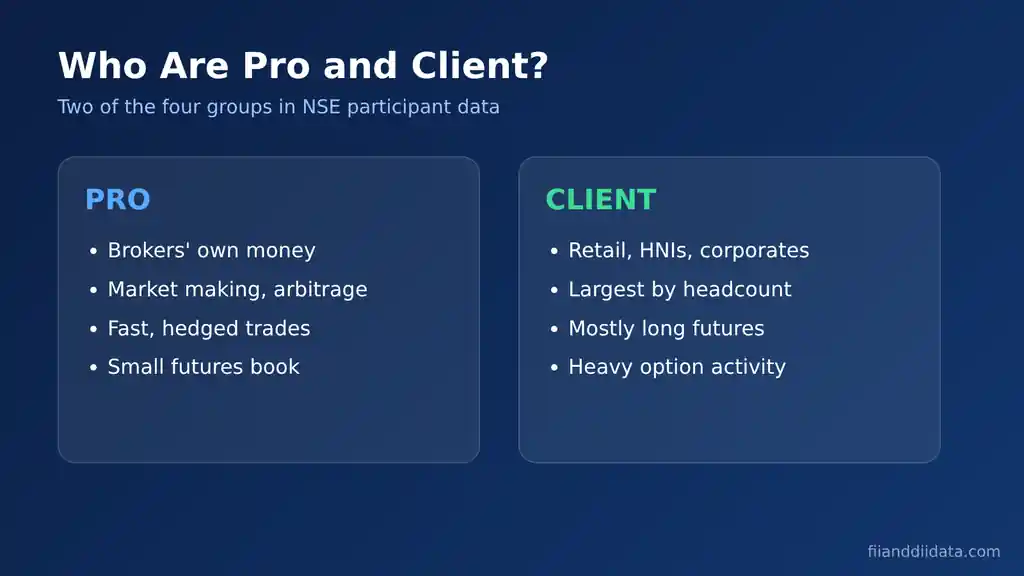
Pro stands for proprietary. It covers trading members (brokers) who trade with the firm’s own capital rather than a customer’s money. These desks run market making, arbitrage between cash and futures, option writing and high-speed strategies. Their positions are usually hedged and held for short periods.
Client is the catch-all bucket for every account that is not FII, DII or Pro. That includes retail traders, but also high net worth individuals (HNIs), corporates, partnership firms and trusts. It is the largest group by number of accounts, so it is best described as non-institutional money rather than “small traders only”.
The two groups behave differently because their goals differ. A Pro desk is paid to manage risk across thousands of trades a day. A Client account is usually expressing a view on where the market will go. Those differences show up clearly in the numbers, as the next section shows.
Pro vs Client Open Interest: 6 Key Differences
| Point | Pro | Client |
|---|---|---|
| Whose money | Broker’s own capital | Retail, HNI, corporate and other accounts |
| Index futures book (28 Oct 2026) | 59,940 contracts | 3,18,290 contracts |
| Index options book (28 Oct 2026) | 33.14 lakh contracts | 100.40 lakh contracts |
| Typical futures stance | Small and often close to flat | Large and mostly long |
| Typical options activity | Writing, spreads and arbitrage | Both buying and selling; large put writing in October 2026 |
| Speed of change | Can flip from long to short in a day | Moves slowly, in steady steps |
The size gap matters most. Pros held about 59,940 index futures contracts in total on 28 October 2026, less than a fifth of the Client book. In index options, the Pro book was about a third of the Client book. So a Pro “view” is better read from options than from futures alone.
Why Pro vs Client Open Interest Often Points in Opposite Directions
Pros often supply the other side of Client trades. When Clients rush to buy futures or sell puts, a Pro desk may take the opposite leg and hedge it elsewhere. That is why the two rows often move in opposite directions on the same day. The gap tells you about crowding, not about who is “right” on one session. Here is what the gap looked like this week.
Latest Pro vs Client Open Interest Data: 28 October 2026
| Index futures | Pro | Client | FII | DII |
|---|---|---|---|---|
| Long contracts | 25,387 | 2,60,655 | 35,808 | 47,598 |
| Short contracts | 34,553 | 57,635 | 2,70,850 | 6,410 |
| Net (long minus short) | -9,166 | +2,03,020 | -2,35,042 | +41,188 |
| Change vs 27 Oct | +3,583 | +8,594 | -13,985 | +1,808 |
| Long ratio | 42.4% | 81.9% | 11.7% | 88.1% |
All four net figures add up to zero, which confirms the table is internally consistent. Clients held 70.6% of all long index futures. FIIs held 73.3% of all shorts. Pros were a small net short. On the same day, the Nifty 50 closed at 22,698.85, down 0.22%, while FIIs bought a net ₹871.80 crore in the cash market, as covered in our FII DII report for 28 October 2026.
Index Options: Where the Pro Book Really Sits
| Index options, 28 Oct 2026 | Pro net | Pro daily change | Client net | Client daily change |
|---|---|---|---|---|
| Calls (long minus short) | +1,93,075 | +87,470 | +1,19,010 | -65,723 |
| Puts (long minus short) | -31,159 | +9,930 | -5,66,082 | +62,817 |
Pros added 87,470 net long calls in one session, a clearly constructive move. Clients did the opposite on calls, but stayed heavy put writers, short a net 5.66 lakh put contracts. Put writing earns premium if the market does not fall much, so the Client book is betting on a floor. FIIs, by contrast, were net long 4.95 lakh puts, which is protection. Numbers like these only help if you read them in the right order.
How to Read Pro vs Client Open Interest: A Worked Example
We will use the real index futures data from 26, 27 and 28 October 2026.
- Net position. Pro: 25,387 long minus 34,553 short = -9,166. Client: 2,60,655 minus 57,635 = +2,03,020.
- Long ratio. Pro: 25,387 ÷ 59,940 × 100 = 42.4%. Client: 2,60,655 ÷ 3,18,290 × 100 = 81.9%. A ratio near 50% means balanced; near 80% means one-sided.
- The gap. Client net minus Pro net = 2,03,020 – (-9,166) = 2,12,186 contracts. A wide and growing gap shows Clients and Pros leaning opposite ways.
- What drove the change. Pro shorts fell by 3,493 while Pro longs rose by 90, so the +3,583 net change came from Pros covering shorts. Client longs rose by 8,866 while shorts were almost flat, so Clients added fresh longs.
- The trend. Pro net went from +29,011 (26 Oct) to -12,749 (27 Oct) to -9,166 (28 Oct). Client net went from +2,07,582 to +1,94,426 to +2,03,020. The Pro flip happened on 27 October, which was monthly expiry day.
What This Pro vs Client Open Interest Reading Says
Put together, the futures data says Clients remain crowded on the long side, while Pros are small and slightly short. The options data softens that picture, because Pros added call longs on 28 October. A fair reading is “Pros are hedged and mildly constructive; Clients are long and selling puts”. It is not a signal that the market must fall, and the expiry on 27 October makes the Pro flip less meaningful than it looks. Our FII options activity tracker helps you check whether institutions agree. Next, a routine you can repeat every evening.
How Traders Use Pro vs Client Data: A 5-Step Checklist
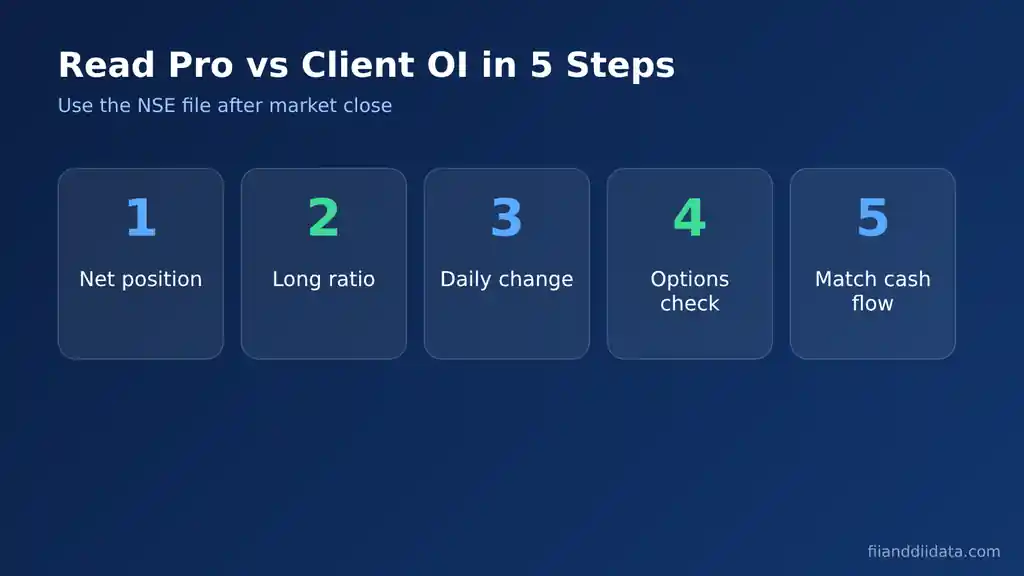
- Log the net positions of Pro and Client in index futures after the evening release. Our daily Pro and Client open interest data page saves you the calculation.
- Track the long ratio for both groups over 10 sessions. Flag Client readings above 80% or below 40% as crowded.
- Split the daily change into longs and shorts. Fresh longs, long unwinding, fresh shorts and short covering each mean something different.
- Check index options for both groups. Pro call buying with Client put writing reads differently from Pro put buying with Client call buying.
- Match with FII flows in cash and futures, using the FII long short ratio and the FII DII data today page. Only then form a view, with your own stop-loss.
A pattern many analysts watch: when Pros cover shorts for several sessions while FIIs also buy in cash, dips tend to get bought. When Clients add longs while both Pros and FIIs add shorts, rallies often struggle. Treat these as tendencies, not rules. Even with a checklist, a few errors keep coming up.
Common Mistakes With Pro vs Client Open Interest
- Reading Pro futures alone. The Pro futures book is small. Its options book carries most of the information.
- Calling Client “dumb money”. The bucket includes HNIs and corporates. Crowding is a caution sign, not an automatic contrarian trade.
- Treating Pro as a crystal ball. Pro desks are often hedged across cash, futures and options. One day’s net figure may be one leg of a larger trade.
- Ignoring expiry. Positions roll or settle on expiry day. The Pro swing on 27 October 2026 is a good example.
- Expecting intraday signals. NSE publishes the file once, after market close. It describes yesterday’s positions, not the next candle.
- Comparing contract counts across years. Lot sizes change, so the same number of contracts can mean a different rupee exposure.
These mistakes matter because the outcomes of the two groups are very different, as SEBI’s own research shows.
What the SEBI F&O Study Says About Pros and Clients
SEBI’s study of equity derivatives trading in FY26, reported by Business Today on 21 August 2026, found that 87.7% of individual traders made net losses. Their combined net loss was ₹91,685 crore, down from ₹1,11,788 crore in FY25, and options trading caused 92% of it. The number of active individual traders fell 18% to 87.5 lakh.
| Group (SEBI FY26 study) | Outcome |
|---|---|
| Individual traders | 87.7% lost money; net loss ₹91,685 crore |
| Proprietary traders | Gross profit ₹44,483 crore (₹45,955 crore in FY25) |
| FPIs | Gross profit ₹13,896 crore, down 55% year on year |
The same study shows proprietary traders as a group earned gross profits of ₹44,483 crore. Two cautions apply. SEBI’s “individuals” are only part of NSE’s Client bucket, and gross profit is before costs. Still, the direction is clear: the Pro side has the edge in tools, speed and risk control. That is a reason to study Pro positioning, not a reason to copy it trade by trade.
Frequently Asked Questions
What is pro vs client open interest?
It is a comparison of the open futures and options positions held by Pro traders (brokers using their own money) and Clients (all other non-institutional accounts) in NSE’s daily participant wise open interest file. It shows whether the two groups lean the same way or opposite ways.
Who is Pro in NSE participant data?
Pro means trading members, or brokers, who trade with the firm’s own capital. Their desks run market making, arbitrage and option strategies, and their positions are usually hedged and short term.
Does Client mean only retail traders?
No. Client covers every account that is not FII, DII or Pro, including retail traders, HNIs, corporates, partnership firms and trusts.
Should I follow Pro positions instead of Client positions?
Pro positions are worth studying because proprietary traders made gross profits of ₹44,483 crore in FY26 per SEBI’s study. But Pro desks are often hedged across segments, so one day’s Pro figure may be one leg of a larger trade. Use it to confirm a view over several sessions.
When is Pro and Client open interest data released?
NSE publishes the participant wise open interest file once per trading day after market close. It is end-of-day data and does not show intraday changes.
The Bottom Line
Pro vs Client open interest shows whether broker desks and the wider public are on the same side. On 28 October 2026, they were not: Clients were 81.9% long in index futures and heavy put writers, while Pros were slightly short in futures but adding call longs in options.
Use the gap as a crowding gauge, read options alongside futures and give expiry days less weight. A simple next step is to start a 10-session log of Pro and Client net positions and long ratios, and check it against the cash flows on our FII and DII data home page. More guides are in our FII DII blog.
Sources: NSE derivatives reports, F&O participant wise open interest; Quantsapp participant wise OI, 28 October 2026; JustTicks participant data, 27 October 2026; Trendlyne participant wise OI, 27 October 2026; Business Today on the SEBI FY26 F&O study, 21 August 2026 (individual traders and proprietary traders reports); NSE provisional FII DII cash data, 28 October 2026.
Disclaimer: This article is for educational purposes only and is not investment advice. Please consult a SEBI-registered advisor before making investment decisions.