Block deal meaning in one line: a block deal is a single large trade of at least Rs 25 crore, agreed privately between a seller and a buyer and executed on the exchange in a special window, so it does not disturb the normal order book. Foreign portfolio investors (FPIs, often called FIIs) and domestic institutions (DIIs) are the most common names on either side.
- Minimum size is Rs 25 crore under the revised SEBI framework, effective 7 December 2025.
- Trades must happen inside two windows, at a price within 3% of the reference price.
- The names are published after market hours, so the signal arrives as a next-day clue, not a live feed.
Every few weeks a headline says that a foreign fund “offloaded a stake” or a domestic mutual fund “picked up a block” in a well-known company. Those headlines almost always describe a block deal. If you follow institutional money in Indian markets, knowing the block deal meaning helps you separate a routine portfolio shift from a genuine change in conviction. This guide explains what a block deal is, how the rules work after SEBI’s recent revision, how it differs from a bulk deal, and how to read one when it shows up in your daily FII and DII tracking.
Block Deal Meaning in Simple Words
A block deal is one big transaction in a single stock, done in one go at an agreed price. Instead of splitting a huge order into thousands of small trades through the day, which would push the price around, the seller and buyer fix terms in advance and the exchange matches the trade in a dedicated window. The quantity is large enough that it would be hard to place through the regular market without moving the share price.
Under the framework SEBI issued on 8 October 2025, which came into effect on 7 December 2025, the minimum size for a block deal is Rs 25 crore. Earlier the floor was Rs 10 crore. The change was meant to keep the block window for genuinely large institutional trades and push smaller orders back into the normal market.
Who uses it? Mostly institutions. A foreign fund trimming a position, a promoter group selling a slice of its holding to a long-only investor, or a domestic mutual fund building a stake in one clean trade are typical examples. Retail investors can technically trade in the window too, but the size makes it an institutional tool in practice. That is why block deals sit naturally beside the rest of the smart money data you may already follow.
How a Block Deal Works: Windows, Price Band and Settlement
The mechanics are rigid on purpose. Knowing them lets you judge whether a reported trade is a normal block deal or something else.
- Two windows: the morning window runs from 8:45 AM to 9:00 AM and uses the previous day’s closing price as the reference. The afternoon window runs from 2:05 PM to 2:20 PM and uses the volume weighted average price (VWAP) of the 1:45 PM to 2:00 PM period.
- Price band: the deal price must be within plus or minus 3% of the reference price. The earlier band was 1%, so the new rule gives buyers and sellers more room to agree on a price.
- Delivery: every block deal must be settled by actual delivery of shares. There is no square-off and no intraday reversal.
- Settlement: it follows the normal T+1 cycle, with the optional T+0 cycle available where the exchange offers it.
- Disclosure: the exchanges publish the stock, the client names, the quantity and the price after market hours.
The 100% delivery rule matters for interpretation. Because nothing can be squared off the same day, a block deal reflects a real change of ownership, not a day trader’s round trip. That makes it a cleaner signal than many other large prints on the tape.
Block Deal vs Bulk Deal: What Is the Difference?
People mix these two up constantly. A bulk deal is a trade where the total quantity bought or sold by a single client is 0.5% or more of a company’s listed equity. It happens during normal market hours, through the regular order book, and is reported after the close. A block deal, in contrast, is defined by value, happens in a separate window, and carries a price band.
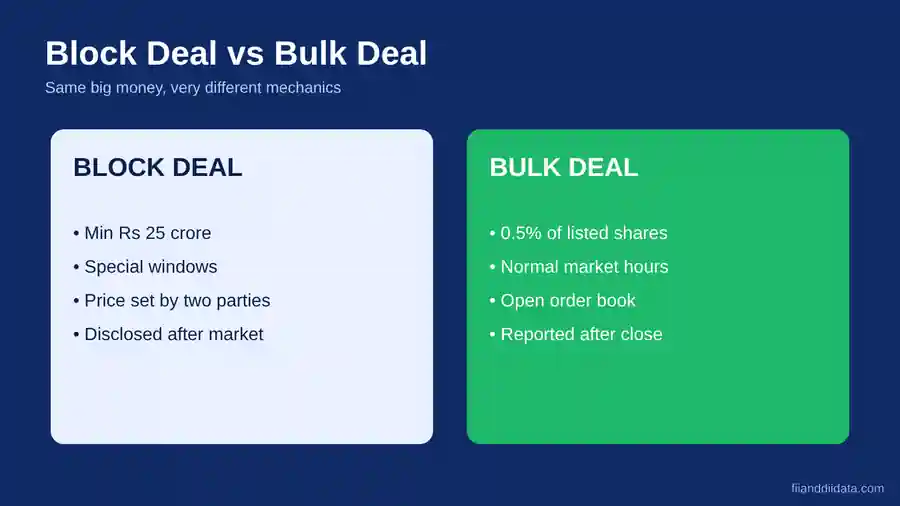
| Feature | Block deal | Bulk deal |
|---|---|---|
| Defined by | Value of at least Rs 25 crore | Quantity of 0.5% or more of listed equity |
| When it trades | Special windows, 8:45 to 9:00 AM and 2:05 to 2:20 PM | Normal market hours |
| Price rule | Within 3% of the reference price | Normal market price discovery |
| Delivery | 100% delivery, no square-off | Can include intraday positions |
| Disclosure | After market hours | After market close |
A quick way to remember it: a block deal is about how big the rupee value is and how it is done, while a bulk deal is about how large a slice of the company changed hands. A single trade can, in rare cases, qualify as both.
Why FII and DII Block Deals Matter
The daily FII and DII figures published by the exchanges show net buying and selling across the whole market. They tell you the direction of institutional money but not where it went. Block deals fill part of that gap because they name the stock, the buyer and the seller.
Here is how the two views connect. Suppose FPIs are net sellers for the day. Block deal data may show that most of that selling came from one large block in a single banking stock, sold to domestic mutual funds. The headline number looks bearish, yet the actual story is a single stock handover with a domestic institution absorbing the supply. Without the block detail you could misread a one-off transfer as broad selling pressure.
Block deals also show who is on the other side. When a promoter sells and an institution buys, the market usually reads it as confidence from the buyer. When an institution sells to another institution, it may only mean a rebalance. When an FII sells and a DII buys, you see the foreign and domestic institutional hand-off that has defined much of Indian market flow in recent years.
How to Read a Block Deal Step by Step
Seeing a large number on a screen is easy. Understanding it takes five quick checks.
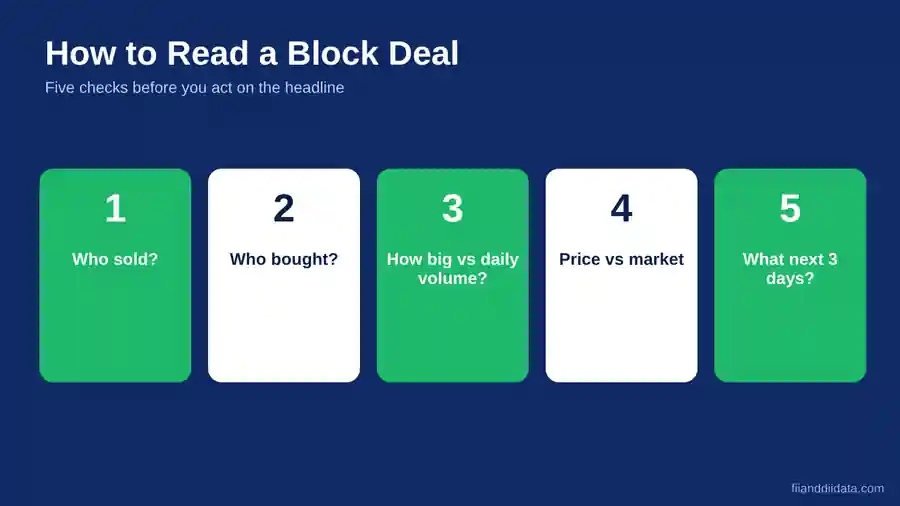
- Check the seller. A promoter, a private equity fund, a foreign fund and a mutual fund all sell for different reasons. Promoter and private equity exits are often planned over time. A long-term FII reducing exposure deserves more attention than a fund closing out a short-lived position.
- Check the buyer. A mix of mutual funds, insurers and sovereign funds is usually a stronger signal than a single unfamiliar name.
- Compare size with daily volume. A block worth a few days of average volume is meaningful. One that equals a small fraction of normal volume is background noise.
- Look at the price. A deal at a discount to the reference price suggests the seller wanted speed. A deal at a premium suggests strong demand from the buyer.
- Watch the next three sessions. If the stock absorbs the supply and holds, the market has accepted the new owner. If it keeps drifting lower, more sellers may be waiting.
Common Mistakes When Reading Block Deals
The first mistake is treating every block deal as a prediction. A block deal is a record of something that already happened, not a forecast. The buyer’s reason may be a rebalance, an index change or a mandate inflow, none of which implies the stock will rise.
The second is confusing the seller’s name with the seller’s intent. A fund name on the sell side can include several schemes, and one scheme selling does not mean the whole fund house turned negative. The third mistake is mixing up timing. Block deal names reach the public after market hours, and the provisional NSE FII and DII numbers appear at about 6 PM IST, while final FPI data from NSDL follows on the next working day. Nothing here is live, so any trade you plan is based on yesterday’s information.
The fourth mistake is ignoring the price band. Since the band widened from 1% to 3%, a trade priced noticeably below the reference does not automatically mean distress. It may simply be a negotiated price inside the new, wider range.
A Worked Example: Reading a Hypothetical Block Deal
Numbers make the checklist easier to follow, so here is a made-up case. Imagine a mid-cap bank whose shares closed at Rs 500 the previous evening. In the 8:45 AM window, a private equity investor sells 6 lakh shares to a group of buyers at Rs 490. That is a 2% discount to the reference price, inside the 3% band, and the total value is Rs 29.4 crore, above the Rs 25 crore floor. The trade qualifies.
Now apply the five checks. The seller is a private equity fund, so the exit is probably planned and not a reaction to bad news. The buyers are three domestic mutual funds and one foreign fund, a broad mix that suggests genuine demand. If the stock normally trades 20 lakh shares a day, the block equals about 30% of one day’s volume, which is meaningful but not dramatic. The 2% discount shows the seller accepted a small price concession to exit quickly. Over the next three sessions, if the stock holds near Rs 490 to Rs 500, the market has absorbed the supply well.
Compare that with a different version of the same event. If the seller were a foreign fund with a long holding history, and the only buyer were a single unknown entity, and the stock kept sliding for three sessions, the reading changes. The raw numbers are similar, yet the context points to weaker demand. This is why the same Rs 29 crore headline can mean very different things, and why block deal data is best read together with your daily FII and DII flow numbers.
One more point helps beginners. Block deals do not appear in the FII and DII net figures as separate items. They are part of the regular cash market turnover that the totals already include. So when you see a large FPI sell number and a matching block deal in one stock, you are looking at the same money from two angles: the headline total and the stock-level detail.
Where to Find Block Deal Data
The primary sources are the exchanges themselves. Both NSE and BSE publish block and bulk deal reports daily after market hours, listing the stock, client, buy or sell side, quantity and price. For the regulatory framework, SEBI’s circulars are available on the SEBI website. For the broader picture of net institutional buying and selling, our daily FII and DII data pages bring the numbers together so you can see where block activity fits within total flows.
Block Deal Meaning: Frequently Asked Questions
What is the block deal meaning in the stock market?
A block deal is a single large trade of at least Rs 25 crore in one stock, agreed between a buyer and a seller and executed in a special exchange window at a price within 3% of the reference price.
What is the minimum value of a block deal in India?
Under the revised SEBI framework effective 7 December 2025, the minimum value is Rs 25 crore. It was Rs 10 crore earlier.
What are the block deal timings?
There are two windows: 8:45 AM to 9:00 AM, using the previous close as reference, and 2:05 PM to 2:20 PM, using the VWAP of 1:45 PM to 2:00 PM.
Is a block deal different from a bulk deal?
Yes. A block deal is defined by value and trades in a separate window with a price band. A bulk deal is 0.5% or more of a company’s listed equity traded during normal hours.
Does an FII block deal mean the stock will fall?
No. A block deal records a past transfer of shares. The reason may be a rebalance or a mandate change, so check the buyer, the size against volume and the price before drawing a view.
Final Takeaway
The block deal meaning is simple once the rules are clear: a large, privately agreed, fully delivered trade of Rs 25 crore or more, done in a protected window and reported after the close. Its value for anyone tracking institutional flows is that it puts names and prices behind the net FII and DII figures. Read the seller, the buyer, the size against volume and the price, then watch how the stock behaves over the next few sessions. Use it as context, not as a trigger.
This article is for education only and is not investment advice. Please check figures on the official exchange and SEBI websites and consult a registered adviser before you trade.