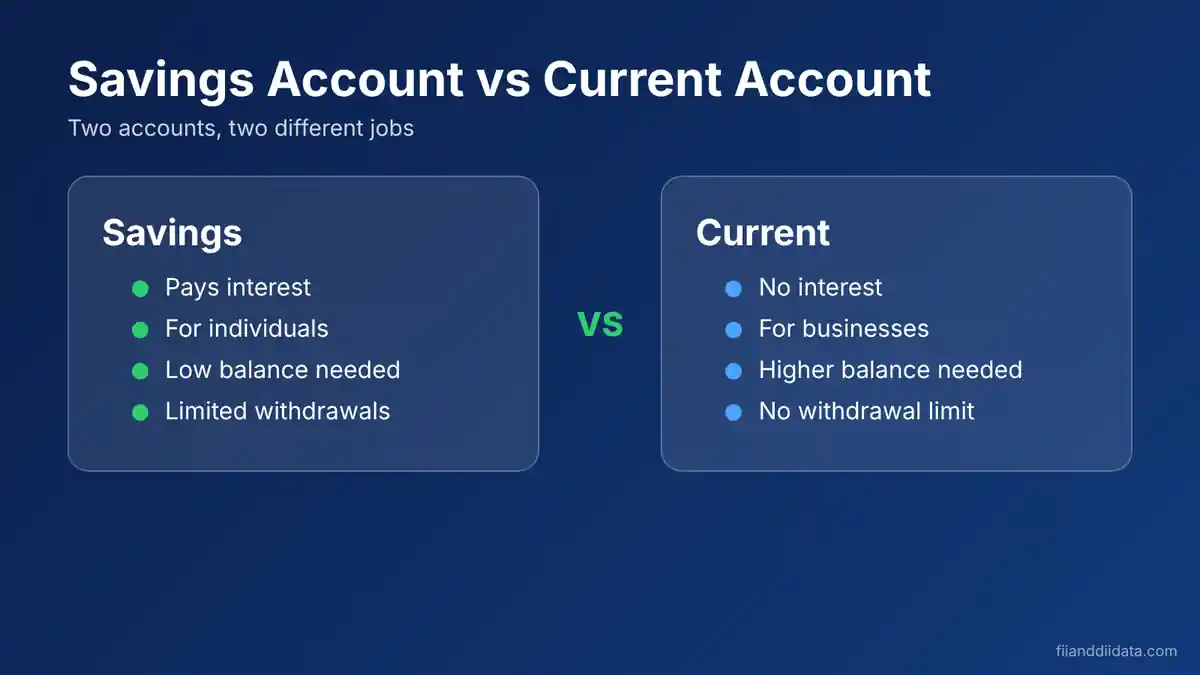
Savings account vs current account is a choice that looks small until you pay for the wrong one. A savings account is built for individuals who want to keep money safe and earn a little interest. A current account is built for people who run a business or a profession and move money in and out all day. The RBI’s own deposit directions draw the line clearly: a savings deposit pays interest and limits withdrawals, while a current account is a non-interest-bearing account meant for frequent transactions.
Key takeaways
- A savings account pays interest. A current account does not pay any interest under RBI rules.
- Savings accounts suit salaried people, students, homemakers and retirees. Current accounts suit traders, firms, professionals and companies.
- RBI directions do not allow savings accounts for business or trading concerns, so a shop owner cannot legally run the shop through one.
- Both account types are covered by deposit insurance up to ₹5,00,000 per depositor per bank.
- Current accounts usually ask for a much higher average balance. On SBI’s page it starts at ₹5,000 and goes up to ₹50 lakh across tiers.
What is a savings account?
A savings account is a deposit account for individuals. You keep money in it, withdraw when you need to, and the bank pays you interest on the balance. According to the RBI’s Commercial Banks Interest Rate on Deposits Directions, 2025, interest on a savings deposit is calculated on the daily product basis, a uniform rate applies on balances up to ₹1 lakh, and the interest is credited at quarterly or shorter intervals.
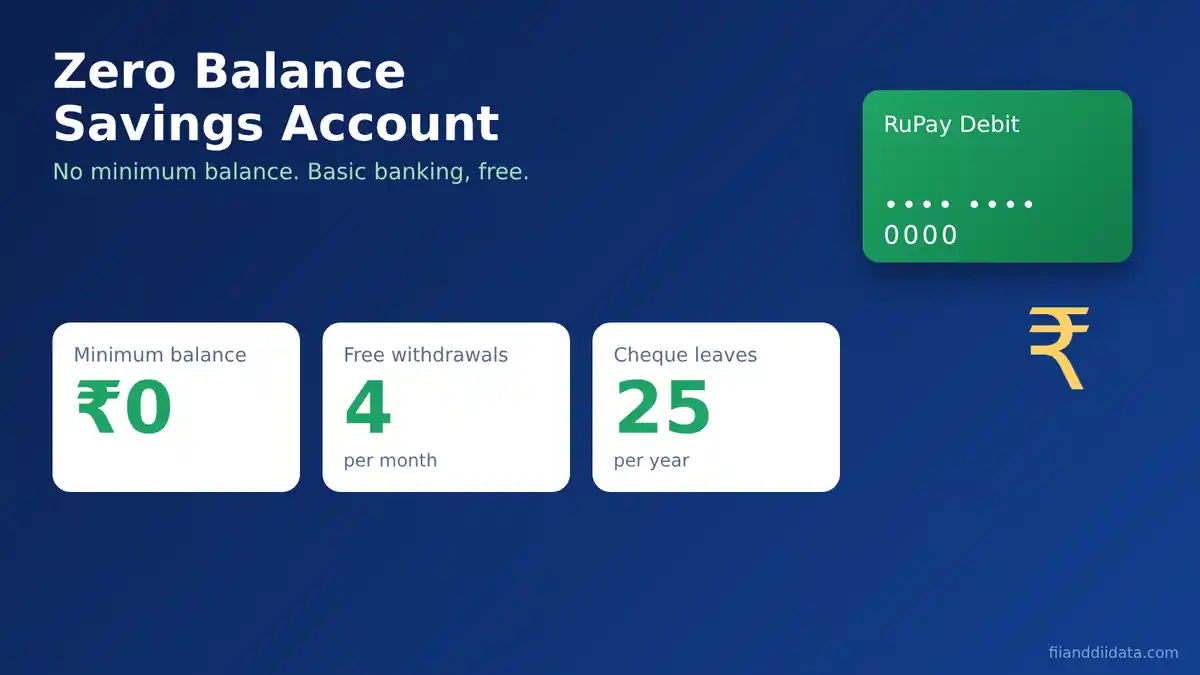
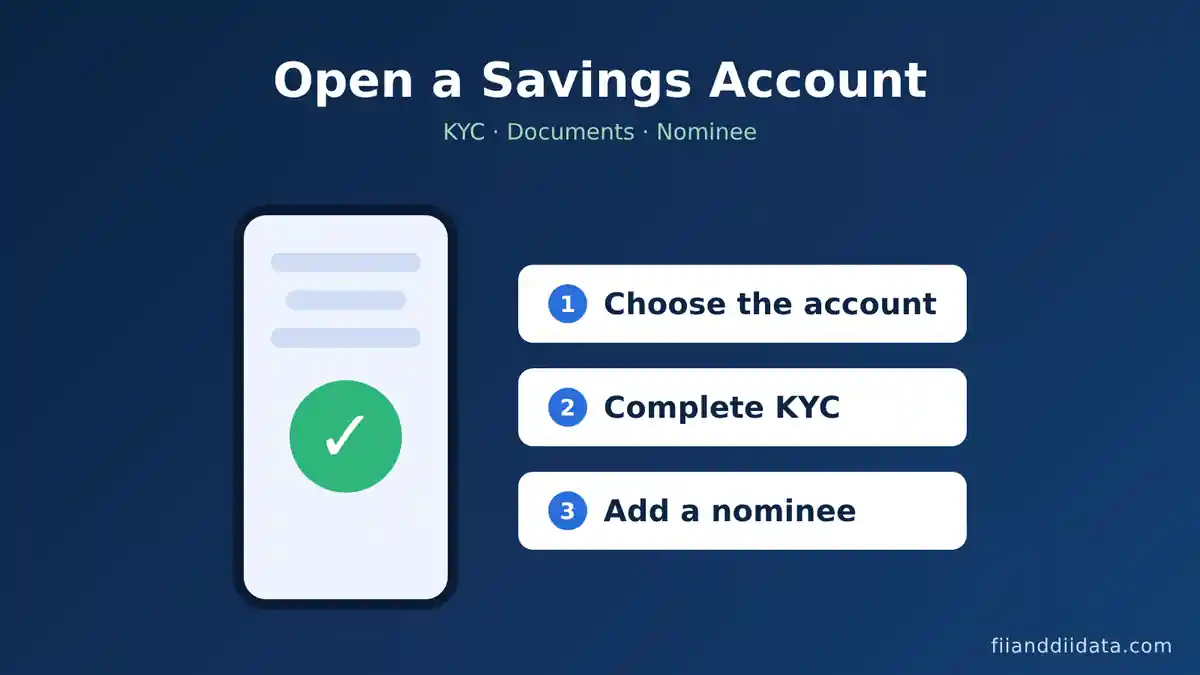
The same directions allow banks to set withdrawal limits on savings deposits, which is why a savings account is not meant for running a business. If you are yet to open one, our guide on how to open a savings account covers documents and steps, and the note on zero balance savings account benefits explains the basic no-frills option.
What is a current account?
A current account is a transaction account for businesses, firms, companies, trusts and professionals. The RBI describes it as non-interest bearing. There is no cap on the number of deposits or withdrawals in the way a savings account has, and many banks add cheque books, cash handling, overdraft facilities and bulk payment tools.
The trade-off is that the bank earns nothing from lending your idle money back to you as interest, so it charges for services instead. That is why current accounts usually carry a higher minimum balance and more fees than savings accounts.
Savings account vs current account: side-by-side comparison
| Feature | Savings account | Current account |
|---|---|---|
| Purpose | Personal savings and everyday spending | Business or professional transactions |
| Who can open | Individuals, including minors with a guardian, as per bank policy | Businesses, firms, companies, trusts, professionals |
| Interest | Yes, on daily balance | No interest |
| Withdrawal limits | Banks may set limits | No such restriction on number of transactions |
| Minimum balance | Low, and zero for basic accounts | Higher, set by tier |
| Overdraft or cash credit | Not designed for it | Usually available |
| Deposit insurance | Up to ₹5 lakh per depositor per bank | Up to ₹5 lakh per depositor per bank |
Interest: the clearest difference
Take ₹3,00,000 kept for a full year at 2.5% per annum. In a savings account that earns ₹7,500. In a current account it earns ₹0. SBI’s current account comparison page, last updated on 28 August 2026, lists its savings bank rate at 2.50% a year effective 15 June 2025. Other banks pay more, and rates change, so check your own bank’s latest schedule before you decide.
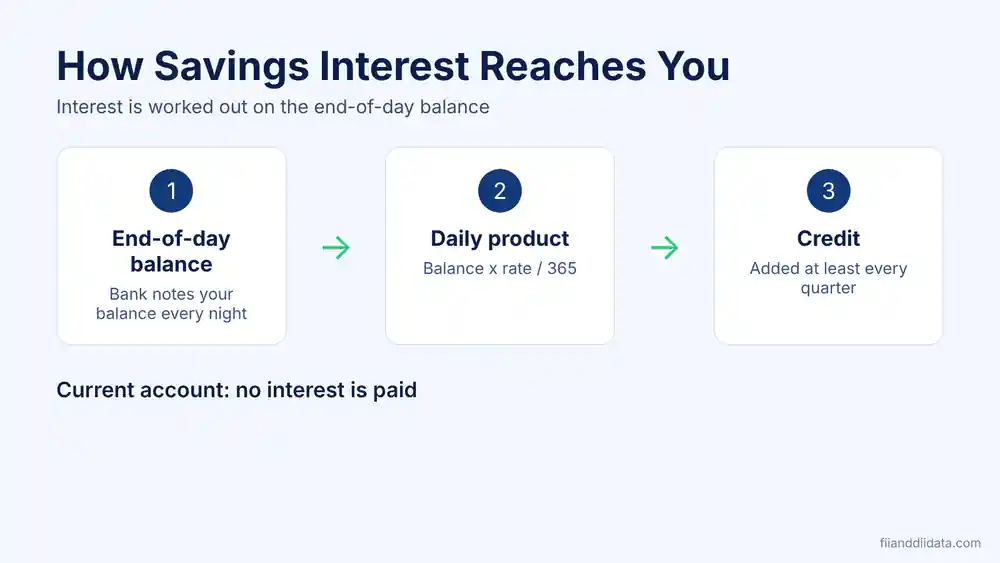
The daily product method means every day’s closing balance counts. Suppose your balance is ₹40,000 for 30 days, ₹25,000 for the next 30 days and ₹60,000 for the last 30 days. At 2.5% the interest for those 90 days is ₹256.85, which is what a ₹41,666.67 average balance would earn. A single large withdrawal in the middle of a quarter therefore cuts your interest even if you top up later.
Interest also matters for how much idle cash you hold. ₹1 lakh left at 2.5% gives ₹2,500 in a year. The same ₹1 lakh in a 7% instrument would give ₹7,000. This is why many people keep only a working balance in the savings account and move the rest to better-paying options. Our post on the best savings account in India compares what banks pay, and the guide on how to build an emergency fund shows where reserve money can sit.
Who is allowed to open which account
Paragraph 43(8) of the RBI deposit directions states that savings accounts cannot be opened for business or trading concerns. If you sell goods, run a clinic or take client payments regularly, the bank is expected to ask for a current account. Salaried individuals, students, pensioners and homemakers use savings accounts.
There is a newer wrinkle for larger borrowers. Under the RBI’s December 2025 circular on current accounts and cash credit or overdraft facilities, effective 1 April 2026, borrowers with exposure under ₹10 crore face no restriction. Where total exposure is ₹10 crore or more, a bank can keep a current account only if it holds at least 10% of the exposure, and other lenders are limited to collection accounts. This reads as a rule for corporate borrowers, not for small shops, and the summary here comes from a law firm’s write-up of the circular, so a business with large bank debt should read the circular itself.
Minimum balance and charges
Savings accounts range from zero balance to a few thousand rupees. Current accounts are tiered. On SBI’s page the monthly average balance requirement runs: Regular ₹5,000, Silver ₹50,000, Gold ₹1 lakh, Diamond ₹5 lakh, Platinum ₹10 lakh, Palladium ₹25 lakh and Rhodium ₹50 lakh. A higher tier buys more free services. For example, the Regular tier offers free cash deposits of 100 times the previous month’s average balance, capped at ₹5 lakh, and 50 free cheque leaves, while Gold offers 15 times capped at ₹100 lakh and 300 leaves. SBI says facilities are subject to change.
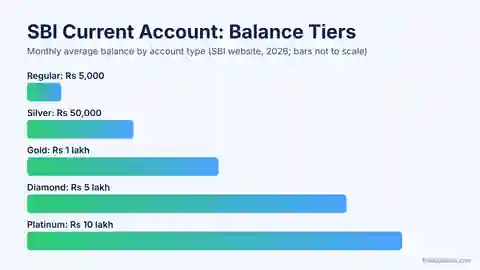
Missing the balance usually brings a penalty, so pick the lowest tier that matches your real monthly float. A small trader who keeps ₹20,000 on average should not sign up for a ₹50,000 tier just for the extra free cheques.
Safety and deposit insurance
The Deposit Insurance and Credit Guarantee Corporation (DICGC) insures savings, current, fixed and recurring deposits up to ₹5,00,000 per depositor per bank, covering principal and interest together. It is the combined total across your accounts in the same bank and ownership capacity, not per account. A business holding ₹40 lakh in a current account has only ₹5 lakh protected if the bank fails, which is a reason larger firms spread balances across banks.
Tax and reporting points
Savings interest is taxable under income from other sources. Under the old regime, Section 80TTA allowed a deduction of up to ₹10,000 for non-senior individuals and Section 80TTB up to ₹50,000 for senior citizens. The Income-tax Act, 2025, effective 1 April 2026, carries these provisions into Section 153, but whether the deduction is available under the new regime depends on how you file, so confirm on the income tax portal or with your tax adviser. Current accounts earn no interest, so there is nothing to deduct, but business receipts are taxed as business income.
Banks also report large cash deposits. Under Rule 114E, cash deposits of ₹10 lakh or more in a year across savings accounts, and ₹50 lakh or more across current accounts, are reported in Form 61A, filed by 31 May of the following year. Reporting is not a penalty, but unexplained cash can attract questions.
Which account do you need?

Start with how the money is used. If it is salary, household spending or personal savings, a savings account is the right and legal fit. If customers pay you, if you need an overdraft, or if you write many cheques, a current account is the right fit. Freelancers and consultants sit in between: many bank with a savings account at first and move to a current account once professional receipts grow or a client or GST registration asks for one.
Some people need both. Keep personal money in a savings account and business money in a current account, so books stay clean and tax filing is simpler. The piece on how to organize personal finances and the personal finance tips page show how to separate the two, and if your income is uneven, read how to budget an irregular income.
Common mistakes to avoid
The first is running a business through a personal savings account, which banks can flag and ask you to convert. The second is choosing a high balance tier you cannot maintain, and paying penalty charges every month. The third is assuming the ₹5 lakh insurance applies per account, when it applies per depositor per bank. The fourth is leaving large idle balances in either account when a different instrument would pay more. Weigh these before opening anything.
Frequently asked questions
Can I use a savings account for business?
RBI directions do not allow savings accounts to be opened for business or trading concerns. If you receive regular business payments, a current account is the correct choice.
Does a current account earn interest?
No. The RBI treats a current account as non-interest bearing, so the bank pays no interest on the balance.
Which account has a higher minimum balance?
Current accounts usually do. On SBI’s page the monthly average balance for current accounts ranges from ₹5,000 to ₹50 lakh depending on the tier, while savings accounts often need much less or nothing.
Are both accounts covered by deposit insurance?
Yes. DICGC insures savings and current deposits up to ₹5,00,000 per depositor per bank, including principal and interest.
Can a salaried person open a current account?
Banks may open one if there is a genuine need, such as a side business, but a salary account normally sits in a savings account.
Conclusion
Savings account vs current account comes down to use. Personal money goes in a savings account, where it earns interest and costs little to maintain. Business money goes in a current account, where the lack of interest is the price of unlimited transactions and credit facilities. Check your bank’s current rate card, balance tier and charges on the day you apply, because all three change. For more money basics, browse our blog, and if you also track markets, our daily FII and DII data page is a good place to start.
Disclaimer: This article is for general information and is not financial, tax or legal advice. Rates, limits and rules change, so confirm with your bank and a qualified adviser before acting.
Sources
- RBI, Commercial Banks Interest Rate on Deposits Directions, 2025 (issued 28 November 2025, accessed 9 November 2026)
- DICGC, Guide to Deposit Insurance (accessed 9 November 2026)
- Income Tax Department, Rule 114E (accessed 9 November 2026)
- Income Tax Portal, Return applicable help (accessed 9 November 2026)
- SBI, Compare Current Accounts (page updated 28 August 2026, accessed 9 November 2026)
- Vinod Kothari Consultants, RBI guidelines on current account and OD facilities (December 2025, secondary source)