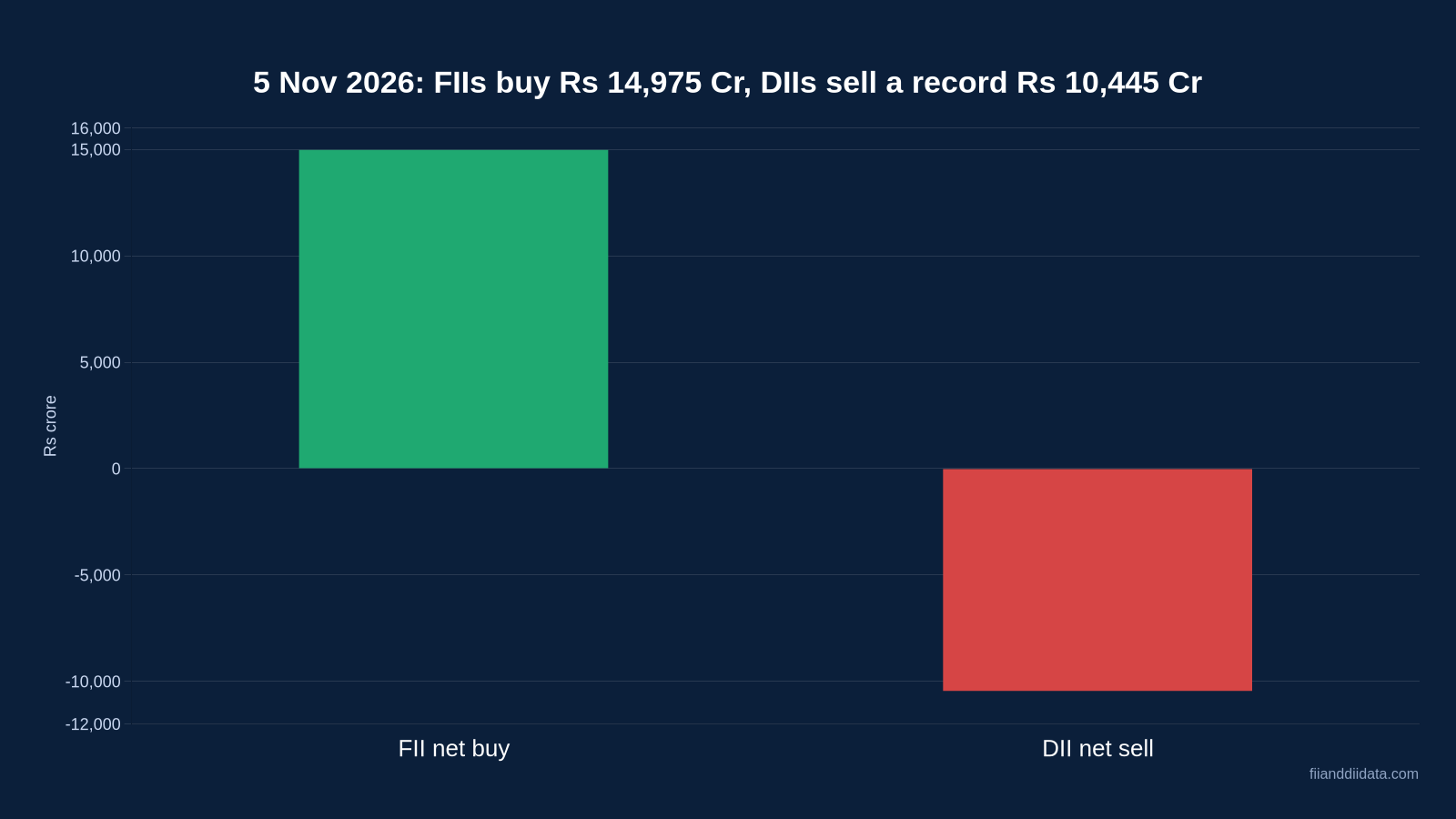
The DII selling record was broken on Thursday, 5 November 2026, when domestic institutions sold a net ₹10,444.54 crore of Indian shares, their largest single-day outflow ever. On the same day, foreign institutional investors bought a net ₹14,974.68 crore, and the Sensex jumped 2,008.61 points. Here is what the split means, why it happened, and what traders should check next.
Key Takeaways
- DIIs sold a net ₹10,444.54 crore on 5 November 2026, their largest single-day outflow on record.
- FIIs bought a net ₹14,974.68 crore, their biggest daily inflow since 24 February 2021.
- Nifty 50 rose 2.4% to 24,536.60, its sixth straight gain and biggest rally since 8 April.
- November to date, FIIs have bought ₹32,210 crore while DIIs have sold ₹18,228 crore.
- FIIs still held 1,37,438 net short index futures contracts, so their cash buying came with hedges.
- What happened on 5 November 2026
- The DII selling record in numbers
- Why DIIs sold into the rally
- How to read a DII selling record day
- What FII futures data adds
- A 4-step checklist for traders
- FAQ
- The Bottom Line
What Happened on 5 November 2026
Indian shares had their best day in seven months. The Sensex closed at 79,310.01, up 2,008.61 points or 2.6%, and the Nifty 50 ended at 24,536.60, up 576 points or 2.4%. Business Standard reported that BSE-listed market value crossed ₹500 trillion for the first time.
The trigger was global. The US midterm result raised hopes of an earlier end to the West Asia conflict, and Brent crude fell to an intraday low of $93.50 a barrel from $104.96 a day earlier, according to Upstox. The rupee closed at 94.47 per dollar, its fifth straight gain, and the 10-year bond yield eased to 7.17%.
Auto, realty and private bank stocks led. Bajaj Finance rose 7.65% and Shriram Finance 6.08%. The surprise came after the close, when the institutional flow data showed two big investor groups moving in opposite directions.
The DII Selling Record in Numbers
DIIs (domestic institutional investors) are Indian mutual funds, insurers, banks and pension funds. FIIs, also called FPIs, are foreign funds. NSE publishes provisional net figures for both groups around 6 PM IST on each trading day. The table shows how the gap widened through the first week of November.
| Date | FII net (₹ crore) | DII net (₹ crore) | Combined (₹ crore) |
|---|---|---|---|
| 2 Nov 2026 | +3,114.70 | -392.20 | +2,722.50 |
| 3 Nov 2026 | +6,836.80 | -3,678.80 | +3,158.00 |
| 4 Nov 2026 | +7,284.00 | -3,712.20 | +3,571.80 |
| 5 Nov 2026 | +14,974.68 | -10,444.54 | +4,530.14 |
| November to date | +32,210.18 | -18,227.74 | +13,982.44 |
Two facts stand out. First, the FII figure is the highest since 24 February 2021, when foreign investors bought ₹28,739 crore. Second, DIIs have now sold on every trading day of November. You can track each session on our FII DII data today page.
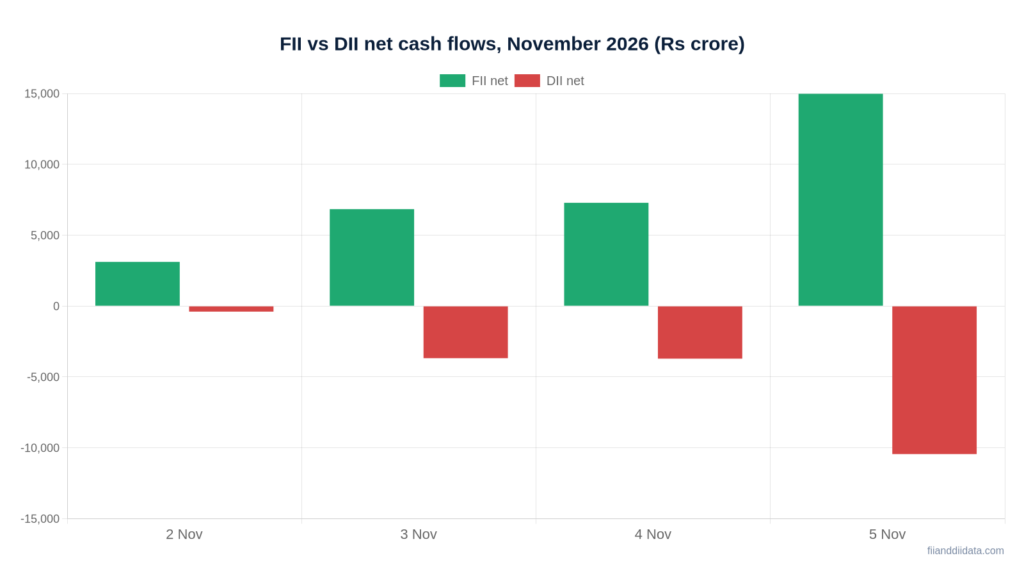
So why would local funds sell into the strongest rally in months? The next section looks at the likely reasons.
Why DIIs Sold Into the Rally
No fund house or insurer has explained the 5 November selling, and NSE data does not show which DIIs sold. What follows is our reading of common patterns, not confirmed fact.
Profit booking after a fast rally
Upstox data shows the Nifty gained 7% in a week. When prices rise that quickly, funds with fixed equity limits often trim winners. Insurers and balanced funds must keep equity within set bands, so a sharp rally forces some selling.
Selling to the buyer who showed up
Every trade needs two sides. When foreign money arrives in size, someone has to sell to it. DIIs bought heavily during earlier FII selling waves, so they had large blocks of liquid large caps to offer. NewsBytes reported that foreign buying focused on large caps such as Bajaj Finance and Reliance Industries.
Redemptions and cash needs
Some selling can also reflect mutual fund redemptions. Our analysis of SIP stoppage trends and October equity fund inflows gives context, but November AMFI data will only be out next month. Until then, treat this reason as a possibility.
How to Read a DII Selling Record Day
A record outflow sounds alarming, but the net number alone can mislead. Use this simple worked example with the 5 November figures.
- Find the combined flow: ₹14,974.68 crore minus ₹10,444.54 crore equals ₹4,530.14 crore of net institutional buying.
- Find the absorption ratio: ₹10,444.54 divided by ₹14,974.68 equals about 70%. DIIs supplied roughly seven of every ten rupees that foreign funds bought.
- Check the price response: the market still rose 2.4%, so buyers were more urgent than sellers.
The takeaway: institutions as a group were still net buyers. The DII selling record tells you who sold, not that the market was weak. The month-to-date picture below shows the same pattern over four sessions.

For longer trends, compare these figures with our monthly FII DII data. Cash flows are only half the story, though. Futures data shows how confident foreign funds really are.
What FII Futures Data Adds
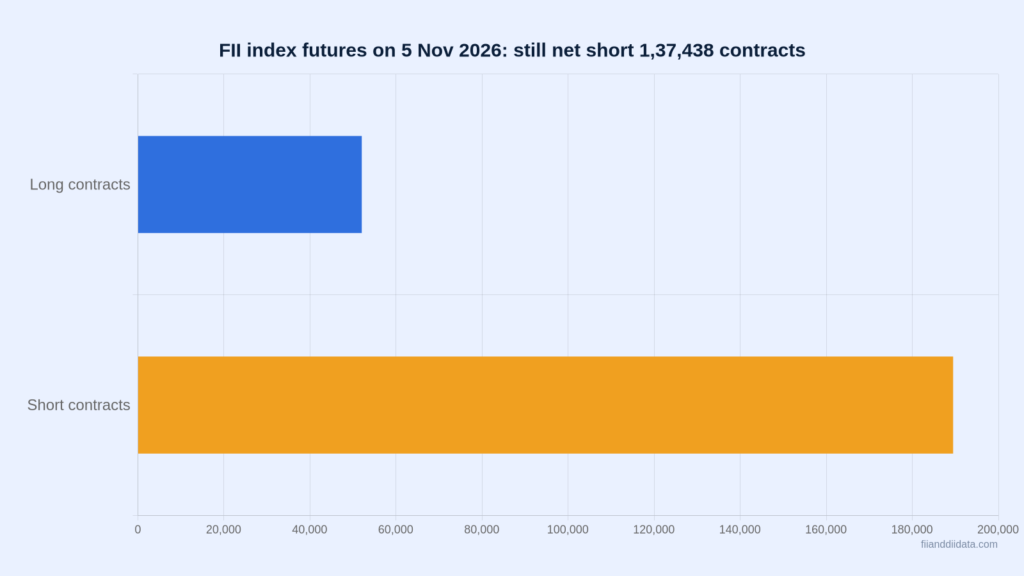
On 5 November, FIIs held 52,037 long index futures contracts against 1,89,475 short contracts, a net short of 1,37,438 contracts, according to NiftyTrader. They did add 17,198 long contracts during the day. In index options, they bought and sold both calls and puts in large numbers.
In plain terms, foreign funds bought shares in the cash market but kept protection in derivatives. India VIX, a measure of expected volatility, also rose 2.83% to 15.62 even as prices climbed. That mix points to cautious buying, not blind optimism. See the full picture on our participant-wise open interest and FII options activity trackers.
A 4-Step Checklist for Traders
- Wait for NSDL final data. NSE numbers are provisional. NSDL publishes final FPI figures on the next working day, and they can differ.
- Check block and bulk deals. One large deal can inflate both FII buying and DII selling on the same day.
- Compare with FII futures positions. Cash buying with a large net short in futures signals hedged, not outright, bullishness.
- Watch the next three sessions. One record day is a data point. A trend needs follow-through.
Common mistakes to avoid: reading DII selling as panic, treating provisional data as final, and chasing a stock only because FIIs bought it. Our earlier report on the four-day foreign buying run shows how fast these flows can change. The questions below cover what readers ask most.
FAQ
What is the DII selling record set on 5 November 2026?
Domestic institutional investors sold a net ₹10,444.54 crore of Indian shares on 5 November 2026, which Business Standard described as their largest-ever single-day net outflow.
Why are DIIs selling while FIIs are buying?
No official reason has been given. Likely factors include profit booking after a 7% weekly rally, fixed equity limits at insurers and balanced funds, and DIIs supplying shares to heavy foreign demand.
Is DII selling bad for the stock market?
Not by itself. On 5 November, combined institutional flow was still a net ₹4,530 crore of buying and the Nifty rose 2.4%. It matters more if selling continues while prices fall.
When is FII DII data released?
NSE releases provisional FII and DII cash data around 6 PM IST on each trading day. NSDL publishes final FPI data on the next working day.
How much have FIIs bought in November 2026?
Based on NSE provisional data, FIIs bought a net ₹32,210 crore in the cash market from 2 to 5 November 2026, while DIIs sold a net ₹18,228 crore.
The Bottom Line
The 5 November DII selling record looks dramatic, but the full picture is calmer. Foreign funds returned in force, domestic funds took the chance to sell, and institutions together were still net buyers on a day the market rose 2.4%.
The bigger question is whether foreign buying lasts. FIIs remain net short in index futures, and the Nifty is still about 7% below its 52-week high. As a next step, check the NSDL final figure and the next three sessions of FII and DII data before changing your positions.
Sources: Business Standard, 5 Nov 2026; Upstox market wrap, 5 Nov 2026; 5paisa FII DII data; NiftyTrader FII derivatives data; NewsBytes.
Disclaimer: This article is for educational purposes only and is not investment advice. Please consult a SEBI-registered advisor before making investment decisions.