To learn how to manage expenses on a low salary, fix your essential costs first, move a small saving out on payday, and give every remaining rupee a written limit before the month starts. The pressure is real: food prices rose 7.74% in September 2026 against headline inflation of 5.54%, as per MoSPI data released on 12 October 2026. This guide shows a 7-step method, a worked ₹20,000 salary plan and the low-cost safety nets most small earners miss.
Key Takeaways
- On a small salary, needs and family support can take 70% or more of pay, so plan in rupees, not textbook percentages.
- Save first, even ₹500 to ₹1,500 a month, through an automatic transfer on salary day.
- Two government covers, PMJJBY and PMSBY, together cost ₹456 a year for ₹2 lakh life and ₹2 lakh accident cover.
- Five small cuts in our example free up ₹2,899 a month, or ₹34,788 a year.
- Avoid borrowing for daily expenses; high-cost loans turn a tight month into a tight year.
Table of contents
- Why a low salary feels tighter in 2026
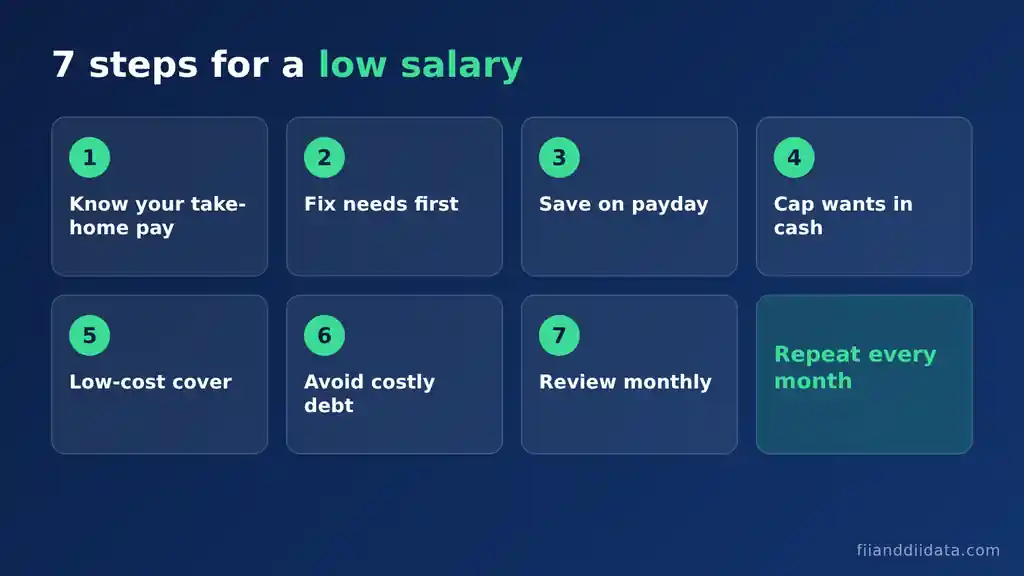
- How to manage expenses on a low salary in 7 steps
- Worked example: a ₹20,000 salary budget
- Five small cuts that free up ₹2,899 a month
- Low-cost protection every small earner should know
- Where to keep ₹500 to ₹1,500 a month
- Borrowing on a low salary: what to avoid
- Managing expenses on a low salary: 5 common mistakes
- Frequently asked questions
- The Bottom Line
Why a Low Salary Feels Tighter in 2026
A low salary leaves little room for error. When most of your pay goes to rent, food and travel, even a small price rise eats directly into savings.
The latest CPI release for September 2026 shows why. Headline inflation was 5.54%, but food inflation was 7.74% and rural inflation 6.08%. House rents rose a milder 2.37%. People on small incomes spend a larger share on food, so they feel the food number most.
What that means in rupees
If you spend ₹4,000 on groceries and ₹5,000 on rent, and prices keep rising at 7.74% and 2.37%, the same groceries would cost about ₹4,310 and the room about ₹5,119 a year from now. That is roughly ₹428 a month more with no change in salary. The method below is built to absorb that.
How to Manage Expenses on a Low Salary in 7 Steps
Step 1: Know your exact take-home pay
Use the amount that reaches your bank after PF, ESI and other deductions. If pay varies with overtime, plan on your lowest month of the last six.
Step 2: Fix needs first, in rupees
List rent, groceries, gas, electricity, phone, travel, medicines and money sent home, using actual figures from two months of UPI and bank history. On a low salary these lines decide everything.
Step 3: Save on payday, not at month-end
Set a standing instruction or recurring deposit that moves a fixed amount a day after salary, even ₹500. Money left for “later” rarely survives the last week.
Step 4: Cap wants and keep them separate
Give eating out, outings and shopping one monthly limit, kept in cash or a separate UPI-linked account so you can see when it runs out.
Step 5: Buy low-cost protection
One hospital bill can wipe out a year of savings. Check your ESI status and enrol in the government’s low-premium life and accident covers, explained below.
Step 6: Do not borrow for daily costs
If the month does not balance, cut wants or find a cheaper option for a need. Borrowing for groceries only moves the shortfall into next month, with interest.
Step 7: Review for 15 minutes each month
On salary day, compare last month’s plan with actual spending and fix one category at a time. The worked example below shows the whole plan on paper.
Worked Example: A ₹20,000 Salary Budget
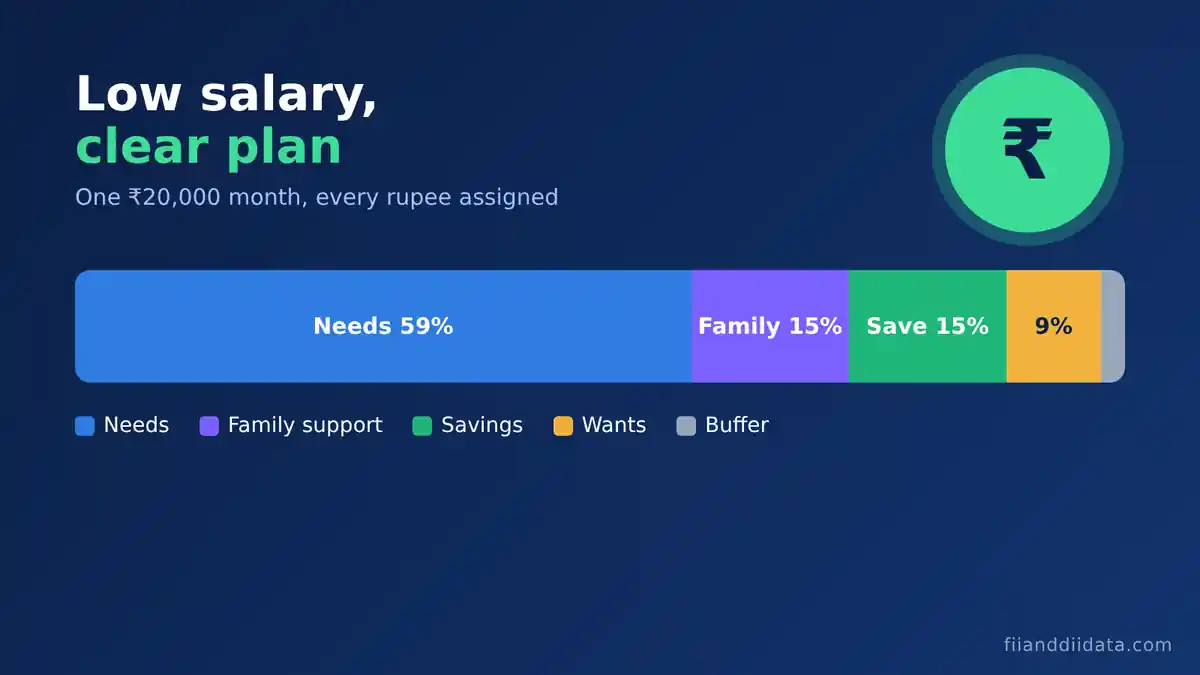
Take Ravi, 24, a warehouse worker in Indore who takes home ₹20,000 a month, shares a room and sends money to his parents. The figures are an illustration, not a recommendation.
| Category | Type | Monthly amount | Share of pay |
|---|---|---|---|
| Rent (shared room) | Need | ₹5,000 | 25.0% |
| Groceries and cooking gas | Need | ₹4,000 | 20.0% |
| Transport to work | Need | ₹1,200 | 6.0% |
| Electricity share | Need | ₹600 | 3.0% |
| Medicines and doctor buffer | Need | ₹500 | 2.5% |
| Phone and internet | Need | ₹400 | 2.0% |
| PMJJBY + PMSBY (₹456 a year ÷ 12) | Need | ₹38 | 0.2% |
| Money sent home | Family support | ₹3,000 | 15.0% |
| Eating out and outings | Want | ₹1,000 | 5.0% |
| Clothes and personal care | Want | ₹800 | 4.0% |
| Emergency fund | Saving | ₹1,500 | 7.5% |
| Post office recurring deposit | Saving | ₹1,000 | 5.0% |
| Festivals and yearly costs fund | Saving | ₹500 | 2.5% |
| Unplanned small costs | Buffer | ₹462 | 2.3% |
| Total | ₹20,000 | 100% |
Added up, needs come to ₹11,738 (58.7%), family support ₹3,000 (15%), wants ₹1,800 (9%), savings ₹3,000 (15%) and a ₹462 buffer. A strict 50/30/20 rule would cap needs at ₹10,000 and allow ₹6,000 for wants, which does not fit a worker who supports his family. The plan still balances and saves 15%.
How to manage expenses on a low salary of ₹15,000
At ₹15,000, the same structure still works with smaller numbers: rent ₹3,500, groceries ₹3,500, money home ₹2,000, transport ₹900, utilities and phone ₹800, medical buffer ₹400, insurance ₹38, wants ₹900, emergency fund ₹1,000, recurring deposit ₹1,000, yearly costs ₹300 and a ₹662 buffer. That is ₹2,300, or 15.3%, set aside each month.
How long the emergency fund takes
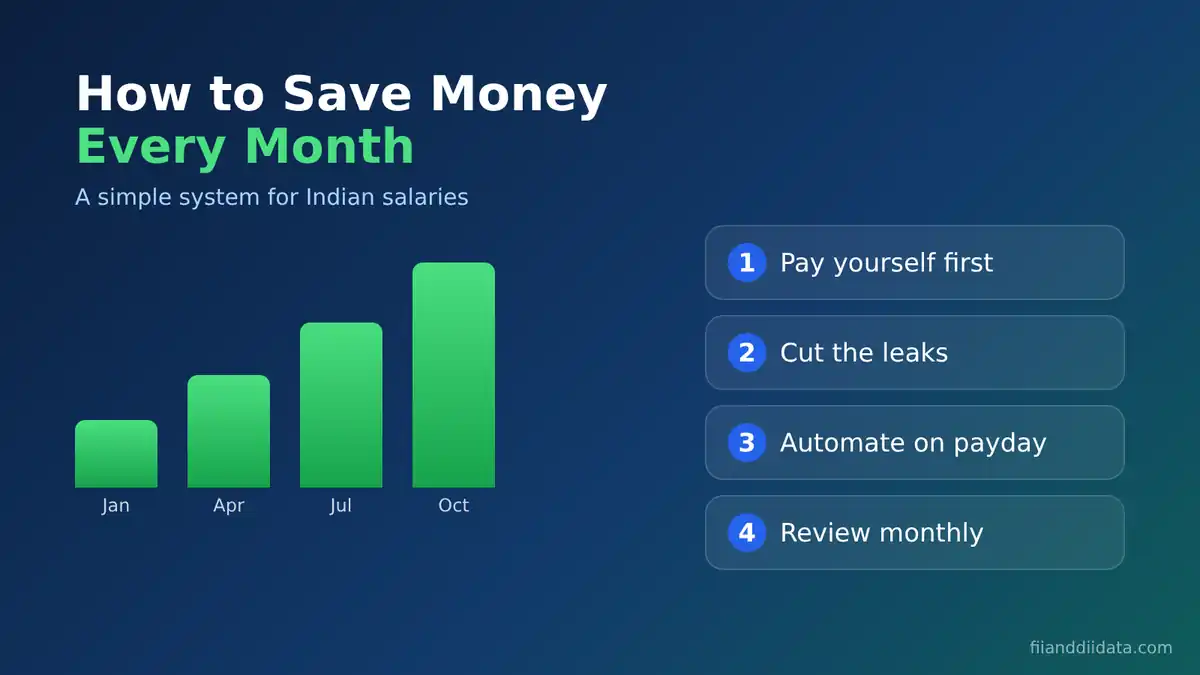
Ravi’s essential monthly outgo, needs plus money home, is ₹14,738. Three months of that is about ₹44,214. At ₹1,500 a month, he reaches it in roughly 30 months, faster if he adds part of any bonus or Diwali gift. For a step-by-step saving routine, see our guide on how to save money every month on a small salary.
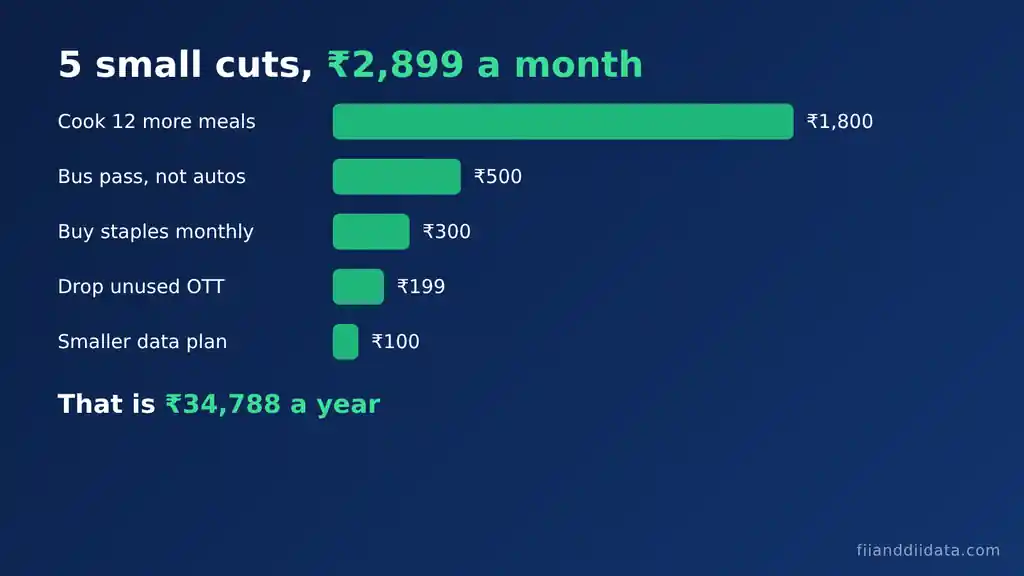
Five Small Cuts That Free Up ₹2,899 a Month
Savings on a low salary usually come from a few small habits, not one big change. The figures below are illustrations based on common prices; check them against your own statements.
| Change | How the saving is worked out | Saving per month |
|---|---|---|
| Cook 12 more meals at home | Ordering at ₹200 vs cooking at ₹50 saves ₹150 a meal, × 12 | ₹1,800 |
| Monthly bus pass instead of autos | 10 auto rides at ₹80 (₹800) vs a ₹300 pass | ₹500 |
| Buy staples once a month | Larger packs of rice, dal and oil vs small daily packs | ₹300 |
| Drop one unused OTT plan | A ₹199 monthly plan you rarely watch | ₹199 |
| Move to a smaller data plan | Use office or home Wi-Fi where you can | ₹100 |
| Total | ₹2,899 |
Over a year, ₹2,899 a month adds up to ₹34,788, close to three-quarters of Ravi’s emergency fund target. Move the saving into your RD the same day, or it turns into extra spending. Cuts stop small leaks; the next section covers big shocks.
Low-Cost Protection Every Small Earner Should Know
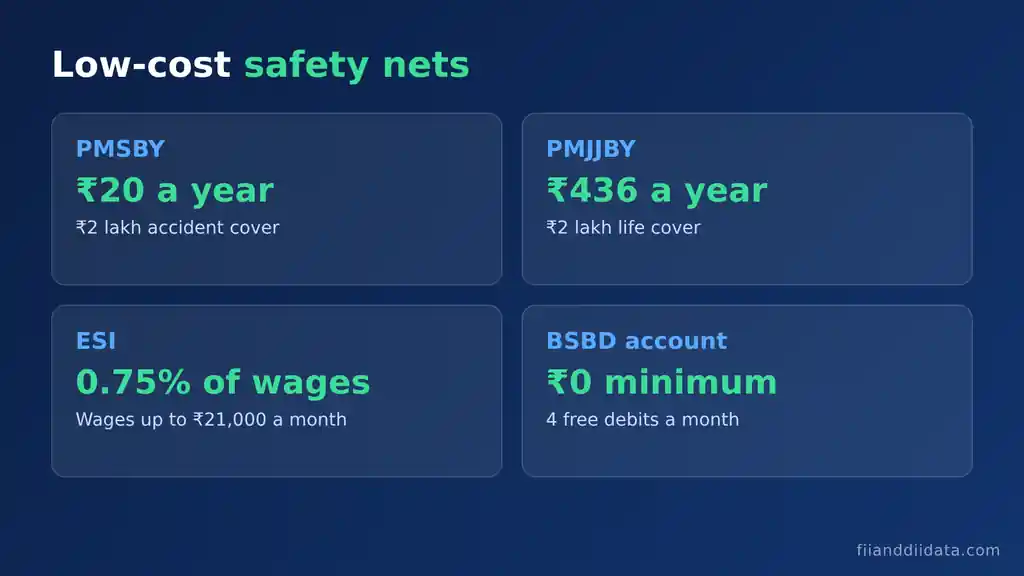
Many money guides say “get insurance” without saying what it costs. Several government-backed options cost very little:
| Option | Who can join | What it costs | What you get |
|---|---|---|---|
| PMSBY (accident cover) | Age 18 to 70 with a bank account | ₹20 a year | ₹2 lakh for accidental death or total disability; ₹1 lakh for partial disability |
| PMJJBY (life cover) | Age 18 to 50 with a bank account | ₹436 a year | ₹2 lakh on death from any cause |
| Atal Pension Yojana | Age 18 to 40 | Varies with pension chosen | Guaranteed pension of ₹1,000 to ₹5,000 a month after 60 |
| ESI (through employer) | Employees earning up to ₹21,000 a month in covered establishments | 0.75% of wages; nil if daily average wage is up to ₹176 | Medical and cash benefits under the ESI scheme |
| BSBD savings account | Any individual | No minimum balance | Up to four free debits a month |
The two Jan Suraksha covers together cost ₹456 a year, or ₹38 a month, for a combined ₹4 lakh of protection in case of accidental death. As per the PIB release of 9 May 2025, PMSBY had more than 51.06 crore enrolments and PMJJBY more than 23.63 crore as of 23 April 2025. You enrol through the bank where you hold your savings account.
Check your ESI status first
The ESIC coverage rules set the wage ceiling at ₹21,000 a month (₹25,000 for persons with disabilities) since 1 January 2017. On wages of ₹21,000, the employee share at 0.75% is ₹157.50 a month, while the employer pays 3.25%. If ESI appears on your salary slip, you already have a medical safety net. If it does not, a basic health policy should be next on your list once your emergency fund starts.
Where to Keep ₹500 to ₹1,500 a Month
Small savings need safety and, for the emergency part, easy access. Post office rates for October to December 2026 were kept unchanged on 30 September 2026:
| Option | Interest rate (Oct to Dec 2026) | Best used for |
|---|---|---|
| Post Office Savings Account | 4.0% | Emergency money you may need any day |
| 5-year Recurring Deposit | 6.7% | Fixed monthly saving habit |
| 1-year Time Deposit | 6.9% | Parking a lump sum such as a bonus |
| Public Provident Fund | 7.1% | Long-term saving over 15 years |
As a worked example, ₹1,000 a month in a 5-year post office RD at 6.7%, compounded quarterly, grows to about ₹71,366 by our calculation. That is ₹60,000 deposited and about ₹11,366 in interest; India Post’s table may differ slightly due to rounding.
Use a zero-balance account to avoid penalty charges
Minimum-balance penalties hurt most when the balance is low. Under RBI’s rules for Basic Savings Bank Deposit accounts, you do not need to keep a minimum balance and up to four debits a month are free. You cannot hold a BSBD account and another savings account in the same bank. Once your income grows, SIPs in mutual funds can follow; we track how Indian savers are using them in our SIP inflow September 2026 report.
Borrowing on a Low Salary: What to Avoid
Debt is where a tight budget most often breaks. The danger is a cycle: borrow this month, repay from next month’s salary, fall short, borrow again.
- Never borrow for groceries, rent or bills. If needs exceed income, the fix is a cheaper room, shared costs or extra income, not credit.
- Keep EMIs small. On a ₹20,000 salary, every ₹1,000 of EMI is 5% of pay gone before the month starts.
- Read the total cost. Before any loan, ask for the full repayment amount and all fees in writing, not just the EMI.
- Use only regulated lenders. Borrow from banks, NBFCs or apps that clearly name the regulated lender behind them.
- Repay the costliest debt first. Pay the minimum on every loan and put spare money into the one with the highest rate.
With debt under control, the last step is avoiding the mistakes that quietly undo a good plan.
Managing Expenses on a Low Salary: 5 Common Mistakes
- Planning on gross pay. PF and ESI deductions never reach your hand. Use take-home pay only.
- Saving whatever is left. Usually nothing is left. Save on payday instead.
- Forgetting yearly costs. Festivals, weddings and trips home break monthly plans. Save a small amount for them each month.
- Skipping insurance to save ₹38 a month. The two Jan Suraksha covers cost less than one restaurant meal a month.
- Ignoring small UPI payments. Twenty ₹50 payments add up to ₹1,000. Check your UPI history weekly.
Monthly checklist for a low salary
- Did the payday saving and RD instalment go out on time?
- Did needs stay within the rupee limits you set?
- Did wants stay inside the cash or separate account limit?
- Are PMJJBY and PMSBY active, and does your salary slip show ESI?
- Did you borrow anything this month? If yes, what will you change next month?
- Is the emergency fund growing towards three months of essential costs?
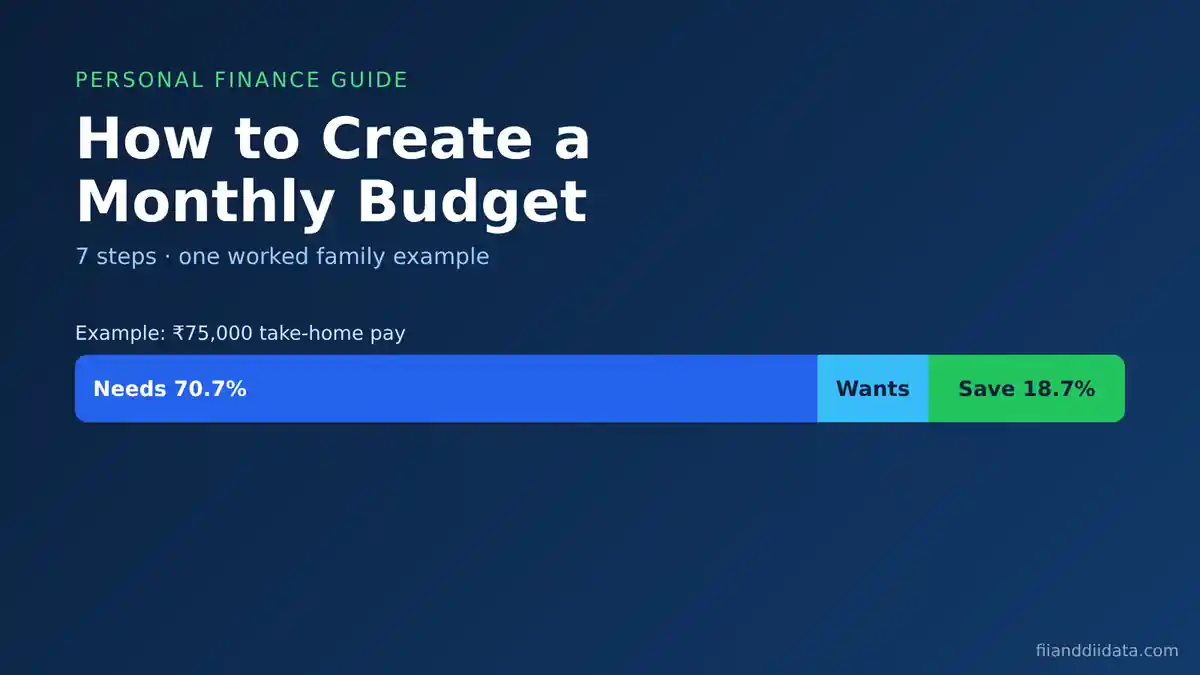
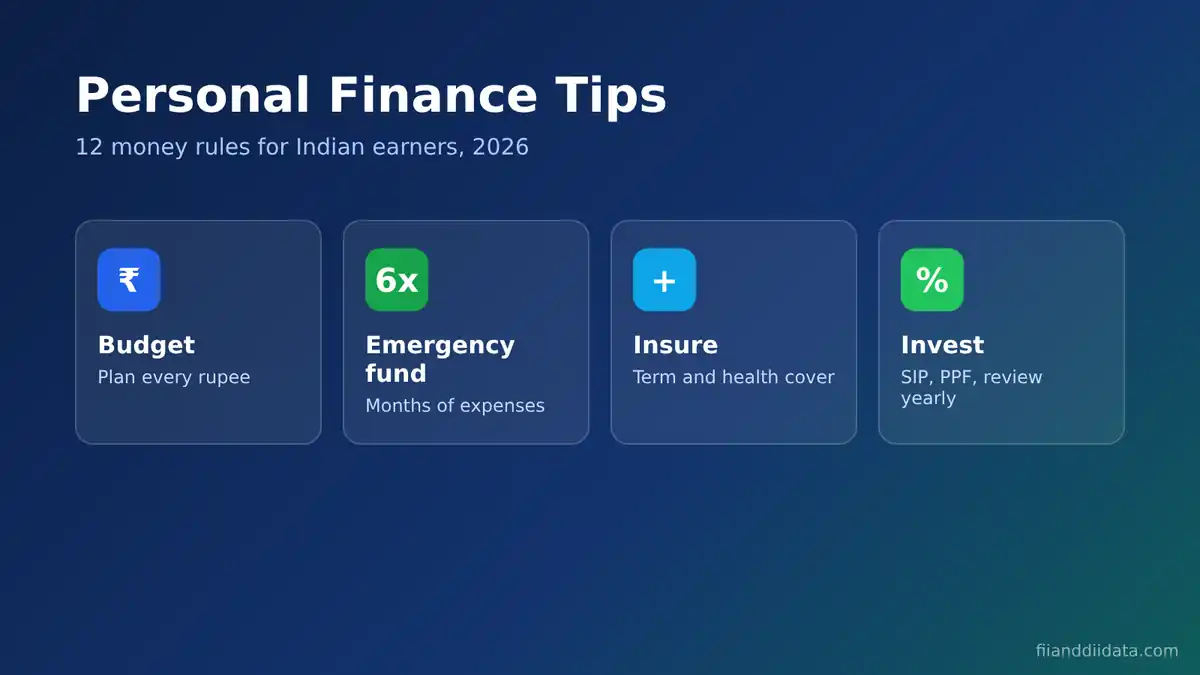
For a longer list of money rules beyond the monthly plan, read our personal finance tips for Indian earners, and if you want to build the budget sheet itself, follow our guide on how to create a monthly budget.
Frequently Asked Questions
How do I manage expenses on a low salary?
Start with your exact take-home pay, list essential costs in rupees, move a fixed saving out on payday, cap wants with a separate cash or account limit, buy low-cost cover such as PMJJBY and PMSBY, avoid borrowing for daily costs and review the plan once a month.
How much should I save from a ₹20,000 salary?
Aim for 10% to 15% to begin with, or ₹2,000 to ₹3,000 a month. In our example, a ₹20,000 earner saves ₹3,000 (15%) across an emergency fund, a recurring deposit and a yearly costs fund. If that is too much, start with ₹500 and raise it with every increment.
Does the 50/30/20 rule work on a low salary?
Often not. On a small salary, rent, food, travel and money sent home can take 70% or more of pay. It is better to fix needs in rupees, save a set amount first and keep a small, capped line for wants.
Which insurance is affordable for low-income earners in India?
PMSBY costs ₹20 a year for ₹2 lakh accident cover (age 18 to 70) and PMJJBY costs ₹436 a year for ₹2 lakh life cover (age 18 to 50), as per PIB. Employees earning up to ₹21,000 a month in covered establishments also get ESI medical benefits for a 0.75% wage contribution.
Where should I keep my emergency fund on a small income?
Keep it somewhere safe and easy to withdraw, such as a savings account or a sweep-in deposit. A zero-balance BSBD account avoids minimum-balance charges. Use a recurring deposit for regular saving beyond the emergency amount.
The Bottom Line
Managing expenses on a low salary is about order, not sacrifice: needs in rupees, savings on payday, a capped line for wants, cheap protection and no borrowing for daily costs. A plan that saves 10% to 15% and covers the big risks is a strong plan at any income.
With food prices rising faster than overall inflation in September 2026, the grocery line deserves the closest watch. Your next step: open your UPI history tonight, total last month’s spending by category, and set up a ₹500 standing instruction for the day after salary. Scheme rules and small savings rates change, so recheck them on official sites before you act. For more guides on money and markets, visit our blog.
Sources: PIB, CPI press release for September 2026 (12 October 2026); PIB, Jan Suraksha schemes complete 10 years (9 May 2025); ESIC, coverage; ESIC, contribution rates; RBI, Basic Savings Bank Deposit Account; India Post, savings schemes interest rates; Business Today, small savings rates unchanged for Oct-Dec 2026 (30 September 2026).
Disclaimer: This article is for educational purposes only and is not investment advice. Please consult a SEBI-registered advisor before making investment decisions.