The MSCI rebalancing November 2026 India review will be announced on 11 November 2026, and the changes take effect from 1 December 2026, with index funds trading at the close on 30 November. A JM Financial note dated 22 October 2026 expects LIC, Meesho and Coforge to join the MSCI India Index and estimates net passive inflows of about $1.4 billion. Here is how the review works, what is expected and how to read the flows.
Key Takeaways
- MSCI announces its November 2026 index review on 11 November; changes apply from 1 December 2026.
- JM Financial sees LIC, Meesho and Coforge as high-probability additions, and OFSS and Siemens Energy India as likely exits.
- Estimated passive flows: about $1.93 billion in, $497 million out, so roughly $1.44 billion net.
- These are broker estimates, not MSCI decisions. In August 2026, JM Financial got all three exits right but only some of the additions.
- Index buying is concentrated in the closing auction, so price moves often happen before the effective date.
Table of contents
- What Is MSCI Rebalancing and Why It Matters for India
- How MSCI Picks Indian Stocks
- MSCI Rebalancing November 2026 India: Expected Changes
- How Much Money Could Move: A Worked Example
- Lessons From the August 2026 Review
- MSCI Rebalancing November 2026 India Timeline and Trader Checklist
- Common Mistakes Around MSCI Reviews
- Frequently Asked Questions
- The Bottom Line
What Is MSCI Rebalancing and Why It Matters for India
MSCI is a global index provider. Its indices, such as the MSCI Emerging Markets Index and the MSCI India Index, are benchmarks for a very large pool of active and passive global money. Passive funds, such as exchange traded funds (ETFs) and index funds, must hold the same stocks in the same weights as the index they track. When MSCI adds or removes a stock, these funds have to buy or sell it.
MSCI reviews its main indices four times a year, in February, May, August and November. The May and November reviews are the semi-annual reviews and usually bring more changes. In each review MSCI can add stocks, delete stocks, move stocks between the Standard (large and mid cap) and Small Cap indices, and change weights when free float or share count changes.
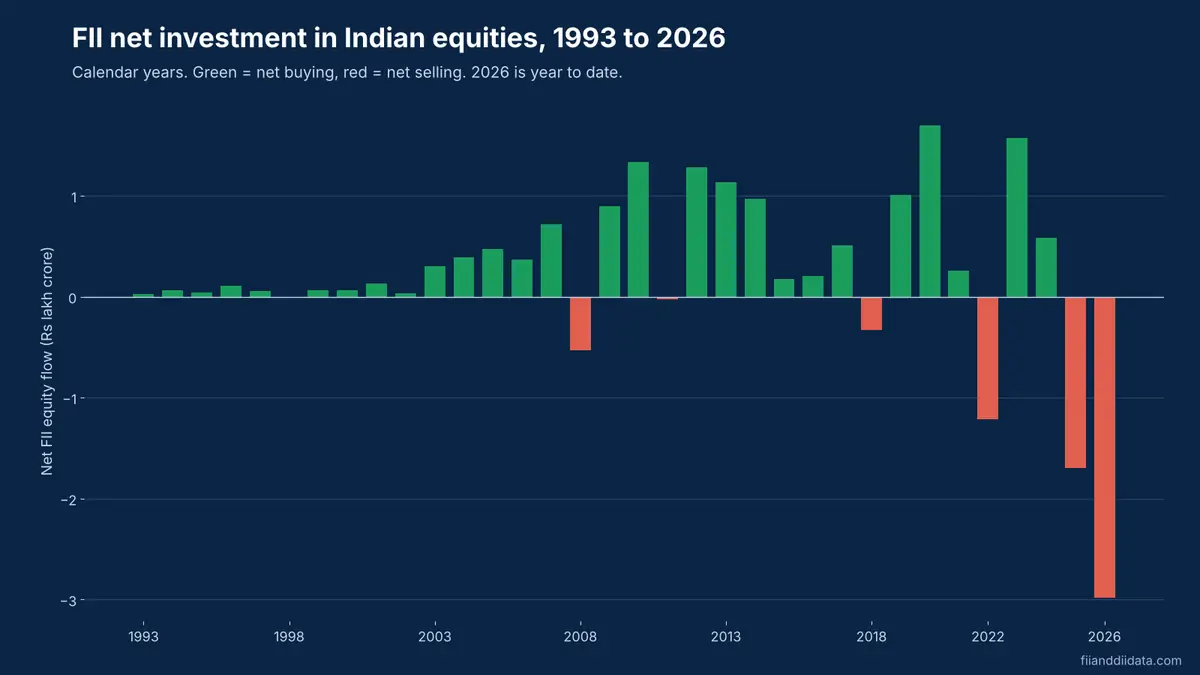
For India, this matters more than it used to. India’s weight in the MSCI Emerging Markets Index was about 11.94% as of 30 April 2026, according to MSCI factsheet data cited by Finnovate, down from close to 20% in mid-2024. A JM Financial report from June 2026 noted that this lower weight makes each change in the India index count for more in flow terms. And with FPIs having pulled a record ₹3.08 lakh crore out of Indian equities in 2026, as tracked in our FPI outflow 2026 report, any passive inflow gets noticed. To see which stocks qualify, start with how MSCI screens them.
How MSCI Picks Indian Stocks: Size, Free Float and Liquidity
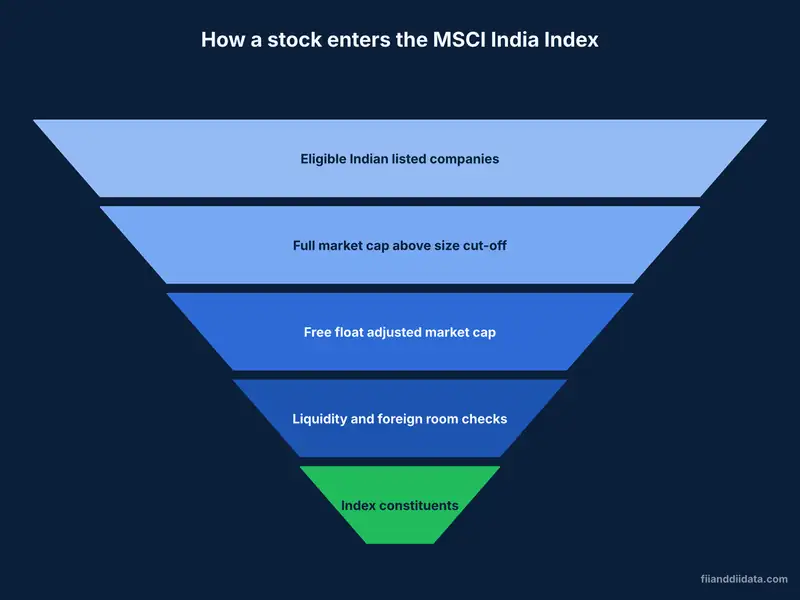
MSCI does not simply pick the biggest companies. It applies a set of tests, and a stock must pass all of them. The MSCI India Index had 165 constituents and covered about 85% of India’s free float adjusted equity universe as of its 30 September 2026 factsheet, as reported by Business Upturn.
- Full market cap. The company’s total market value must clear a minimum size cut-off for the Standard index.
- Free float adjusted market cap. Free float means shares the public can actually trade. Promoter, government and strategic holdings are excluded. A company can be huge on paper but small in MSCI’s eyes if most shares are locked with promoters.
- Liquidity. The stock must trade enough, measured by how often and how much it changes hands.
- Foreign room. There must be enough headroom under the foreign ownership limit for global funds to buy.
- Buffers. MSCI uses buffer zones so that stocks near the cut-off do not move in and out every quarter.
Weights inside the index follow free float adjusted market cap, not full market cap. This is why a sharp rally can push a mid cap into the Standard index, and why a fall in free float can push a stock out. These rules explain the names in the frame this November.
MSCI Rebalancing November 2026 India: Expected Inclusions and Exclusions
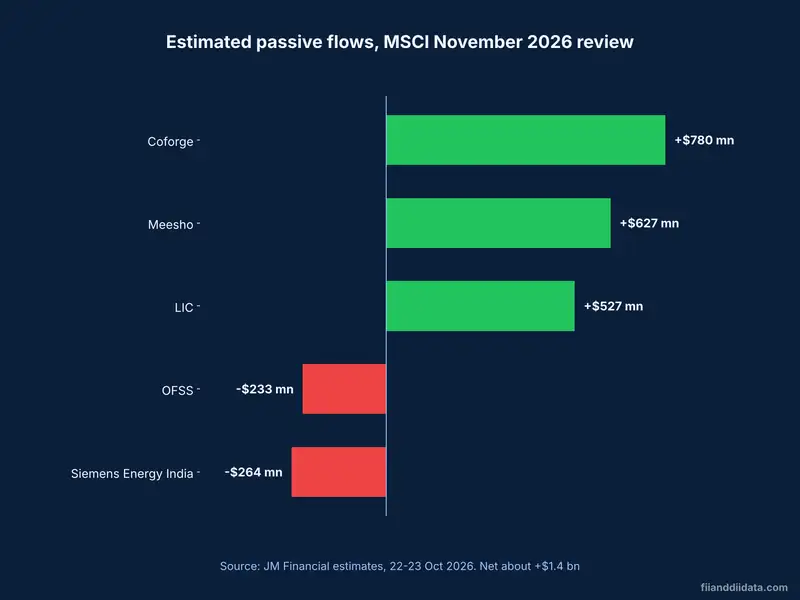
Brokerages run their own models before each review. The most widely reported estimate for this review comes from JM Financial Institutional Securities, in a note dated 22 October 2026. The table lists its high-probability changes and the estimated passive flows for each stock.
| Stock | Expected change | Estimated passive flow (US$) |
|---|---|---|
| Coforge | Move from Small Cap to Standard index | +780 million |
| Meesho | Inclusion | +627 million |
| Life Insurance Corporation of India (LIC) | Inclusion | +527 million |
| Siemens Energy India | Exclusion | -264 million |
| Oracle Financial Services Software (OFSS) | Exclusion | -233 million |
| Net estimate | +1,437 million |
Why Coforge, Meesho and LIC are in the frame
Coforge is the clearest case of a market cap jump. Its shares rose 55.34% over six months, according to Business Standard on 23 October 2026, and its liquidity improved. JM Financial had rated Coforge only a medium-probability upgrade in its August preview. It missed then, and is now rated high probability.
Meesho and LIC are both listed as high-probability additions to the Standard index. For a newer listing, the test is usually trading history and free float. For LIC, the issue has always been free float, because the government holds most of the shares. Even a large company enters with a modest weight when its tradable share base is small. Keep this in mind when you look at the flow numbers next.
How Much Money Could Move: A Worked Example
A flow estimate in dollars means little until you compare it with how much a stock normally trades. Here is a simple way to size it. The rupee rate and daily turnover below are round numbers for illustration, not market data.
- Step 1, convert the flow. Coforge’s estimated inflow is $780 million. At an assumed ₹95 per dollar, that is about ₹7,410 crore.
- Step 2, compare with turnover. Suppose the stock trades ₹1,000 crore a day on average. The passive demand equals about 7.4 normal trading days.
- Step 3, look at timing. Index funds aim to buy at the closing price on the effective day, so much of that demand lands in one closing auction on 30 November.
- Step 4, check who is already positioned. Active funds and arbitrage desks often buy weeks earlier and sell to index funds at the close.
The same maths explains why exclusions can hurt. Siemens Energy India’s estimated outflow of $264 million is about ₹2,508 crore at the same assumed rate. If its normal daily turnover were ₹300 crore, index selling would equal more than eight days of trading. That is why JM Financial warns that exclusion candidates can face selling pressure as the announcement nears.
Put the total in context too. A net $1.4 billion passive inflow is real money, but it is small next to the ₹48,056 crore FPIs sold in October 2026 up to the 23rd, as shown in our FPI selling October 2026 analysis. MSCI flows move single stocks far more than they move the Nifty. Before trusting any estimate, though, check how the last one turned out.
Lessons From the August 2026 Review: Forecast vs Result
Broker previews are useful, but they are not the final list. The best test is to compare the last preview with what MSCI actually did. In July 2026, JM Financial named likely changes for the August review and estimated about $2.3 billion of passive inflows. MSCI announced the result on 12 August, effective after the close on 31 August 2026.
| Stock | JM Financial view (16 Jul 2026) | Actual MSCI decision (Aug 2026) |
|---|---|---|
| Groww (Billionbrains Garage Ventures) | Inclusion, high probability | Added |
| Adani Energy Solutions | Inclusion, high probability | Added |
| Laurus Labs | Upgrade from Small Cap, strong | Added |
| Adani Green Energy | Inclusion, high probability | Not added |
| Biocon | Upgrade from Small Cap, strong | Not added |
| Coforge | Upgrade, medium probability | Not added |
| Ather Energy | Inclusion, medium probability | Not added |
| Lenskart Solutions | Not named | Added |
| Astral | Exclusion, high probability | Removed |
| SBI Cards and Payment Services | Exclusion, medium probability | Removed |
| Balkrishna Industries | Exclusion, low probability | Removed |
The scorecard is mixed. JM Financial got all three exits right, including one it rated low probability. On additions, three of its named picks made it, four did not, and one stock it did not name, Lenskart, was added. The India index went from 165 to 166 constituents, according to PL Capital.
Two lessons follow. First, a “high probability” label is a model output, and price moves between the preview and the cut-off can change the result. Second, deletions tend to be easier to predict than additions, because a falling free float or price is visible early. Use previews as a watchlist, not a promise. The timeline below shows when to watch.
MSCI Rebalancing November 2026 India Timeline and Trader Checklist
Each MSCI review follows the same rhythm. For this one, the key dates are already known from MSCI’s schedule as reported by brokerages.
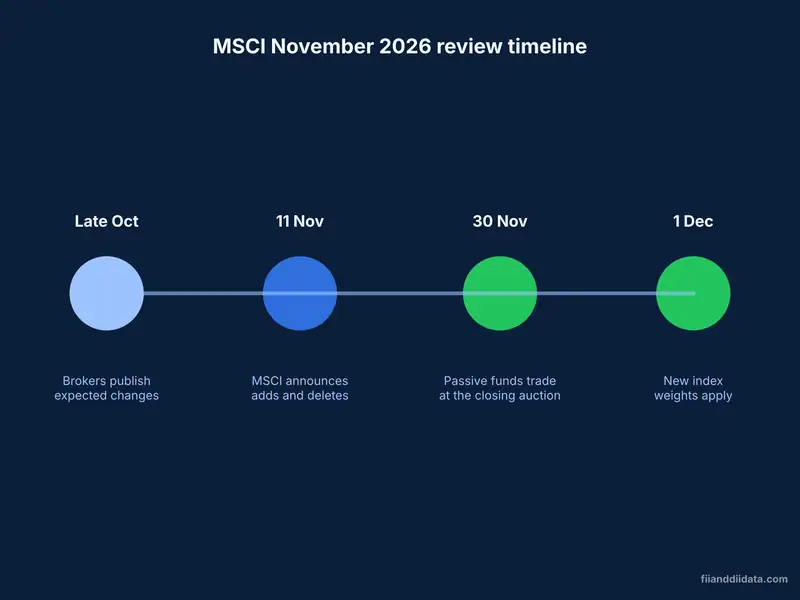
- Late October 2026: broker previews published. JM Financial’s came on 22 October.
- 11 November 2026: MSCI announces additions and deletions. MSCI usually posts lists late in the evening European time, which falls after midnight in India, so the Indian market reacts on 12 November.
- 30 November 2026 (Monday): last trading day before the change. Passive funds trade at the closing price.
- 1 December 2026: new constituents and weights take effect.
How to track MSCI rebalancing November 2026 India flows
Use this checklist from now until the effective date.
- Note the expected adds and deletes and their estimated flows from at least two broker previews.
- Compare each flow with the stock’s average daily traded value. Flows above three to five days of turnover tend to matter more.
- Watch prices in the 20 trading days before 11 November. JM Financial cites historical excess returns of 8% to 15% for high-conviction inclusion candidates in that window.
- On 12 November, check the official MSCI list. Drop any trade built on a stock that was not included.
- Track foreign flows daily through our FII DII data around MSCI rebalancing summary, especially on 30 November, when the FII cash figure can swing because of index trades.
- Treat the effective day close as a liquidity event, not a signal about the company’s business.
For context on which stocks foreign funds were already adding before this review, see our list of FII holding increase stocks in Q2 FY27. Next, the errors that cost traders most around these events.
Common Mistakes Around MSCI Reviews
- Treating a preview as a decision. The August 2026 review showed that even high-probability picks can miss.
- Buying on the effective day. By the closing auction, most of the expected demand is usually priced in. Stocks can fall after inclusion once index buying ends.
- Reading index flows as a market view. Passive buying is mechanical. It says nothing about whether foreign funds like the company, and it does not reverse an FPI selling trend.
- Ignoring free float. A big company with a small float gets a small weight and a smaller inflow than its size suggests.
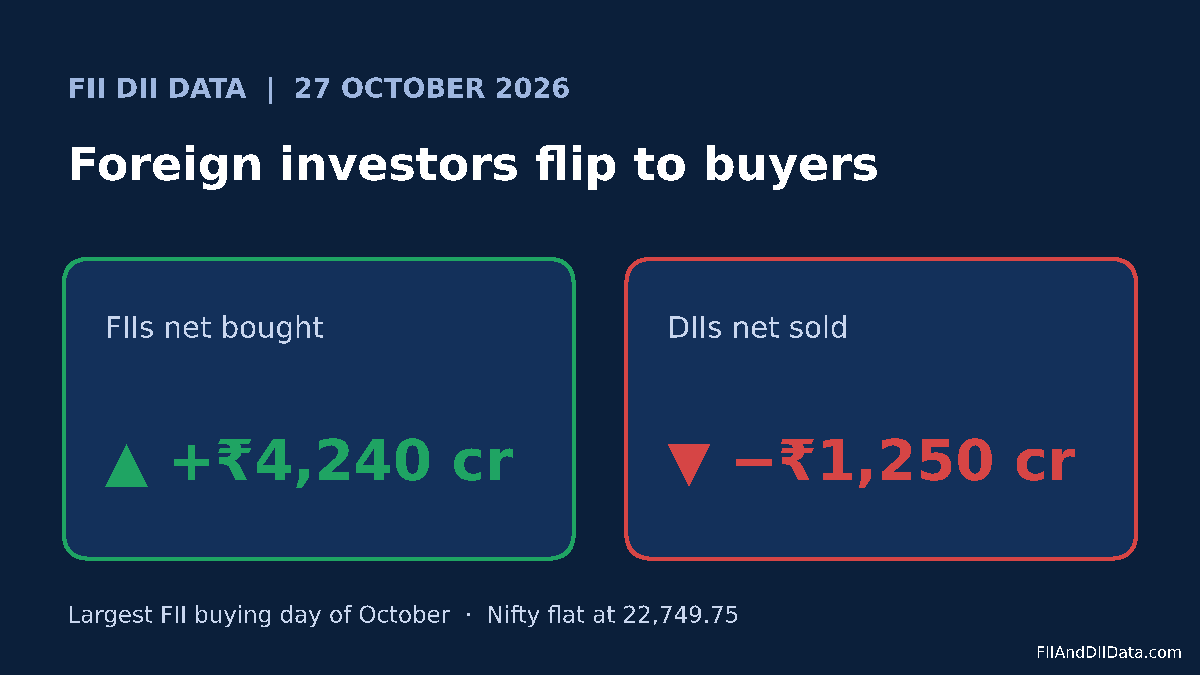
- Mixing up the daily FII number. A large FII buy or sell figure on 30 November may simply reflect index trades. Check the date before drawing conclusions, as we explain in our guide on whether FIIs will come back to India.
Avoid these and MSCI reviews become a set of known dates you can plan around. The questions below cover what readers ask most.
Frequently Asked Questions
When is the MSCI rebalancing November 2026 India announcement?
MSCI will announce the November 2026 index review on 11 November 2026. The changes take effect from 1 December 2026, so passive funds trade at the close on Monday, 30 November 2026.
Which Indian stocks may be added to MSCI in November 2026?
JM Financial, in a note dated 22 October 2026, sees LIC, Meesho and Coforge as high-probability additions to the MSCI India Standard Index. Oracle Financial Services Software and Siemens Energy India are seen as likely exclusions. These are estimates, not MSCI decisions.
How much money will flow into India from the MSCI review?
JM Financial estimates about $1.93 billion of passive inflows into the expected additions and about $497 million of outflows from the expected exclusions, for a net of roughly $1.4 billion. Actual flows depend on the final list and weights.
How often does MSCI rebalance its indices?
MSCI reviews its main indices four times a year, in February, May, August and November. Changes take effect after the close on the last business day of the review month.
Does MSCI inclusion mean the stock price will rise?
No. Much of the buying often happens before the announcement or before the effective date. Prices can rise, stay flat or fall on the effective day, and some stocks weaken after index buying ends.
The Bottom Line
The November 2026 MSCI review is a scheduled liquidity event with known dates: 11 November for the announcement and 30 November for the closing auction. Current broker estimates point to LIC, Meesho and Coforge coming in, OFSS and Siemens Energy India going out, and about $1.4 billion of net passive money moving into Indian stocks.
That is meaningful for the stocks involved, but small next to this year’s FPI selling. The August review also showed that previews can miss. As a next step, wait for the official list on 12 November, size each flow against normal turnover, and follow the daily numbers on our FII DII data dashboard. You can find more explainers on the FIIAndDIIData.com blog.
Sources: Business Standard, 23 Oct 2026 (JM Financial November preview); Business Upturn, 23 Oct 2026 (per-stock flow estimates); Business Standard, 16 Jul 2026 (JM Financial August preview); PL Capital, 31 Aug 2026 (August 2026 MSCI changes); MSCI announcement notice for the August 2026 review; MSCI EM factsheet data via Finnovate, 1 Jun 2026; ANI via The Tribune, 21 Jun 2026.
Disclaimer: This article is for educational purposes only and is not investment advice. Please consult a SEBI-registered advisor before making investment decisions.