FII call writing means foreign portfolio investors sell index call options and collect the premium, expecting the index to stay below a chosen strike. NSE’s participant-wise data showed FII short index calls rising to 9.73 lakh contracts on 13 Nov 2026, up from 7.19 lakh on 9 Nov. This guide explains how to read that number, what it signals, and where it misleads.
Key Takeaways
- A short call earns only the premium, so sellers expect the index to stay at or below the strike.
- FII call short open interest grew 35.3% between 9 Nov and 13 Nov 2026, faster than call long (24.4%) and put short (28.9%).
- The FII net put position stayed near +3.87 lakh contracts, so the shift was in calls, not puts.
- Open interest cannot separate a hedge from a directional bet, so use it as context, not as a trade signal.
In this guide:
- What is FII call writing?
- How a short call earns and loses
- Where to find FII call short data
- FII index options open interest, 9 Nov vs 13 Nov 2026
- Worked example from the 13 Nov file
- Five step checklist
- What the number cannot tell you
- Frequently asked questions
- The bottom line
What Is FII Call Writing?
Index option sellers earn a premium upfront. When a foreign investor sells a Nifty or Bank Nifty call, that investor agrees to pay the buyer the amount by which the index finishes above the strike at expiry. In return, the seller keeps the premium if the index closes at or below the strike. Selling an option is also called writing it, which is where the term comes from.
NSE publishes this activity in its participant-wise open interest file. The file splits every trader group (Client, DII, FII and Pro) into long and short positions across index futures, index options and stock derivatives. For options it goes one level deeper: call long, call short, put long and put short. The column that matters here is Option Index Call Short in the FII row.
A rising call short number means more call contracts have been sold and are still open. It is a count of positions, not a count of trades. Open interest rises when new contracts are created and falls when they are closed or expire. That makes it a different lens from the FII DII data today page, which tracks buying and selling in the cash market.
Foreign institutions hold some of the largest books in the index options market, so traders track the FII options data to see whether the biggest group is leaning toward resistance, support or neither. If you are new to the file itself, our explainer on participant-wise open interest covers every column.
How a Short Call Earns and Loses
A short call has a capped gain and an open-ended loss. The maximum gain is the premium received. Losses begin once the index moves above the strike plus the premium, a level called the break-even.
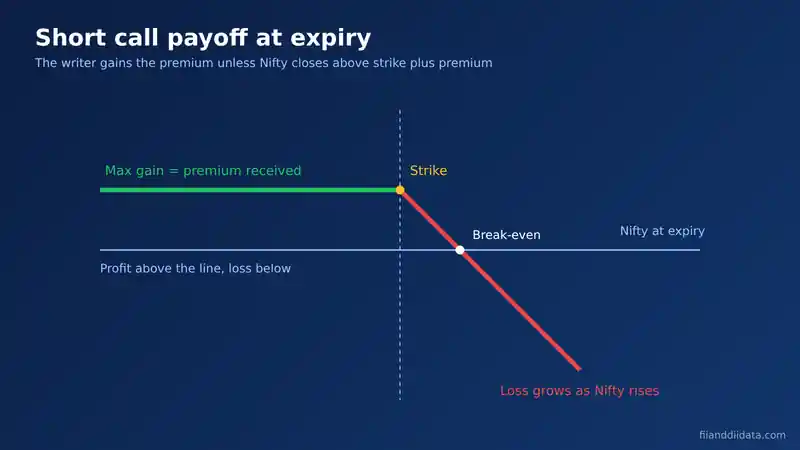
There are three outcomes at expiry. If the index finishes below the strike, the seller keeps the full premium. If it finishes between the strike and the break-even, the seller keeps part of the premium. Above the break-even, the loss grows point for point with the index.
That lopsided shape explains why call writers usually choose strikes well above the current index level. A far strike lowers the chance of being hit, and a higher volatility reading lifts the premium to compensate for the tail risk. Many institutions also sell calls against long futures or a stock portfolio. That covered structure turns the open-ended risk into a capped one, which is why a rising call short count does not always mean a bearish view.
Where to Find FII Call Short Data
NSE uploads the participant-wise open interest CSV after market close on each trading day, under the derivatives section of its reports page. Open the file, find the row labelled FII, and read four option columns: Option Index Call Long, Option Index Call Short, Option Index Put Long and Option Index Put Short. All values are in contracts.
The same row also carries index futures, so you can compare option activity with the futures book in one sitting. If you would rather skip the CSV, the FII options activity tracker on this site turns each daily file into a readable table.
One point of terminology matters. Short call open interest means contracts that FII have sold and not yet closed. It does not mean they are short the index. A seller of calls gains when the index falls or stays flat, but a seller of puts gains when the index rises or stays flat, so the two columns must be read together.
FII Index Options Open Interest, 9 Nov vs 13 Nov 2026
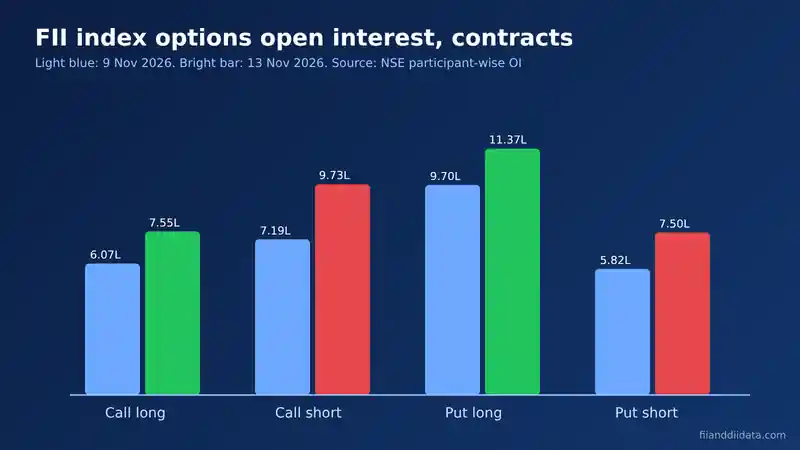
The table compares the FII index options book in the NSE files for 9 Nov and 13 Nov 2026. Figures are in lakh contracts.
| FII index options position | 9 Nov 2026 | 13 Nov 2026 | Change |
|---|---|---|---|
| Call long | 6.07 | 7.55 | +1.48 |
| Call short | 7.19 | 9.73 | +2.54 |
| Put long | 9.70 | 11.37 | +1.67 |
| Put short | 5.82 | 7.50 | +1.68 |
| Net call (long minus short) | -1.12 | -2.18 | -1.06 |
| Net put (long minus short) | +3.88 | +3.87 | -0.01 |
Call short rose by 2.54 lakh contracts, about 35 percent. Call long rose by 1.48 lakh, about 24 percent. Because sales grew faster than purchases, the net call position widened from minus 1.12 lakh to minus 2.18 lakh. On the put side, both legs rose by almost the same amount (1.67 and 1.68 lakh), so the net put position stayed close to plus 3.87 lakh.
Put long exceeds put short, and call short exceeds call long. In plain terms, FII were net buyers of puts and net sellers of calls: protection below, premium collection above. That pairing is often described as a cautious or range-bound lean, although the file alone cannot confirm intent.
The put call ratio is the quick way to compress these four numbers into one reading, but it hides which leg moved. Here the call short leg did most of the work, which a single ratio would blur.
Worked Example From the 13 Nov File
Take the same two files and work through them in four steps.
- Net call position. Call long 7.55 lakh minus call short 9.73 lakh gives -2.18 lakh. FII are net short calls.
- Short to long ratio. 9.73 divided by 7.55 gives 1.29 on 13 Nov. On 9 Nov it was 7.19 divided by 6.07, or 1.18. The ratio rose, so selling outpaced buying.
- Change in call short. 9.73 minus 7.19 gives 2.54 lakh, which is 35.3% of the 9 Nov level.
- Compare with puts. Put short rose 1.68 lakh on a base of 5.82 lakh, or 28.9%. Call writing grew faster than put writing.
The reading: FII added call sales faster than they added anything else. That fits sellers building capped-upside positions better than it fits fresh bullish buying.
To see what one such contract means in rupees, use a hypothetical case that is not from NSE data. Suppose the index is at 24,000 and a seller writes the 24,500 call for a premium of 80 points. The break-even is 24,580. If the index expires at 24,300, the seller keeps all 80 points. If it expires at 24,700, the call is 200 points in the money, so the net loss is 200 minus 80, or 120 points per unit.
Five Step Checklist
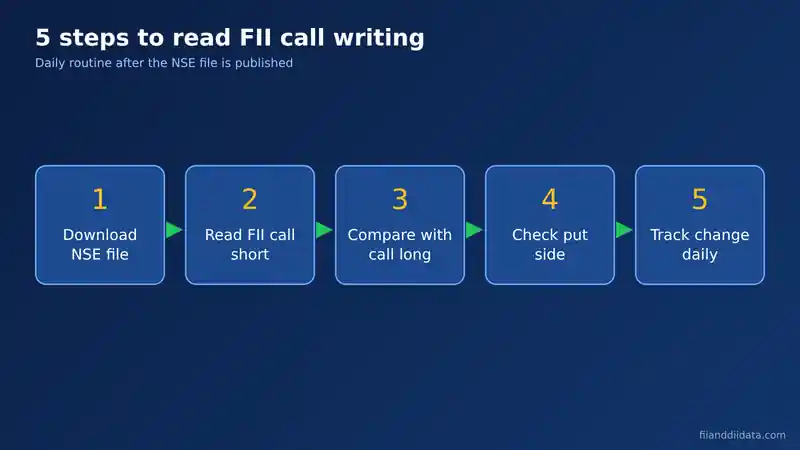
Use this routine each evening after the NSE file appears. It takes a few minutes once you know the columns.
- Download the NSE file. Pick the latest participant-wise open interest CSV and note its date.
- Read FII call short. Record the Option Index Call Short value for the FII row.
- Compare with call long. Subtract short from long to get the net call position.
- Check the put side. Do the same for puts so you know whether calls moved alone or with puts.
- Track the change daily. The day to day change tells you more than a single day’s level.
What the Number Cannot Tell You
Open interest is a snapshot of positions, and it leaves out the reason for each one. Four limits are worth keeping in mind.
- Hedge or bet. A short call can sit beside long futures as a covered call. The file shows the call but does not link it to the hedge, so you cannot tell which it is.
- No strike or expiry. The file adds up all strikes and all expiries. A rise of 2.54 lakh could be one far strike or many near ones, and the file will not say.
- Rollovers distort changes. Around expiry, positions are closed and reopened in the next series, which can make the daily change look larger than the real shift in view.
- Every seller has a buyer. Each call FII sell is bought by someone else. The pro vs client open interest view shows which group is on the other side.
It also helps to compare options with futures. The piece on index futures vs index options shows how the same group can be long in one and hedged in the other. Treat call short open interest as context for a view you built elsewhere, not as a signal on its own.
Frequently Asked Questions
What does FII call writing mean?
It means foreign portfolio investors sell index call options and receive the premium. They keep it if the index stays at or below the strike at expiry, and they pay out if it finishes above the strike plus premium.
Is FII call writing bearish?
Not always. Call writing profits when the index stays flat or falls, so it leans bearish or range-bound, but institutions also sell calls as a covered hedge against long positions. The NSE file cannot separate the two.
Where can I find FII call short data?
NSE publishes the participant-wise open interest CSV after market close on its derivatives reports page. Read the Option Index Call Short column in the FII row. This site also converts each file into a daily table.
How often is the data updated?
NSE publishes one file per trading day after the market closes, so the figures reflect the previous session. Holidays and weekends have no new file.
Can FII call writing predict where the market goes?
No. Open interest shows positions held, not the reason or the outcome. Use it with price action, futures positioning and the put side before forming a view, and never as a standalone trade signal.
The Bottom Line
Between 9 Nov and 13 Nov 2026, FII call short open interest rose from 7.19 lakh to 9.73 lakh contracts while the net put position barely moved. The shift was in calls, and it was larger than the rise in call buying. That is worth noting, but it is a snapshot of positions, not a forecast. Read it next to the put side, the futures book and the index itself, and revisit it each day when the next NSE file arrives. For the wider picture, start from our main page on FII and DII data.
Sources: NSE participant-wise open interest files for 9 Nov and 13 Nov 2026, from the NSE derivatives reports page. Regulatory context for foreign portfolio investors: SEBI.
Disclaimer: This article is for education only and is not investment advice. Check the official NSE files before you act, and consult a registered adviser for decisions about your money.