What does FII buying mean? It means foreign institutional investors bought more Indian shares than they sold, so their net figure is positive. On 11 November 2026, for example, FIIs bought ₹30,087 crore of shares and sold ₹17,524 crore, a net purchase of ₹12,563 crore in provisional exchange data. This guide shows how that number is built, who sold to the FIIs, and how to read it without overreacting.
Key Takeaways
- FII buying means gross purchases by foreign institutions were larger than their gross sales, so the net figure is positive.
- FIIs buy and sell every day. On 11 November 2026 they bought ₹30,087 crore and sold ₹17,524 crore, a net purchase of ₹12,563 crore.
- Every share an FII buys comes from another seller. On that day DIIs were net sellers of ₹8,435 crore.
- FIIs were net buyers in all seven sessions from 2 to 11 November 2026, adding up to ₹65,736 crore in provisional cash data.
- Read FII buying together with DII flows, the size of the move, the streak and F&O positions, not as a stand-alone buy signal.
Table of contents
- What does FII buying mean? The short answer
- Gross buy, gross sell and net: how FII buying is calculated
- If FIIs buy, who sells?
- What does FII buying mean in real numbers? 2 to 11 November 2026
- Why FIIs buy and what FII buying means for the market
- How to read FII buying data: a 6-point checklist
- Common mistakes investors make
- FAQs
- The Bottom Line
What Does FII Buying Mean? The Short Answer
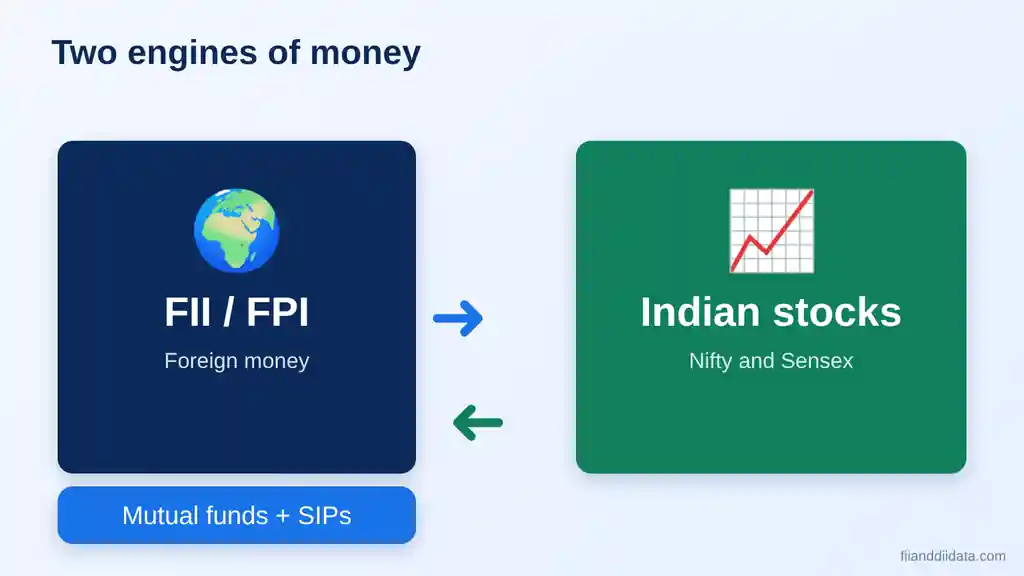
A foreign institutional investor (FII) is a fund based outside India that invests in Indian shares and bonds. Pension funds, sovereign wealth funds, hedge funds and global mutual funds all belong to this group. SEBI now registers them as foreign portfolio investors (FPIs), but market reports still use both names for the same set of investors.
What does FII buying mean in plain words?
When a headline says “FIIs bought ₹5,000 crore today”, it does not mean foreign funds only bought. It means that after adding up every purchase and every sale they made that day, purchases were ₹5,000 crore higher. FIIs are then called net buyers. If sales are higher, they are net sellers, which we explain in our guide on what FII selling means.
Three points follow. First, FII buying is always a net number. Second, it can cover a day, a week, a month or a year. Third, it usually refers to the cash market, where shares actually change hands, unless the report says futures or options.
Cash market buying vs F&O buying
Buying in futures and options (F&O) works differently. If an FII buys Nifty futures, it may expect a rise, or it may be closing an earlier short position. No shares change owners, and the position can be closed within days.
| Point | Cash market buying | F&O buying |
|---|---|---|
| What changes | Ownership of shares | A contract position (long or short) |
| Money enters India? | Yes, dollars are converted to rupees | Not necessarily |
| Typical purpose | Add exposure, invest new money | Take a view, hedge or cover shorts |
| Where to track | Daily cash FII/DII figures | Participant wise open interest |
We track the cash side on our FII DII data today page and the derivatives side on the participant wise open interest page. Next, the arithmetic behind the headline number.
Gross Buy, Gross Sell and Net: How FII Buying Is Calculated
After market close, the exchanges publish three numbers for FIIs: gross purchase, gross sale and net value. The formula is simple:
Net FII flow = Gross buy value – Gross sell value
A worked example
Imagine one global fund on one trading day. It buys ₹1,400 crore of bank shares because it likes their valuations. On the same day it sells ₹500 crore of IT shares to trim that sector. Its net figure is ₹1,400 crore minus ₹500 crore, which is +₹900 crore. The data counts this fund as a net buyer of ₹900 crore, even though it also sold.
Now scale that up to hundreds of foreign funds, each with its own reasons. The daily FII number is the sum of all those decisions. Here is the real picture for 11 November 2026.
| 11 November 2026 | Gross buy (₹ crore) | Gross sell (₹ crore) | Net (₹ crore) |
|---|---|---|---|
| FII / FPI | 30,087 | 17,524 | +12,563 |
| DII | -8,435 |
Two things stand out. FIIs still sold over ₹17,500 crore of shares, so plenty of money moved out even on a strong buying day. And their purchases were about 1.7 times their sales. Of the ₹47,611 crore they traded in total, the net purchase was about 26%. That share is a quick way to judge how one-sided a day was.

Every purchase needs a seller, so the next question is who sat on the other side of that trade.
If FIIs Buy, Who Sells?
A stock exchange only matches trades. For every share bought there is exactly one share sold. So when FIIs are net buyers of ₹12,563 crore, other investors must be net sellers of the same ₹12,563 crore.
On 11 November 2026, domestic institutional investors (DIIs) such as mutual funds, insurers, banks and pension funds were net sellers of ₹8,435 crore. That covers about two thirds of the FII purchase. The remaining gap of roughly ₹4,128 crore came from retail investors, wealthy individuals, brokers’ proprietary desks and other participants.
Why would domestic funds sell? Often they book profit after a rally, or they trim positions to meet redemptions. A seller needs a willing buyer at the right price, and in early November foreign funds were that buyer. When both big institutional groups move in opposite directions, the net of the two is a useful clue, which we use in the checklist below.
What Does FII Buying Mean in Real Numbers? 2 to 11 November 2026
Foreign money returned in a hurry. After heavy selling in October, FIIs were net buyers in every session of the first half of November. Provisional exchange data shows a total net purchase of ₹65,736 crore over the seven sessions below, while DIIs were net sellers on all seven days.
| Date (2026) | FII net (₹ crore) | DII net (₹ crore) | FII + DII (₹ crore) |
|---|---|---|---|
| Mon, 2 Nov | +3,115 | -392 | +2,723 |
| Tue, 3 Nov | +6,837 | -3,679 | +3,158 |
| Wed, 4 Nov | +7,284 | -3,712 | +3,572 |
| Thu, 5 Nov | +14,975 | -10,445 | +4,530 |
| Fri, 6 Nov | +13,750 | -5,969 | +7,781 |
| Mon, 9 Nov | +7,212 | -7,173 | +39 |
| Wed, 11 Nov | +12,563 | -8,435 | +4,128 |
| Total | +65,736 | -39,805 | +25,931 |
Business Standard reported on 9 November 2026, citing a Choice Wealth note, that 5 November saw the biggest single-day FPI net purchase in nearly six years in provisional NSE data. Depository figures, which include primary market deals, tell a similar story with different numbers: PTI reported on 1 November that FPIs sold a net ₹34,843 crore of equities in October, and the Choice Wealth note put the first week of November at a net purchase of ₹38,971 crore. To see why the two sources differ, read our explainer on why NSE and NSDL FII figures differ.
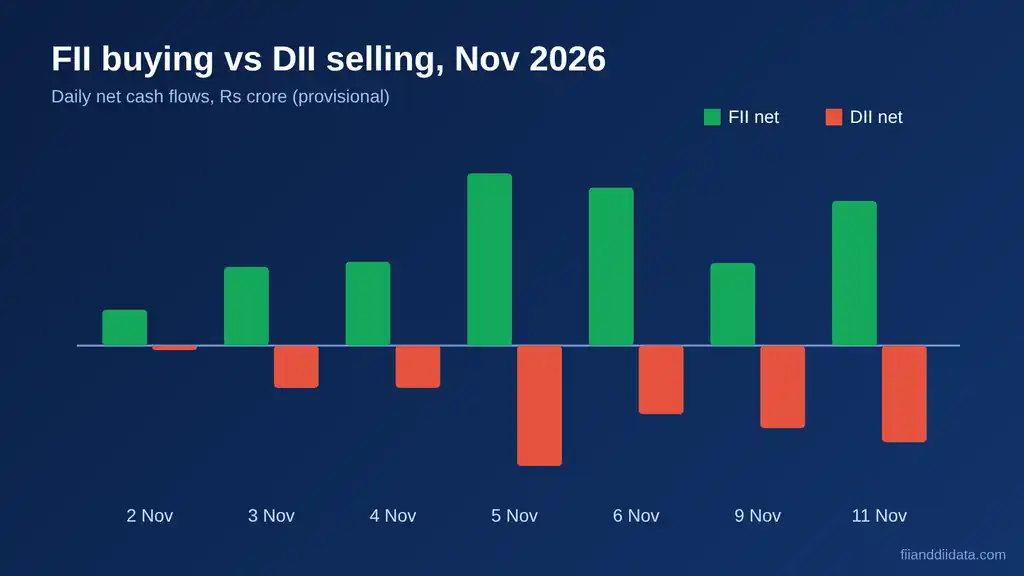
The FII + DII column adds a second lesson. Even with DIIs selling, the two groups together were net buyers on every day, though on 9 November the combined figure was only ₹39 crore. We keep the running tally on our FII buying in November 2026 page. But why did foreign funds come back?
Why FIIs Buy and What FII Buying Means for the Market
Foreign funds manage money across many countries, so their reasons are often global as well as Indian. Common triggers include:
- Falling crude oil: India imports most of its oil, so cheaper crude helps inflation, the current account and the rupee.
- A steadier rupee: a stronger rupee lifts the dollar value of Indian returns.
- Cheaper valuations: after a weak year, Indian stocks can look inexpensive to global funds.
- Rotation from other themes: money leaving crowded global trades looks for markets with a different story.
- Stable US yields: when US bond yields stop rising, emerging markets lose less to dollar assets.
For early November 2026, Choice Wealth’s Dheeraj Gaur, quoted by Business Standard on 9 November, pointed to the US midterm results, which raised the odds of de-escalation in the US-Iran conflict and pulled oil down. Brent fell about 13% in the week, and the rupee strengthened to about ₹93.90 per dollar from about ₹95.40 a week earlier. He also cited global funds rotating out of AI-linked stocks, cheap Indian valuations and steady earnings. These are the brokerage’s views, and the same note warned that Iran talks could reverse the oil move.
What does it mean for the market? Sustained FII buying usually supports large caps, especially banks, because foreign funds own large stakes in them. It can also support the rupee as dollars come in. Our guide to how FII flows move the stock market explains the channels. But buying alone does not guarantee a rally, which is why a routine helps.
How to Read FII Buying Data: A 6-Point Checklist
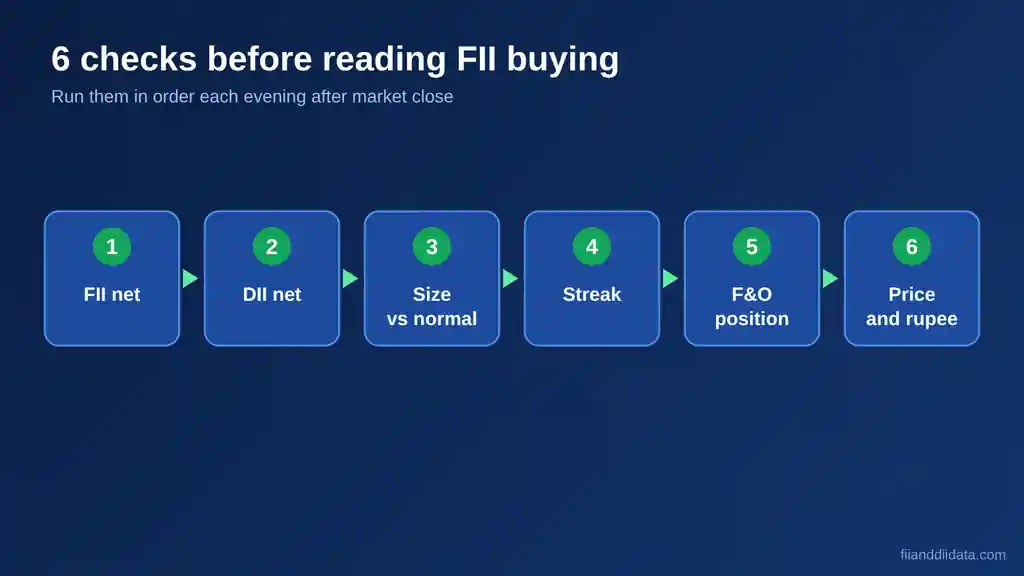
NSE publishes provisional FII and DII cash figures after market close, usually around 6 PM IST on trading days. NSDL publishes final FPI data the next working day. You can see the official release on the NSE FII/DII reports page, or follow the tables on our FII and DII data home page. Each evening, run these six checks in order:
- FII net: is it positive, and how large? On 11 November it was +₹12,563 crore.
- DII net: add it to the FII figure. A positive total, like +₹4,128 crore on 11 November, means institutions as a group still added money.
- Size versus normal: the seven-session average in our table is about ₹9,391 crore a day, so ₹12,563 crore was roughly 1.3 times normal.
- Streak: seven positive sessions say more than one big day, which may be a block deal or an index rebalancing.
- F&O position: check whether FIIs are buying index futures or covering shorts, or hedging cash purchases.
- Price and rupee: if FIIs buy and the Nifty and rupee both rise, the buying is working. If prices still fall, sellers are heavier.
For the longer view, our FII DII monthly data page shows how each month adds up. Even with this routine, a few habits trip up investors again and again.
Common Mistakes Investors Make
- Thinking FIIs only bought. Net buying hides large gross selling. On 11 November FIIs still sold ₹17,524 crore.
- Treating FII buying as a buy signal for every stock. Foreign funds may buy banks while selling other sectors on the same day.
- Ignoring DII flows. In the seven sessions above, DIIs sold ₹39,805 crore. Looking at FIIs alone gives half the picture.
- Mixing provisional and final data. Exchange and NSDL figures measure different things and can differ by thousands of crores.
- Assuming the streak will last. October’s selling reversed within days, and November’s buying can reverse too.
- Confusing F&O longs with cash buying. Buying index futures does not bring fresh money into shares.
Avoiding these mistakes turns the daily FII number into useful context. The questions below cover what readers ask most.
FAQs
What does FII buying mean in the share market?
It means foreign institutional investors bought more Indian shares than they sold over a period, so their net figure is positive. For example, on 11 November 2026 FIIs bought ₹30,087 crore and sold ₹17,524 crore, making them net buyers of ₹12,563 crore in provisional data.
Is FII buying good for the market?
Often yes, but not always. Sustained FII buying tends to support large caps and the rupee. The impact still depends on who sells and on global factors such as oil and US yields, so it should be read with DII flows and price action.
What happens when FIIs buy and DIIs sell?
Shares move from domestic to foreign owners. From 2 to 11 November 2026, FIIs bought a net ₹65,736 crore while DIIs sold a net ₹39,805 crore, so the two groups together were still net buyers.
What does FII net buyer mean?
A net buyer is an investor group whose total purchases are larger than its total sales in a period. FIIs can sell thousands of crores of shares in a day and still be net buyers if they buy even more.
When is FII buying data released?
NSE releases provisional FII and DII cash market data after market close, usually around 6 PM IST on trading days. NSDL publishes final FPI figures, which also include primary market deals, on the next working day.
The Bottom Line
FII buying means foreign funds bought more Indian shares than they sold over a period. It is a net figure built from heavy two-way trading, and every rupee of it is matched by a seller. Early November 2026 showed how fast it can turn: ₹65,736 crore of net buying in seven sessions, after a month of net selling.
The practical step is to check FII net, DII net, the size versus normal and F&O positions together each evening, and to act on streaks, not single days. Come back after 6 PM IST on trading days for the latest provisional figures.
Sources: Business Standard, Choice Wealth explains FPI buying, 9 November 2026; Business Standard (PTI), 1 November 2026; Quantsapp FII DII data; StockPil, FII vs DII this week (2 to 6 November 2026); Kotak Neo, 8 November 2026; NSE provisional FII/DII data.
Disclaimer: This article is for educational purposes only and is not investment advice. Please consult a SEBI-registered advisor before making investment decisions.