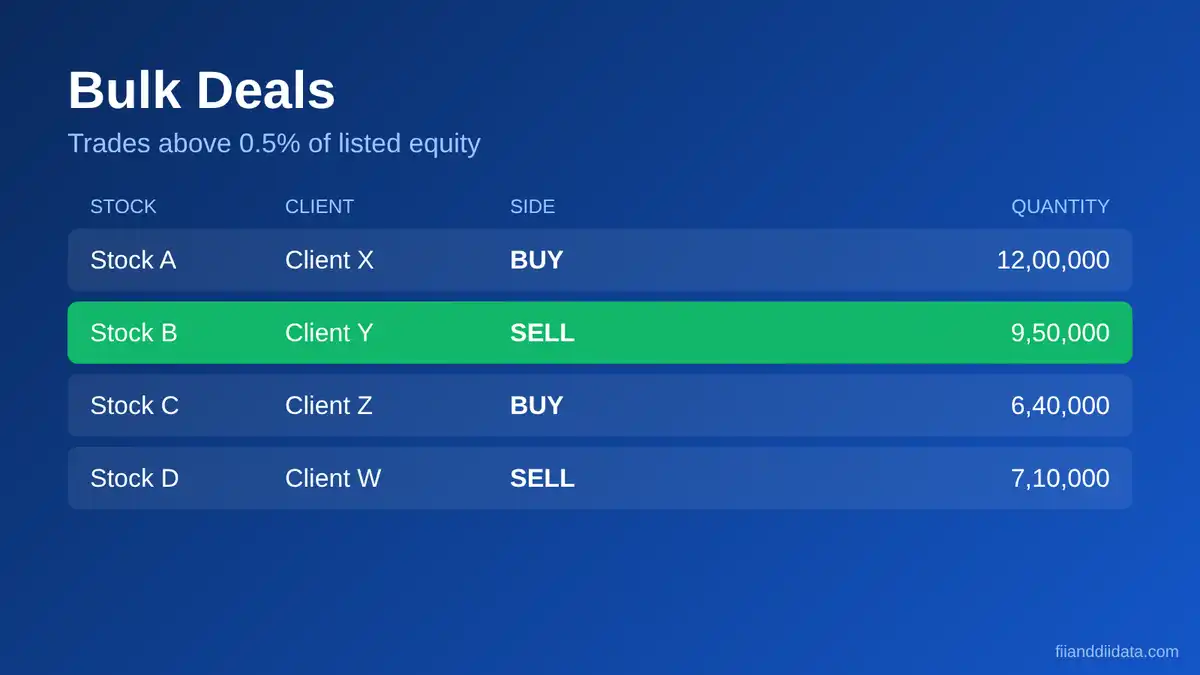
Bulk deal meaning: a bulk deal is a trade in a single stock where one client buys or sells more than 0.5% of the company’s listed equity shares in a day. Exchanges publish the client name, side, quantity and average price after market hours. This guide explains the rule, where to find the data, and how to read bulk deals alongside FII and DII flows, with a worked example.
Key Takeaways
- A bulk deal is a single-client trade above 0.5% of a company’s listed equity shares in one trading day.
- The rule comes from a SEBI circular dated 14 January 2004, and exchanges disseminate the data the same day after market hours.
- A bulk deal shows who traded one stock. FII and DII net data shows total institutional flow across the market. The two answer different questions.
- A bulk deal can be a buy or a sell, and the name of the client does not make it a signal on its own.
- Check side, size against equity, size against volume and the next three sessions before drawing any view.
- Bulk Deal Meaning in Simple Words
- The 0.5% Rule Behind a Bulk Deal
- Where to Find Bulk Deal Data
- Worked Example: What 0.5% Looks Like
- Bulk Deal vs Block Deal
- Why FII and DII Bulk Deals Matter
- Bulk Deal Meaning in Practice: Five Checks
- FAQs
- The Bottom Line
Bulk Deal Meaning in Simple Words
Every day, thousands of clients trade on NSE and BSE. Most trades are small and nobody notices them. A bulk deal is the exception: one client trades so many shares of one company that the quantity crosses a size threshold, and the market is told about it.
The definition has three parts. The trade is in a single scrip. The client is a single entity, counted across all its orders for the day. The total bought or sold is more than 0.5% of the number of equity shares listed on the exchange. When all three are true, the broker reports it and the exchange publishes it.
The purpose is transparency. Large trades can move a price, and other investors are entitled to know who is behind the volume. That is why bulk deals sit next to the daily FII and DII data as a stock-level view of what institutions and large investors are doing.
The 0.5% Rule Behind a Bulk Deal
The rule comes from SEBI circular SEBI/MRD/SE/Cir-7/2004, issued on 14 January 2004. It says that when the total quantity of shares bought or sold in a scrip is more than 0.5% of the listed equity, the trading member must disclose the details to the exchange immediately after execution. The exchange then disseminates the information to the public on the same trading day, after market hours.
Two points often get missed. First, the 0.5% is measured against listed equity shares, not against that day’s traded volume. A stock with thin trading can see a bulk deal that is a large share of the day’s volume, while a heavily traded stock may need a very big order to qualify. Second, the quantity is aggregated. Ten smaller orders by the same client that add up to more than 0.5% count as a bulk deal, even if no single order does.
Where to Find Bulk Deal Data
Both exchanges publish bulk deals on their websites. NSE has a report titled Bulk Deals, Block Deals and Short Selling, where you can download a CSV and filter from one day up to one year. The columns are date, symbol, client name, buy or sell, quantity and weighted average trade price. BSE has its own Bulk Deals and Block Deals pages and an archive for older dates.
A deal can appear on one exchange and not the other, because the 0.5% test applies to trades on that exchange. BSE entries can also be corrected after publication. If a figure matters to you, check both sources before using it. The broader daily institutional picture is on the FII DII data today page, which is updated from NSE provisional numbers that arrive around 6 PM IST, while NSDL final data follows on the next working day.
Worked Example: What 0.5% Looks Like
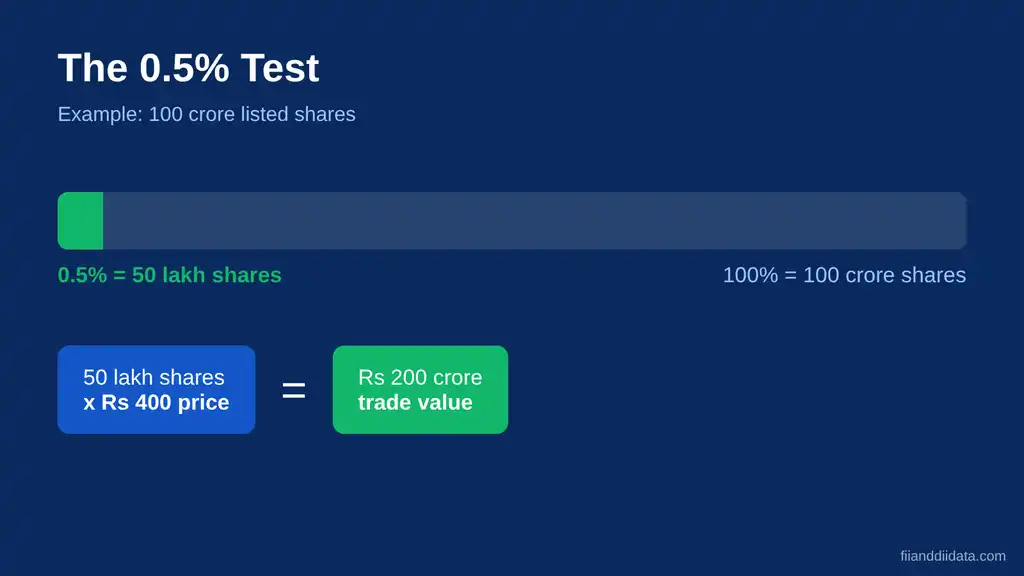
Take a hypothetical company with 100 crore listed equity shares. This is an illustration, not a real stock. The 0.5% threshold works out to 50 lakh shares. A client who buys more than 50 lakh shares in a day triggers the disclosure.
Now add a price. If the shares trade near Rs 400, then 50 lakh shares is a trade of about Rs 200 crore. If the same company traded at Rs 40, the same share count would be only Rs 20 crore. So the 0.5% rule is about share count, and the rupee size of a bulk deal changes with the price of the stock.
Suppose the day’s total volume in this hypothetical stock was 2 crore shares. A 60 lakh share purchase would be 30% of that day’s volume. That tells you the client was a major force in the session, which is a more useful fact than the headline quantity alone. Ratios like this are why the second and third checks later in this guide matter.
Bulk Deal vs Block Deal
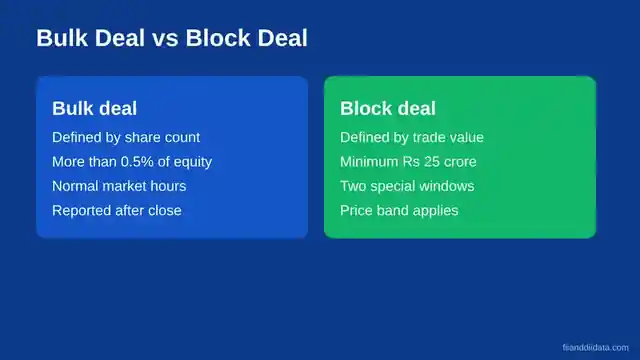
People mix up the two terms because both involve large quantities. They are different in how they are executed and in what triggers disclosure. A bulk deal happens in the normal market and is flagged because of its size. A block deal is a negotiated trade done in a separate window. For the full explanation of the second type, see our guide to block deal meaning.
| Feature | Bulk deal | Block deal |
|---|---|---|
| Trigger | More than 0.5% of listed equity in a day | Minimum order value of Rs 25 crore |
| Where it trades | Normal market session | Separate windows, 8:45 to 9:00 AM and 2:05 to 2:20 PM |
| Price control | Market price | Within 3% of the reference price |
| Disclosure | After market hours, same day | After market hours, same day |
Why FII and DII Bulk Deals Matter
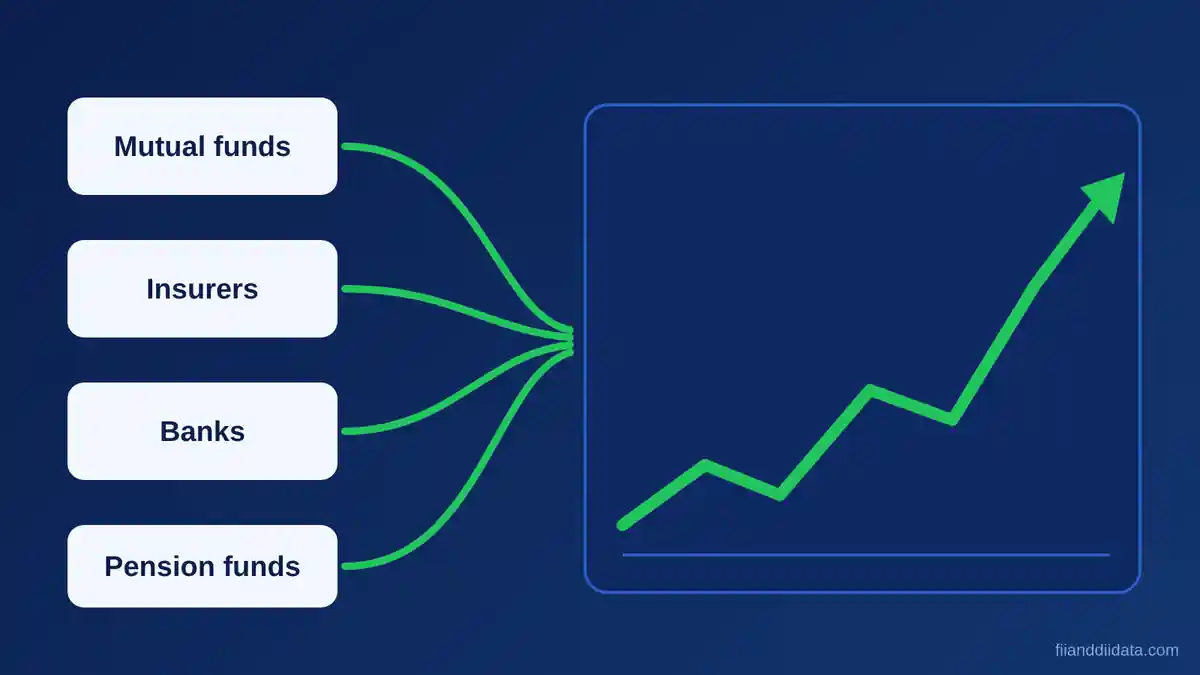
Foreign portfolio investors and domestic institutions are the biggest buyers and sellers in Indian stocks, so many bulk deals carry their names. When a mutual fund, insurer or foreign fund appears as the buyer in a mid-cap, it is a stock-level footprint of the flow you see in the daily totals.
It helps to keep the scale in mind. For the week ended 6 November 2026, Business Standard, citing Choice Wealth, reported that FPIs were net buyers of Rs 38,971 crore. A single bulk deal is a small slice of a number like that. Daily net figures sum every trade by a category, while a bulk deal shows one client in one stock. You can see how these totals build up month by month in the FII DII monthly data page.
Bulk deals also help with the idea of smart money. If a long-term fund keeps adding a stock over several sessions, the pattern says more than any one day. Pair that with the quarterly shareholding pattern to confirm whether the buying shows up in reported holdings. Remember that the client name may be a fund’s sub-account, not the parent, and that foreign flows can be routed through different entities. Our note on FII vs FPI explains why the labels differ.
Bulk Deal Meaning in Practice: Five Checks
A list of bulk deals is easy to misread. A short routine keeps the reading honest, and it works for any stock.
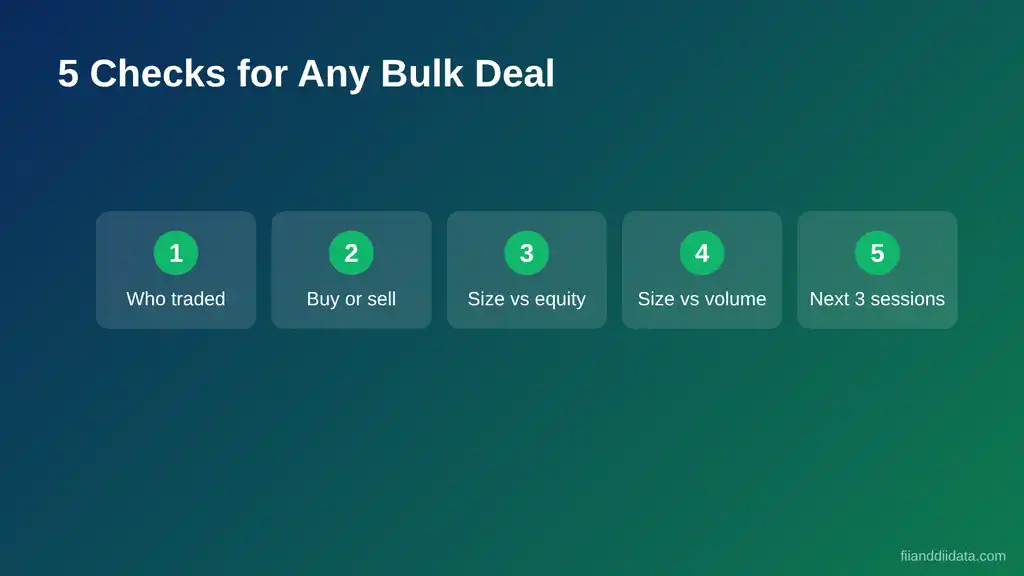
The five checks for any bulk deal meaning
First, who traded. A known institution is different from an unfamiliar trading firm. Second, buy or sell, because the same name can appear on both sides. Third, size against listed equity, which tells you how big the stake change is. Fourth, size against that day’s volume, which tells you how much of the session the client drove. Fifth, watch the next three sessions. A deal followed by steady buying is different from one followed by a quick reversal.
Common mistakes to avoid
The first mistake is treating every bulk deal as a buy signal. Many are sales. The second is ignoring that the same client may buy and sell the same stock on the same day, which nets out to little. The third is reading a bulk deal as proof of a trend in the whole market. For that, use the broader flow data, including the participant-wise open interest view for derivatives positioning. Bulk deals are one input and never a trading rule.
FAQs
What is the bulk deal meaning in the stock market?
A bulk deal is a trade where one client buys or sells more than 0.5% of a company’s listed equity shares in a single day. The exchange publishes the details after market hours.
What is the limit for a bulk deal in India?
The limit is more than 0.5% of the listed equity shares of the company, counted for one client across all orders in a day, as set by SEBI circular SEBI/MRD/SE/Cir-7/2004.
Are bulk deals the same as FII buying?
No. Bulk deals show one client in one stock. FII data is the net total of a whole category across the market. An FII can appear in a bulk deal, but the two datasets measure different things.
When is bulk deal data published?
Brokers disclose the trade to the exchange immediately, and the exchange makes it public the same trading day after market hours. NSE and BSE both publish it on their websites.
Is a bulk deal a buy signal?
Not by itself. A bulk deal can be a sale, and size, side and follow-up trading matter more than the name of the client.
The Bottom Line
Bulk deal meaning comes down to one rule: more than 0.5% of a company’s listed equity, traded by one client in one day, gets disclosed. The data is public, free and published the same day. Used with the daily FII and DII data and the monthly totals, it adds stock-level detail to the institutional picture. Read the side, the size and the follow-up, and treat each deal as context rather than a call to act. You can find more explainers in the FII DII blog.
Sources
- SEBI circular SEBI/MRD/SE/Cir-7/2004, 14 January 2004, published at sebi.gov.in
- Bulk Deals, Block Deals and Short Selling report, NSE India, checked 11 November 2026
- Bulk Deals and Block Deals pages, BSE India, checked 11 November 2026
- FPI weekly flow of Rs 38,971 crore, Business Standard, 9 November 2026 (Choice Wealth)
This article is for educational purposes only and is not investment advice. Please consult a SEBI-registered advisor before making investment decisions.