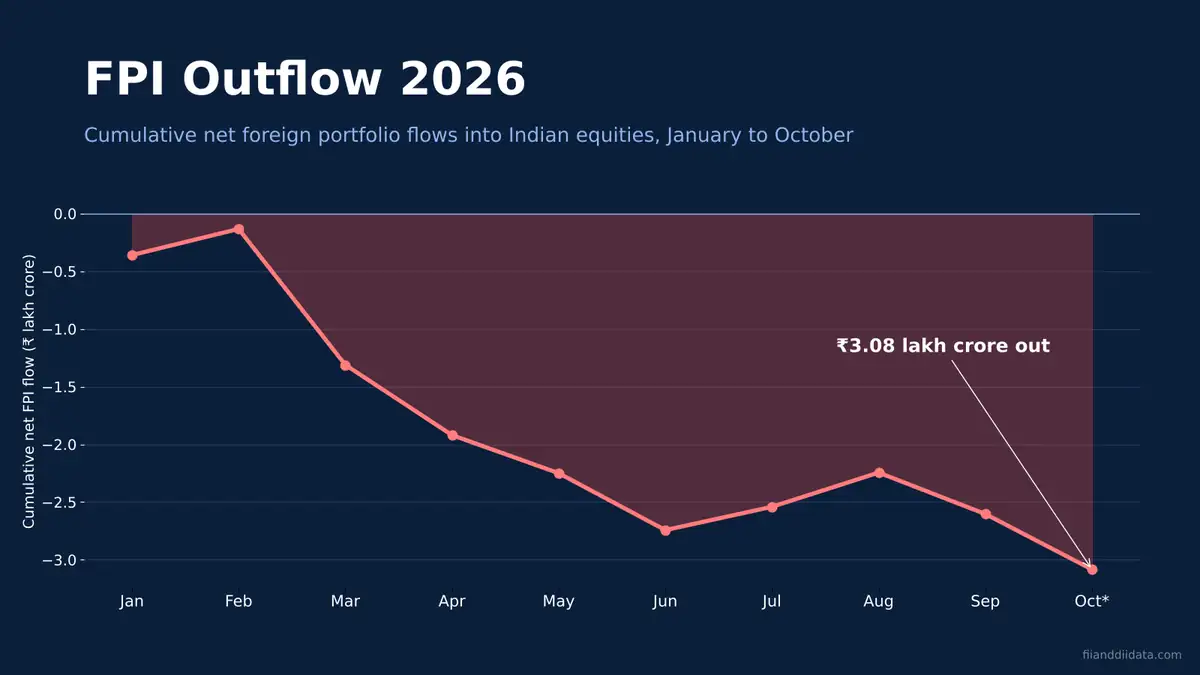
Quick answer: FIIs are selling Indian stocks in October 2026 because high US bond yields and the global AI chip rally are pulling money away from India, crude oil near $100 a barrel is pushing up inflation, the RBI has started raising rates again, and the rupee keeps weakening. Foreign investors have now pulled a record ₹3.08 lakh crore out of Indian equities in 2026, almost double the full-year 2025 outflow. DIIs have bought nearly every rupee FIIs sold, which is why the Nifty has fallen about 7.5% instead of crashing.
If you track FII DII data every evening, October 2026 has looked the same almost every day: a big red number for FIIs and a big green number for DIIs. This FII DII data analysis breaks down how much FIIs have sold, the seven reasons behind the selling, which sectors are being hit, and what the institutional flow data is signalling for the Nifty from here.
How Much Have FIIs Sold in October 2026?
The selling in October has been the heaviest of the year. Here are the key numbers from exchange and NSDL data:
| Metric | Figure | Period |
| FII net selling (exchange cash data) | -₹45,934 crore | First 12 sessions of October |
| DII net buying (exchange cash data) | +₹47,895 crore | First 12 sessions of October |
| FPI net outflow (NSDL) | -₹47,417 crore | 1 to 12 October |
| FPI net outflow (NSDL) | -₹35,861 crore | September 2026 |
| FPI net inflow (NSDL) | +₹29,628 crore | August 2026 |
| FPI net outflow, 2026 so far | -₹3.08 lakh crore | 1 January to 12 October |
| FPI net outflow, full year 2025 | -₹1.66 lakh crore | Calendar 2025 |
By the week ending 9 October, FIIs had been net sellers for eight weeks in a row, dumping ₹30,294 crore that week alone. Over those eight weeks the Nifty 50 slid from 24,366 to 22,520, a fall of 7.57%.
Why do the numbers differ between sources?
The daily FII figure NSE publishes in the evening (usually around 6 PM IST) is provisional cash-market data. NSDL’s FPI figure is the final settled number and also includes money FPIs put into IPOs and other primary market deals. That is why one October figure says ₹45,934 crore and another says ₹47,417 crore. Both point to the same trend. Use the exchange data for daily signals and NSDL data for monthly and yearly totals.
7 Reasons Why FIIs Are Dumping Indian Stocks
1. US Bond Yields Are Too Attractive to Ignore
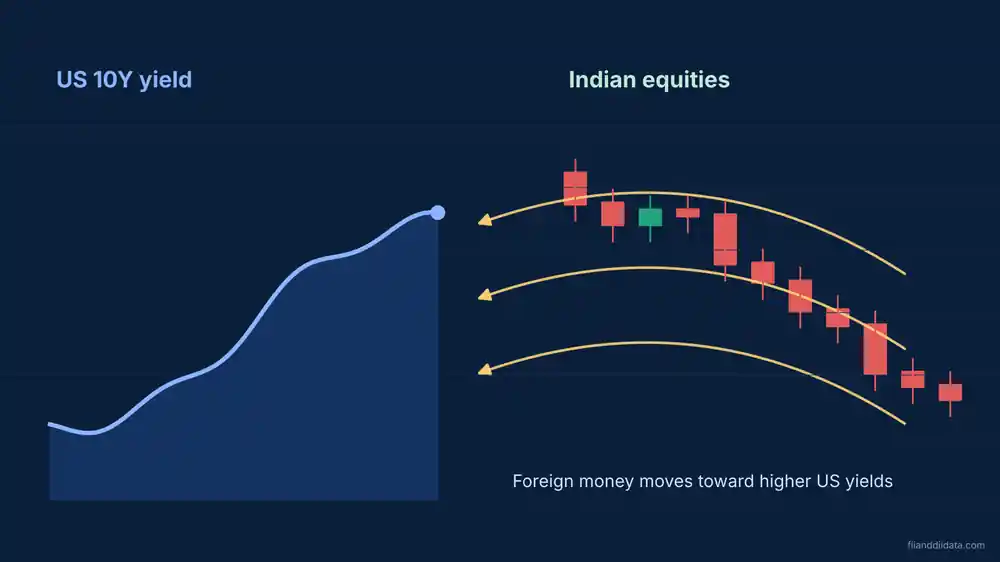
When a global fund manager can earn a high, near risk-free return on US Treasuries in dollars, the case for holding volatile emerging market stocks gets weaker. Elevated US yields have been one of the biggest drivers of foreign outflows in 2026. The gap between Indian and US 10-year bond yields is now only about 230 basis points, and that thin cushion barely covers the rupee’s fall against the dollar.
2. The Global AI and Semiconductor Trade
Global money is chasing artificial intelligence and chip stocks in the US, Taiwan and South Korea. India has very few listed companies that directly benefit from the AI hardware boom, so when funds rebalance towards these markets, India becomes a source of cash. This is a rotation out of India, not a judgement that India’s economy is weak.
3. Crude Oil Near $100 a Barrel
India imports roughly 90% of the crude oil it uses. With Brent crude hovering close to $100, India’s import bill rises, the trade deficit widens and inflation goes up. Foreign investors treat high oil prices as a direct negative for India, and that shows up quickly in FII DII data.
4. The RBI Has Started Hiking Rates
On 7 October 2026, the RBI’s Monetary Policy Committee raised the repo rate by 25 basis points to 5.50% and changed its stance to “calibrated tightening”. CPI inflation rose to 4.8% in August, and the RBI now projects inflation at 6.0% for the October to December quarter. Rising rates mean costlier loans for companies and consumers, which hurts the earnings outlook. Markets are also pricing in the possibility of another hike in December.
5. A Weakening Rupee
The rupee has lost about 3.45% against the dollar over the past year. For a foreign investor, a falling rupee eats directly into returns. If a stock is flat in rupee terms but the rupee falls 3.5%, the FII has lost 3.5% in dollar terms. Selling also pushes the rupee lower, because FIIs convert their rupees back to dollars when they exit. This creates a cycle that can feed on itself.
6. Expensive Valuations
Indian stocks have traded at a premium to other emerging markets for years. That premium was easy to justify when growth was strong and rates were falling. With rates now rising and earnings growth slowing, many global funds see better value elsewhere and are trimming their India weight.
7. Mixed Q2 FY27 Earnings
The September quarter results season has been uneven. IT and hospitality companies have reported strong numbers, but banks are facing margin pressure and consumer goods companies are struggling with weak rural demand after a poor monsoon. Without broad-based earnings upgrades, foreign investors have little reason to buy.
Which Sectors Are FIIs Selling?
The selling is broad-based. In the first half of October, FPIs were net sellers in 18 of the 23 sectors tracked by NSDL. Here is the sector-wise picture:
| Sector | FPI Net Flow ($ million) | Main Concern |
| Banking and Financials (BFSI) | -908 | Margin pressure, costly deposits |
| FMCG | -860 | Weak rural demand, poor monsoon |
| Automobiles | -687 | Higher fuel costs, rate hikes |
| Healthcare | -578 | US regulatory risk, stretched valuations |
| Telecom | -413 | Profit booking |
| Capital Goods | -409 | High valuations |
| IT | +273 | Strong results, weak rupee helps exporters |
Banking stands out. In September, financial services alone saw FPI outflows of ₹13,147 crore, roughly six times the sector’s long-term monthly average. Because banks have the biggest weight in the Nifty and Bank Nifty, heavy FII selling in this one sector drags the whole index down.
IT is the only major sector where FPIs are buying. A weaker rupee boosts the earnings of exporters who bill in dollars, and IT companies reported strong Q2 numbers.
How DIIs Are Saving the Market
Here is the part that makes 2026 different from past sell-offs. In October’s first 12 sessions, DIIs bought ₹47,895 crore, which is slightly more than the ₹45,934 crore FIIs sold. In the week ending 9 October, DIIs bought ₹30,313 crore against FII selling of ₹30,294 crore, almost a perfect match.
Across 2026, DIIs have invested ₹6.83 lakh crore in Indian equities. That money comes from monthly SIPs, insurance premiums and pension contributions, which keep flowing in regardless of what global funds do. This is why a record year of foreign selling has produced a correction of around 7.5% rather than a crash. You can read more about this tug of war in our guide on the difference between FII and DII.
Perspective: FPI equity holdings in India stood at about $694 billion in mid-October, nearly 27% below their September 2024 peak. Foreign ownership of Indian stocks is steadily shifting into domestic hands. Over the long term this makes the market less dependent on global money, but in the short term it means FII flows can still drive sharp daily swings.
Is the FII Selling Ending? Signs to Watch
On 21 October 2026, provisional data showed both FIIs and DIIs as net buyers in the cash market, with FIIs buying roughly ₹1,000 to ₹1,200 crore depending on the data set. That is a welcome change, but one green day does not reverse eight weeks of selling. Here is what to watch in the FII DII data over the coming weeks:
- 5 to 7 days of FII buying in a row: A single day means little. A streak of consistent net buying in the FII DII cash market daily summary would be the first real sign of a turn.
- FII positions in index futures: Check the participant wise open interest data. If FIIs start covering their short positions in Nifty futures, the selling pressure is easing.
- FII options activity: Rising FII put writing on the FII options activity tracker often shows big players expect a floor.
- Crude oil and the rupee: A fall in Brent below $90 or a stable rupee would remove two of the biggest reasons for selling.
- US bond yields: Any meaningful drop in US yields would make emerging markets like India attractive again.
- RBI’s December policy: If inflation cools and the RBI pauses, the earnings outlook improves.
What Should Retail Traders Do?
- Do not fight a strong FII trend: While FIIs are selling heavily and short in index futures, aggressive long positions in Nifty and Bank Nifty carry extra risk.
- Watch the size, not just the direction: If FII selling is larger than DII buying on a given day, the market usually falls even if DIIs are buying.
- Look where FIIs are buying: Sectors still getting foreign money, such as IT, tend to hold up better during broad sell-offs.
- Long-term investors can stay calm: FII selling waves have come and gone many times. In October 2024, FIIs sold over ₹1.13 lakh crore in the cash market in a single month, and the market eventually recovered. SIP investors are buying at lower prices during these phases.
Frequently Asked Questions (FAQs)
Why are FIIs selling Indian stocks in 2026?
FIIs are selling because high US bond yields and the global AI chip rally offer better opportunities elsewhere, crude oil near $100 is raising inflation, the RBI has hiked rates, the rupee is weakening, valuations are expensive and Q2 FY27 earnings are mixed.
How much have FIIs sold in 2026?
According to NSDL data, foreign portfolio investors pulled a record ₹3.08 lakh crore out of Indian equities between 1 January and 12 October 2026. That is almost double the ₹1.66 lakh crore outflow for the full year 2025.
Why is the market not crashing despite heavy FII selling?
DIIs have been buying almost every rupee FIIs sell. In the first 12 sessions of October, DIIs bought ₹47,895 crore while FIIs sold ₹45,934 crore. Steady SIP inflows give DIIs a large pool of money to deploy, which limits the fall.
Which sectors are FIIs selling the most?
In the first half of October 2026, FPIs sold the most in banking and financials, followed by FMCG, automobiles, healthcare, telecom and capital goods. IT was the only major sector with net FPI buying.
When will FIIs start buying again?
No one can predict the exact turn. Signs to watch include 5 to 7 straight days of FII net buying, FIIs covering short positions in index futures, a drop in US bond yields, crude oil falling below $90 and a stable rupee.
Conclusion
FIIs are dumping Indian stocks in October 2026 for global reasons as much as local ones: high US yields, the AI trade, costly crude, a weaker rupee and a central bank that has turned hawkish. The scale is historic, with ₹3.08 lakh crore already gone this year. But the other half of the story matters just as much. DIIs are absorbing the selling almost rupee for rupee, and that is keeping this a correction rather than a crash.
The turning point will show up in the institutional flow data before it shows up in the headlines. Track FII and DII activity every evening on the FII DII Data Dashboard, and watch for a sustained streak of FII buying backed by short covering in index futures.
Also Read:
What is FII and DII Data? Complete Guide
FII Long Short Ratio Explained
FII and DII Data F&O Activity
FII DII Cash Market Daily Summary
Data sources: NSDL FPI data (as reported by Business Standard), NSE and BSE provisional cash market data, RBI Monetary Policy Statement of 7 October 2026. Figures are as of 21 October 2026. Disclaimer: This article is for educational purposes only and is not investment advice. Please consult a SEBI-registered advisor before making investment decisions.