
FII options expiry is the day when foreign institutional investors’ index option contracts settle or roll, and it can change open interest sharply. Nifty’s weekly contracts expire today, Tuesday 17 November 2026, and the latest NSE participant-wise file (16 November) shows FIIs holding 11.41 lakh index put longs and 8.38 lakh put shorts. Here is how to read those numbers without mistaking expiry clean-up for a new market view. For daily context, see our FII and DII data hub.
Key Takeaways
- On 16 Nov 2026, FIIs held 8.19 lakh index call longs, 10.06 lakh call shorts, 11.41 lakh put longs and 8.38 lakh put shorts.
- FII index options open interest rose from 28.78 lakh contracts on 9 Nov to 38.04 lakh on 16 Nov, a gain of 32.2%.
- Net put position (long minus short) eased from +3.88 lakh to +3.03 lakh over the same week.
- Open interest drops on expiry day mostly because contracts expire, not because FIIs changed their view.
- The next NSE monthly expiry in November falls on Monday 23 Nov 2026, as 24 Nov is a market holiday.
Table of Contents
- What Is FII Options Expiry?
- November 2026 Expiry Dates at a Glance
- FII Options Open Interest Before This Expiry
- Why Open Interest Falls When Contracts Expire
- Worked Example: Reading an Expiry Drop
- Expiry Week Checklist for Traders
- Pros and Cons of Tracking FII Options Expiry
- Common Mistakes to Avoid
- FAQs
- The Bottom Line
What Is FII Options Expiry?
An index option is a contract that ends on a fixed date, called the expiry. On that date NSE settles the contract in cash against the closing index value, and the open position disappears from the books. FII options expiry therefore means the point when foreign portfolio investors’ call and put positions in index options either settle or are rolled into a later series.
NSE reports FII positions in four buckets for index options: call long, call short, put long and put short. The figures come from the participant-wise open interest file, which covers Client, DII, FII and Pro categories. If the format is new to you, read our explainer on participant-wise OI and then open the NSE participant-wise open interest data page for the daily numbers.
This article focuses on one question: what happens to those numbers around expiry, and how should you read them? For the call and put basics, our FII options data guide is the best starting point. It also explains why the long and short columns are never equal, since each contract has a buyer and a seller in different participant groups.
November 2026 Expiry Dates at a Glance
Expiry days in November 2026 do not all fall on the usual weekday. Two market holidays pushed expiries one day earlier, so check the calendar before you compare weeks.
| Date (2026) | Day | Contracts expiring | Note |
|---|---|---|---|
| 3 Nov | Tuesday | Nifty weekly | Regular expiry day |
| 9 Nov | Monday | Nifty weekly | Moved earlier from Tuesday 10 Nov, a market holiday |
| 17 Nov | Tuesday | Nifty weekly | Today’s expiry |
| 23 Nov | Monday | Nifty weekly and monthly | Moved earlier from Tuesday 24 Nov, a market holiday |
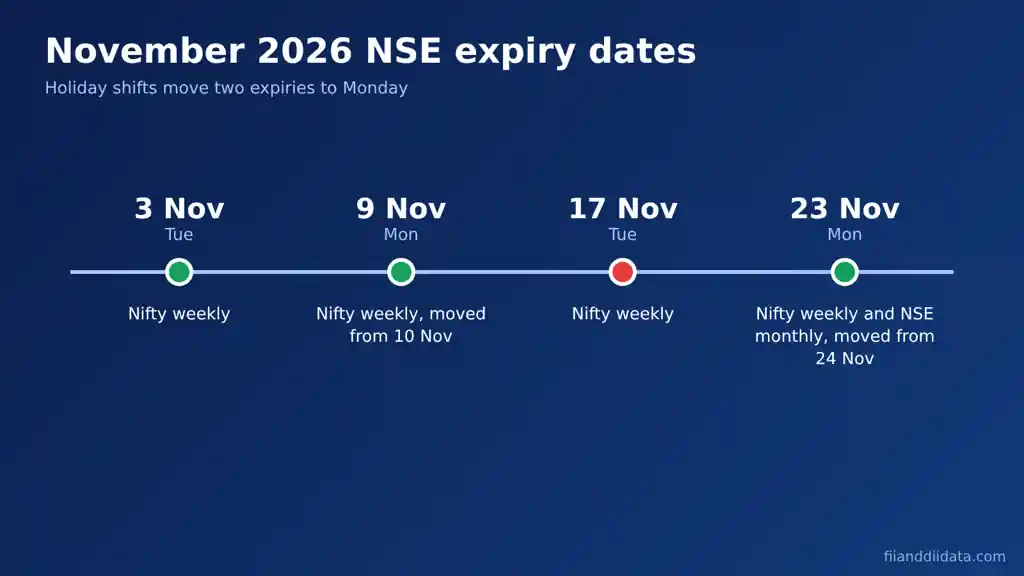
Because the 9 Nov expiry was a Monday, the open interest figure for that date already reflects a fresh weekly cycle. Keep this in mind when you compare the 9 Nov and 16 Nov rows in the next section.
FII Options Open Interest Before This Expiry
The table below uses FII index option open interest from the NSE participant-wise files, in lakh contracts. The 16 Nov file was released after the close on 16 Nov. We do not have the 17 Nov file yet, because NSE publishes it after today’s close.
| Date (2026) | Call long | Call short | Put long | Put short | Net put |
|---|---|---|---|---|---|
| 9 Nov | 6.07 | 7.19 | 9.70 | 5.82 | +3.88 |
| 13 Nov | 7.55 | 9.73 | 11.37 | 7.50 | +3.87 |
| 16 Nov | 8.19 | 10.06 | 11.41 | 8.38 | +3.03 |
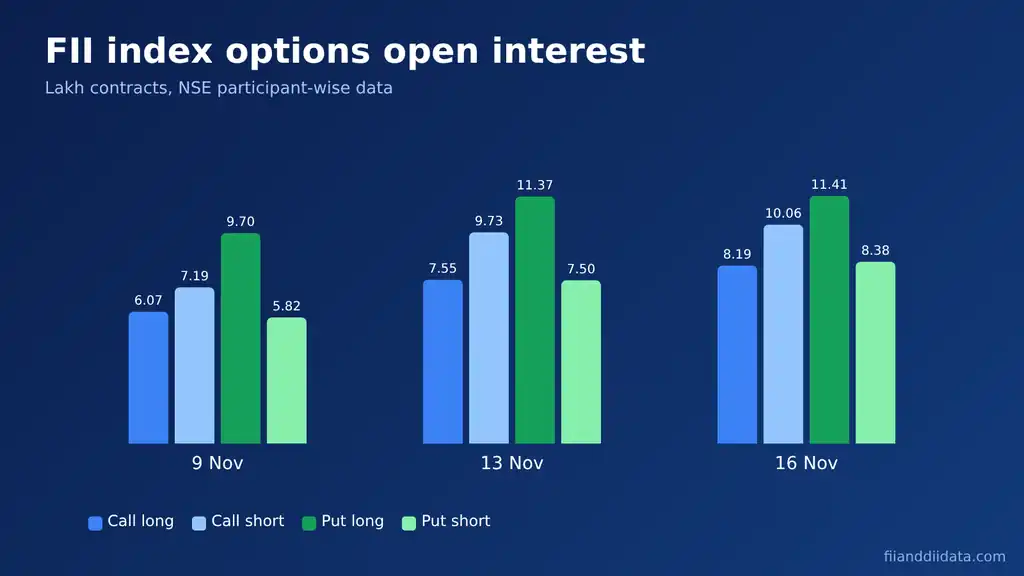
Three points stand out. Total FII index options open interest rose from 28.78 lakh to 38.04 lakh contracts between 9 and 16 Nov, a gain of 32.2%. Call longs grew 34.9% and call shorts grew 39.9%, so FIIs were net short calls by 1.87 lakh on 16 Nov. On the put side, longs rose 17.6% while shorts rose 44.0%, which trimmed the net put cushion from 3.88 lakh to 3.03 lakh.
To see how the put side behaves in more detail, read our guide on FII put buying, which explains how to tell a hedge from a bearish bet.
Why Open Interest Falls When Contracts Expire
Open interest counts contracts that are still open. When a series expires, every contract in it closes at once, so open interest falls even if no one placed a new trade. This is the single most common reason for a sharp drop in the FII numbers the day after expiry.
How FII options expiry changes the numbers
- Contracts in the expiring series vanish, which lowers both long and short columns.
- Positions that FIIs roll forward reappear in the next series, so part of the drop comes back within a day or two.
- Weekly and monthly series expire together on monthly expiry days, so the clean-up is larger on those dates.
- Short positions in the expiring series close the same way, so the net position can swing even if nobody trades.
This is why one-day moves around expiry are weak signals. A better habit is to compare the same point in two consecutive weeks. A put call ratio can also help smooth the noise, as long as you compare it across several sessions.
Weekly and monthly expiries behave differently. A weekly series is short and cheap, so traders use it for quick views and event risk. A monthly series carries more open interest and attracts more hedging by large holders. On Monday 23 Nov 2026 both expire together, so expect a larger clean-up in the file that follows. Plan your comparison in advance, and use the 16 Nov numbers above as the baseline.
One more reminder about timing: NSE releases provisional participant-wise data after the market closes, so any figure you read during trading hours is from the previous session. It reflects the last completed session only.
Worked Example: Reading an Expiry Drop
This is a hypothetical illustration, not NSE data. Suppose FIIs hold 2.0 lakh put longs before expiry, and 0.6 lakh of them sit in the weekly series that expires today. After expiry, put longs fall to 1.4 lakh with no new trade. That is a 30% drop, and a careless reader may call it a big unwinding of hedges.
Now assume FIIs roll 0.4 lakh contracts into next week’s series. Put longs rise back to 1.8 lakh, so the true change over the cycle is a fall of 10%, not 30%. The lesson is simple: measure the change after the roll, and always compare the same side of the book, long with long and short with short.
Expiry Week Checklist for Traders
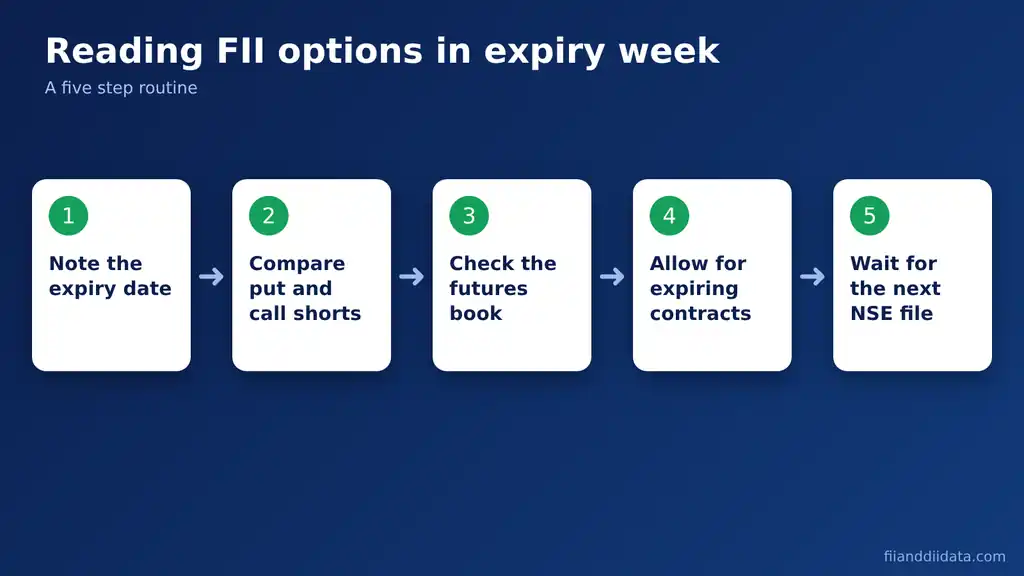
Use this routine each expiry week. It takes a few minutes and keeps you from reacting to clean-up noise. Write the numbers down before expiry, because the next file will look very different.
- Confirm which series expires and on which day, using the calendar above.
- Note FII call long, call short, put long and put short from the last file before expiry.
- Compare each figure with the same day last week, not with the previous day.
- Check the futures book on our FII futures data page, since options and futures must be read together.
- Wait for the first file after expiry, then repeat the comparison. Our FII options activity tracker helps with this step.
You can also match the derivatives view with the cash market in the FII DII data today summary.
Pros and Cons of Tracking FII Options Expiry
Pros
- It shows how large foreign investors manage risk around fixed dates.
- The NSE data is public and published every trading day.
- Week-on-week comparison filters out most expiry noise.
- It adds an options view to the cash market picture.
Cons
- Open interest does not show strike prices, so intent stays unclear.
- Hedges and directional bets look identical in the raw numbers.
- Data is end of day, so it lags intraday moves.
- Expiry clean-up can mislead readers who compare consecutive days.
Common Mistakes to Avoid
The first mistake is reading the drop after expiry as a change of view. The second is comparing consecutive sessions without checking holidays, since the market was closed on 10 Nov. The third is using FII positioning as a standalone trade signal. Rules also change from time to time, so keep an eye on exchange circulars and SEBI notices before you act on an old habit.
FAQs
What is FII options expiry?
FII options expiry is the date when foreign institutional investors’ index option contracts end and settle in cash. Open positions in that series disappear, and any rolled positions show up in the next series.
Why does FII open interest fall after expiry?
Open interest counts open contracts only. When a series expires, all its contracts close, so open interest drops mechanically even if FIIs placed no new trade.
When is the next monthly expiry in November 2026?
The monthly expiry falls on Monday 23 Nov 2026, moved earlier from Tuesday 24 Nov because the market is closed that day. The Nifty weekly series expires on the same day.
Does FII options expiry decide market direction?
No. Expiry changes the size of open interest, but direction depends on many factors. Use FII positioning as context, together with price action and the futures book.
Where can I find FII options data?
NSE publishes participant-wise open interest every trading day in its derivatives reports section. It lists long and short positions in index options for FII, DII, Pro and Client categories.
The Bottom Line
FII options expiry changes the size of the FII options book, not necessarily its meaning. On 16 Nov 2026 FIIs held 11.41 lakh put longs against 8.38 lakh put shorts, and the net put position had eased to +3.03 lakh from +3.88 lakh a week earlier. That is context for today’s expiry, not a forecast.
A practical next step: note today’s four FII option figures, then compare them with the 17 Nov file, released after today’s close. If you want the full picture, keep our daily data pages open and revisit the monthly expiry on 23 Nov.
Sources
- NSE India: Derivatives reports, participant-wise open interest
- NSE India: Trading holidays
- SEBI: Securities and Exchange Board of India
Disclaimer: This article is for educational purposes only and is not investment advice. Derivatives carry a high risk of loss. Please consult a SEBI-registered advisor before making investment decisions.