FPI debt investment is the money foreign portfolio investors put into Indian government bonds, corporate bonds and other debt instruments. It matters because debt flows move bond yields, the rupee and sometimes the mood of the equity market too. In 2026 the story has swung sharply: a large surge into Fully Accessible Route (FAR) bonds in June, followed by heavy withdrawals in September and October. This guide explains the routes, the rules, the latest numbers and how to read them, with a worked example you can reuse.
Key Takeaways
- FPIs can buy Indian debt through the General Route, the Fully Accessible Route (FAR) and the SRVA route, plus Sovereign Green Bonds available through the IFSC.
- From 1 April 2026 the Voluntary Retention Route (VRR) is merged into the General Route.
- FAR bonds saw a net inflow of ₹21,652 crore in June 2026, then net outflows in August, September and October.
- For a foreign investor the real return is coupon plus or minus the rupee move, not the coupon alone.
- Track route, monthly flows, yield versus currency, index news and RBI rule changes.
In this guide
- What FPI debt investment means
- The routes: General, FAR and SRVA
- Rules and the RBI Master Direction
- 2026 flows: surge and exits
- Worked example: coupon versus currency
- Why FPIs buy or sell Indian bonds
- Debt versus equity flows
- Common mistakes
- How to track the data
- FAQs
What FPI debt investment means
A foreign portfolio investor (FPI) is an overseas fund, bank, pension or insurer registered in India to invest in listed securities. Most headlines about FPIs cover equities, which we track on the FII and DII data home page. Debt is the quieter half. FPIs buy central government securities (G-secs), state development loans, corporate bonds and, in some cases, treasury bills. They earn the coupon, any price gain or loss as yields move, and a currency gain or loss when they convert rupees back into dollars.
Debt flows are more sensitive to global rates than equity flows. When US yields rise, the extra income from Indian bonds shrinks and money can leave quickly. When global bond indices add India, passive funds must buy, and inflows arrive in a rush. Both patterns showed up in 2026.
If you are new to the wider framework, start with our overview of FPI investment in India, which covers registration, categories and the equity side. This article focuses only on debt.
The routes: General, FAR and SRVA
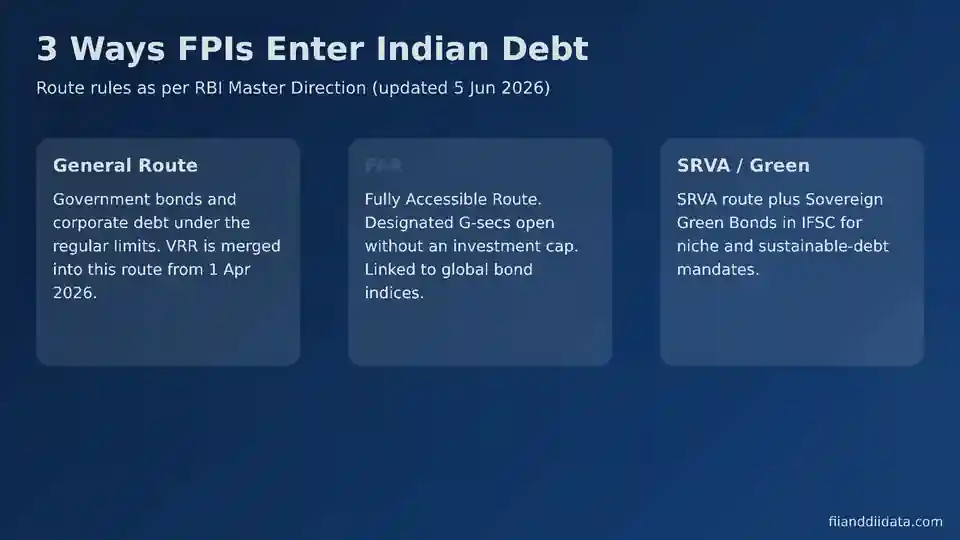
Foreign investors do not all enter the bond market the same way. India uses separate routes so the RBI can open some securities fully while keeping limits on others. The graphic below summarises the three main ways in.
| Route | What it covers | Investment cap | Typical user |
|---|---|---|---|
| General Route | Government securities and corporate debt under the regular framework | Subject to the limits set by RBI and SEBI | Active funds that want broad access |
| Fully Accessible Route (FAR) | Specified government securities designated as fully accessible | No investment cap on these securities | Index trackers and large global bond funds |
| SRVA route | Separate special route with its own conditions under the Master Direction | As per the route conditions | Investors using Special Rupee Vostro Accounts |
| Sovereign Green Bonds (IFSC) | Sovereign Green Bonds available through the IFSC | As notified for the IFSC route | Sustainable-debt mandates |
The route matters because it decides how easily money can enter and leave. FAR bonds are the ones tracked by global index providers, so they attract most of the passive money. That is also why FAR flows swing so much from month to month.
The Voluntary Retention Route (VRR) used to sit as a separate window with a retention commitment. From 1 April 2026 it has been merged into the General Route, so there is one less category to track in the data.
Rules and the RBI Master Direction
The governing document is the RBI Master Direction on Non-resident Investment in Debt Instruments (2025), last updated on 5 June 2026. It lists which instruments each route can buy, how limits are set and how reporting works. FPIs also have to follow SEBI registration and custodian rules.
Two practical points follow from this. First, check the current version of the Master Direction before relying on any article, because route details have been revised, including during 2026. Second, tax is a separate layer. Interest income and capital gains on debt are taxed differently from equity gains, and the rates and treaty positions matter for the net return. Our guide to FPI tax in India explains the structure, including how capital gains are treated.
2026 flows: surge and exits
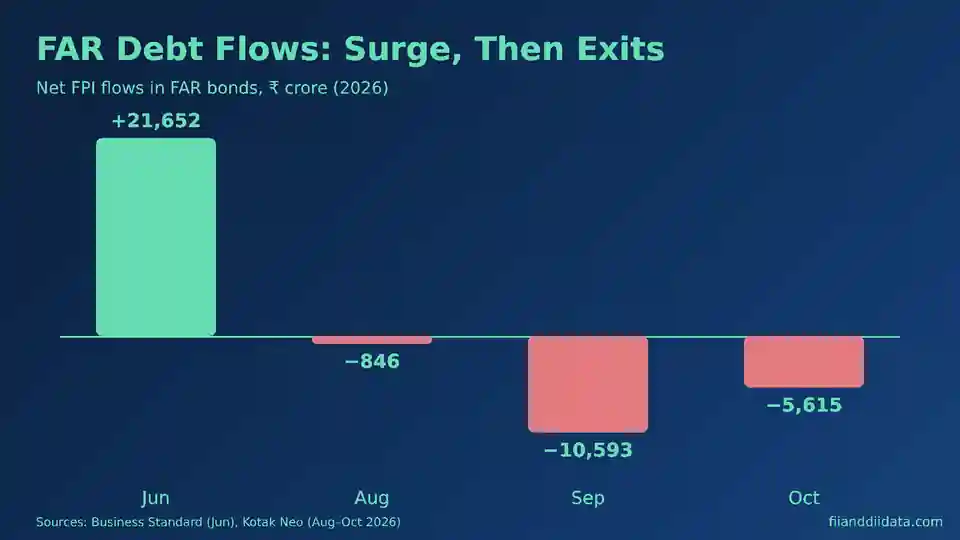
June 2026 was a standout month. Foreign investors put a net ₹21,652 crore into FAR bonds, as reported by Business Standard on 30 June 2026. The buying was tied to demand from index-linked funds and the attraction of Indian yields against other emerging markets.
The reversal came later in the year. According to Kotak Neo, FAR bonds saw net withdrawals of about ₹846 crore in August, ₹10,593 crore in September and ₹5,615 crore in October. Other data providers round or classify these figures differently, so always check which source a number comes from before comparing months.
| Month (2026) | FAR net flow (₹ crore) | Direction |
|---|---|---|
| June | +21,652 | Net inflow |
| August | −846 | Net outflow |
| September | −10,593 | Net outflow |
| October | −5,615 | Net outflow |
Early November reports, including a 5paisa market note on 4 November 2026, pointed to a rebound in debt buying after the autumn exits. One month does not make a trend, so it is better to watch whether the buying holds across several weeks.
Worked example: coupon versus currency
Here is a simple, hypothetical example. It is not a forecast and not a recommendation. Suppose a foreign fund invests ₹1,000 crore in a 6% government bond and holds it for one year with no change in the bond price. The coupon earns ₹60 crore, so the rupee return is 6%.
Now add the currency. The fund reports in dollars, so what matters is the rupee move over the year:
| Rupee move vs USD | Rupee return | Return in USD terms |
|---|---|---|
| Rupee stable | 6.00% | 6.00% |
| Rupee weakens 3% | 6.00% | about 2.8% |
| Rupee strengthens 2% | 6.00% | about 8.1% |
The same bond gives three very different outcomes. This is why foreign investors watch the rupee as closely as the yield, and why a sharp rupee fall can trigger selling even when the bond itself has not changed.
Why FPIs buy or sell Indian bonds
Four forces explain most of the movement in FPI debt investment:
- Global rates. Higher US yields make Indian bonds less attractive in relative terms.
- Index inclusion. India’s FAR bonds sit in JPMorgan GBI-EM, the Bloomberg EM Local Currency index and the FTSE EMGBI. Inclusion in the Bloomberg Global Aggregate index has been deferred, so that source of demand is still pending.
- Currency outlook. A stable or strengthening rupee supports inflows, as the example above shows.
- RBI policy and inflation. Rate cuts can lift bond prices, while inflation surprises can push yields up.
How debt flows differ from equity flows
Equity investors are paid for growth. They look at earnings, valuations and sector trends, and they tend to stay for years. Debt investors are paid for income and safety, so they care about yields, inflation, rate expectations and the exchange rate. That difference changes how the two groups behave.
Debt money is also more concentrated. A handful of global bond funds track the same indices, so when an index changes its weights or adds a new market, many of them trade on the same day. This is why a single month can show a very large inflow or outflow, as in June and September 2026, without any change in the underlying economy.
For readers of the daily institutional data, the practical lesson is simple. A quiet equity day does not mean foreign money is idle. Large sums can move through bonds that never appear in equity tables. Looking at both gives a fuller picture of how much foreign capital is entering or leaving India, and which market is absorbing the change.
Common mistakes when reading FPI debt data
- Mixing sources. Different providers report different totals for the same month. Pick one source and stay with it.
- Ignoring the route. General Route and FAR flows behave differently. A total hides the detail.
- Treating one month as a trend. Debt flows are lumpy, especially around index events.
- Forgetting the currency. A good coupon can be wiped out by a weak rupee.
- Linking debt flows to equity flows. They often move apart. Check each separately.
How to track FPI debt investment
You do not need a terminal. A simple routine works:
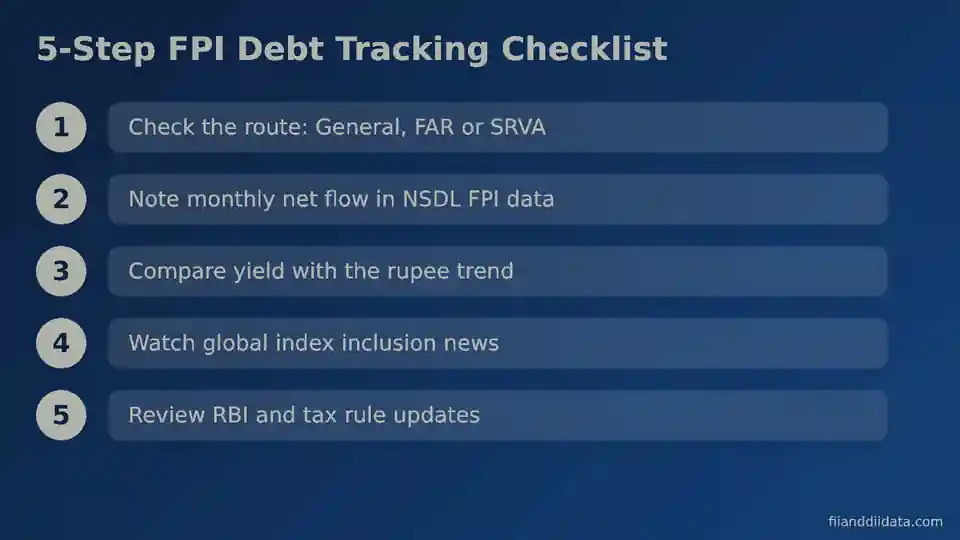
Use depository data for monthly and fortnightly numbers, compare them with the ten-year G-sec yield and the rupee, and keep an eye on index announcements and RBI circulars. For the equity side of the same investors, the FII and DII data page gives the daily picture, which helps you see whether foreign money is moving across both markets or only one.
FAQs on FPI debt investment
What is FPI debt investment?
FPI debt investment is the money foreign portfolio investors put into Indian government securities, corporate bonds and similar debt instruments through routes approved by the RBI and SEBI.
What is the Fully Accessible Route (FAR)?
FAR is a route that lets non-residents invest in specified government securities without an investment cap. These bonds are the ones tracked by major emerging-market bond indices.
What happened to the Voluntary Retention Route?
From 1 April 2026 the Voluntary Retention Route has been merged into the General Route, so FPIs now use the General Route for what VRR used to cover.
How much did FPIs put into FAR bonds in 2026?
Business Standard reported a net inflow of ₹21,652 crore into FAR bonds in June 2026. Kotak Neo data shows net outflows in August, September and October 2026.
Why does the rupee matter for FPI bond returns?
Foreign investors measure returns in their home currency. If the rupee weakens, it reduces the dollar return even when the bond coupon and price are unchanged.
The Bottom Line
FPI debt investment is shaped by routes, global rates, index decisions and the rupee. The June 2026 surge and the autumn exits show how fast sentiment can change when most of the money sits in index-linked FAR bonds. Read flows by route, stick to one data source, and always weigh the yield against the currency. Next, compare these debt trends with the equity picture before drawing conclusions about foreign sentiment.
Sources: RBI Master Direction on Non-resident Investment in Debt Instruments (2025, updated 5 June 2026); Business Standard (30 June 2026); Kotak Neo (9 November 2026); 5paisa (4 November 2026).
Disclaimer: This article is for educational purposes only and is not investment advice. Please consult a SEBI-registered advisor before making investment decisions.