
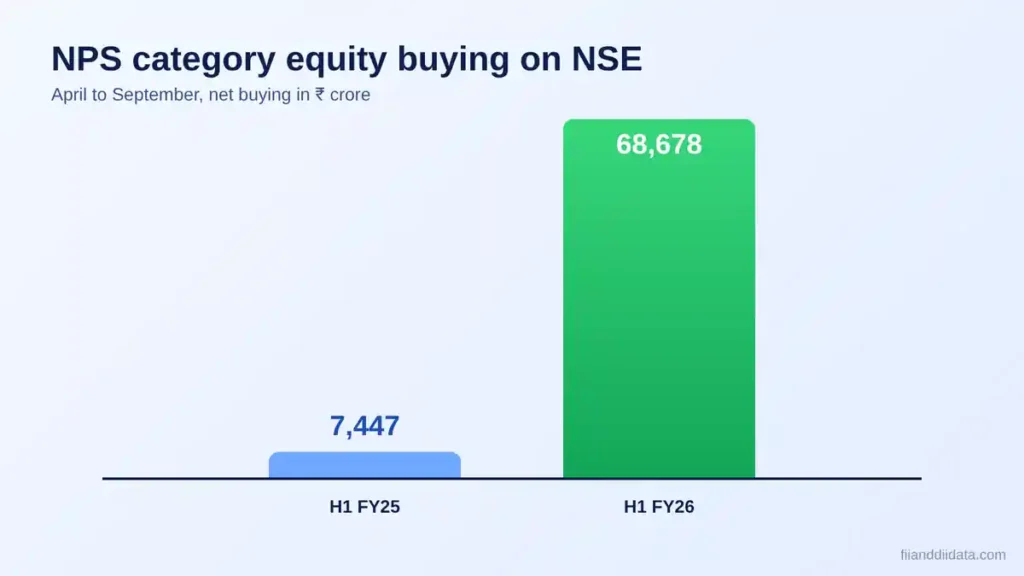
Understanding pension funds India equity flows helps you read why domestic institutions kept buying when foreigners sold. NSE data shows that net buying by the NPS category rose from Rs 7,447 crore to Rs 68,678 crore in April to September 2025. Retirement savings are now a steady, growing source of domestic stock demand.
Key Takeaways
- NPS category net buying on NSE was Rs 68,678 crore in April to September 2025, against Rs 7,447 crore a year earlier.
- The equity limit for many NPS schemes rose from 15% to 25% in 2025, which explains much of the jump.
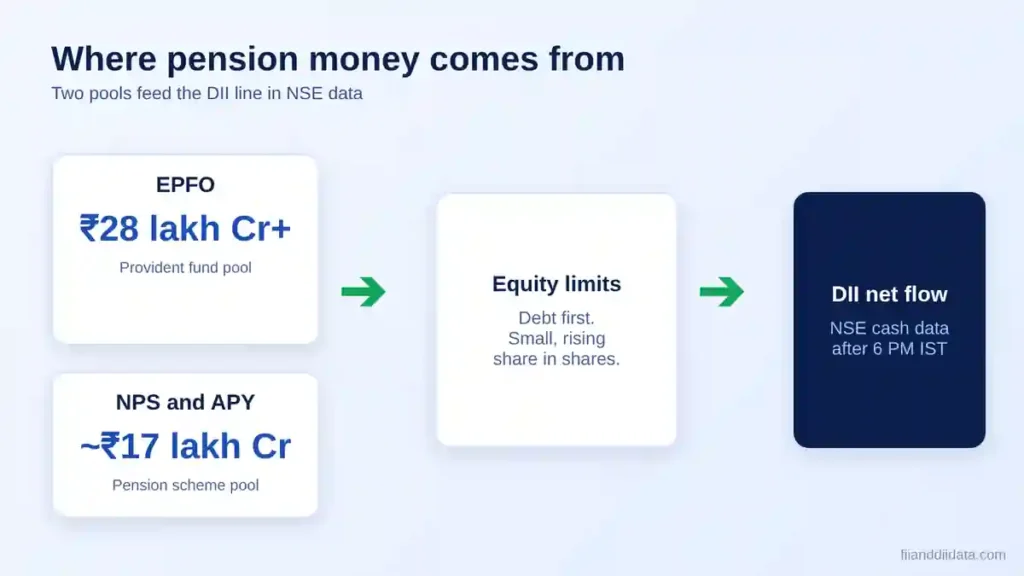
- NPS and Atal Pension Yojana hold about Rs 17 lakh crore and EPFO holds over Rs 28 lakh crore (Business Today, 1 October 2026).
- NPS equity buying slowed to about Rs 14,700 crore in the September 2026 quarter as bond yields rose.
- Traders should treat pension buying as a slow, rule-based support, not a signal for daily Nifty moves.
Contents
- What pension funds are in Indian equities
- Where retirement money comes from
- How pension money turns into domestic flow
- Latest NPS buying data from NSE
- Why the buying slowed in 2026
- A four-step checklist for traders
- Common mistakes
- Pension funds vs other domestic investors
- Frequently asked questions
- The bottom line
What Pension Funds Are in Indian Equities
A pension fund collects contributions from working people today and invests them so that the money can pay a pension later. In India, the main pools are the Employees’ Provident Fund Organisation (EPFO), the National Pension System (NPS) and the Atal Pension Yojana (APY). Each follows strict rules on how much it may put into shares.
These funds are domestic institutional investors. That puts them on the same side of the market as mutual funds, insurers and banks. If you are new to the term, our guide on the difference between FII and DII explains who sits on each side.
Pension managers are patient buyers. They do not chase a one-day move. Their money arrives every month through salary deductions, so the buying is regular and large. Next, let us see where that money actually comes from.
Where Retirement Money Comes From
Three large pools feed the system. According to Business Today (1 October 2026), NPS and APY together hold about Rs 17 lakh crore across roughly 9 crore subscribers, growing about 20% a year. EPFO holds more than Rs 28 lakh crore. Together, the retirement pools are close to Rs 45 lakh crore.
Only a part of this reaches the stock market. EPFO puts 45% to 65% of its incremental flows into government securities, and it invests a limited share in equity ETFs. Business Standard (3 November 2025) reported that EPFO began allocating 5% of incremental flows to ETFs in 2015, raised it to 10% in 2016 and 15% in 2017. EPFO’s total ETF investment was Rs 1.97 trillion in FY23 and Rs 2.35 trillion in FY24.
Why the equity limit matters
Rules decide how much a pension scheme may hold in shares. The cap on equity for a number of NPS schemes was raised from 15% to 25% from April 2025. The same report says the change applies to the whole corpus, not only to new money. That is why a single policy decision moved billions of rupees into stocks.
How Pension Money Turns Into Domestic Flow
The path is simple. A worker contributes, the fund manager applies the equity limit, and the manager buys shares on the exchange. Those purchases are part of the domestic institutional demand that offsets foreign selling. Our explainer on the role of DII in the Indian stock market covers this support in more detail.
NSE reports the NPS category separately in its monthly Market Pulse publication, so you can track pension buying on its own. The daily release shows one headline DII line, which is the net of all domestic institutions. If you want a refresher, read what DII buying means.
A simple worked example
This is an illustration with round numbers, not reported data. Suppose a pension scheme receives Rs 1,000 crore of new contributions in a month. Its equity limit is 25%, and it is already at that limit. To stay at the limit, it must put Rs 250 crore of the new money into shares and Rs 750 crore into bonds. Now suppose the limit is raised and the scheme is below the new cap. It can buy far more than Rs 250 crore until it reaches the cap. That one-time catch-up is what a policy change does to flows.
Net buying works the same way. If domestic institutions buy Rs 12,000 crore of shares in a day and sell Rs 9,500 crore, net buying is Rs 2,500 crore. Pension money is one of several contributors to that figure.
Latest NPS Buying Data From NSE
The sharpest rise showed up in the first half of FY26. Business Standard (3 November 2025), citing NSE data, reported that NPS category inflows for the three months to September 2025 were Rs 37,409 crore, the highest in rolling three-month data since 2016. The article cautions that NSE data may not capture activity on every exchange, but it shows the trend clearly.
| Period | NPS category net buying (Rs crore) |
|---|---|
| Three months to September 2016 | 894 |
| Three months to September 2024 | 4,509 |
| Three months to September 2025 | 37,409 |
| April to September 2024 (H1 FY25) | 7,447 |
| April to September 2025 (H1 FY26) | 68,678 |
The table shows a jump of nearly ten times in half a year. The same report links part of the rise to the higher equity limit, possibly through a one-time rebalancing. Monthly data would show whether the pace continues after the catch-up ends.
Why the Buying Slowed in 2026
The pace did not stay at the 2025 peak. The Economic Times, citing NSE data and reported by Lapaas Voice on 15 October 2026, said insurers and NPS funds together bought Rs 22,714 crore of equities in the September 2026 quarter. That was 45% lower than Rs 41,465 crore in the June quarter. Insurers bought Rs 8,013 crore and NPS funds about Rs 14,700 crore.
Two reasons were given. Higher government bond yields made debt more attractive, and falling share prices reduced the room for fresh equity buying. The base effect also matters, because 2025 followed the limit change and was unusually high.
Domestic buying overall stayed strong. NiftyTrader (updated 26 June 2026) reported that domestic institutions bought about Rs 4.16 lakh crore between January and early June 2026, while foreign investors sold about Rs 2.7 lakh crore. In March 2026 alone, DIIs bought Rs 1.36 lakh crore after the Nifty fell about 11%. You can follow day-by-day figures through our FII DII data today page and the monthly FII DII data tracker.
A Four-Step Checklist for Traders
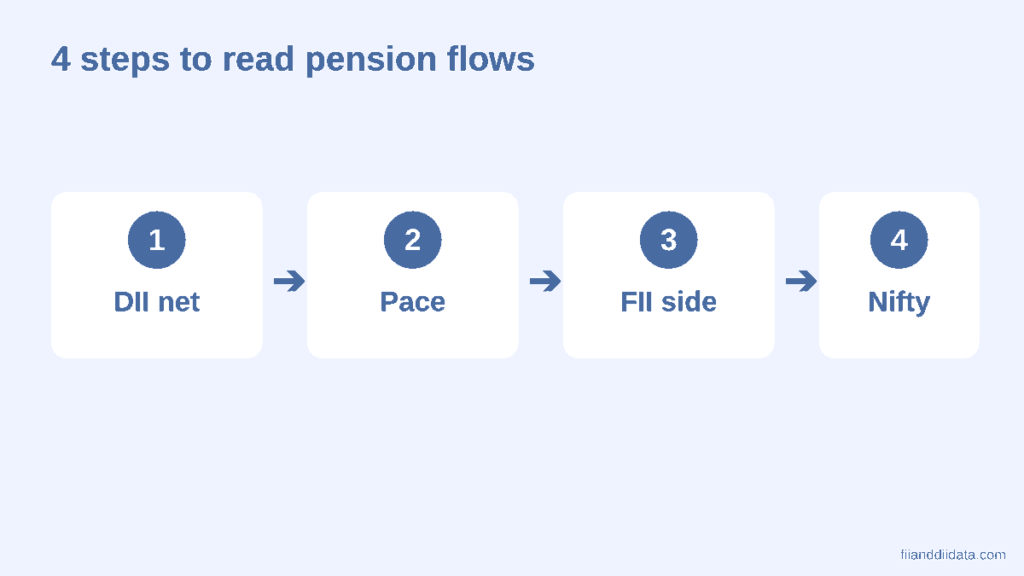
Pension buying is slow and rule-based, so use it as background context. Here is a practical way to check it each month.
- Check DII net flow. Look at the net figure for the day and the week after market close. NSE releases provisional cash data around 6 PM IST.
- Check the pace. Compare this month with the last three months. A fading pace, as in the September 2026 quarter, tells you support is weaker.
- Check the FII side. Strong domestic buying against heavy foreign selling limits the fall, but it does not stop it. Read our FII and DII data page for both sides together.
- Check the Nifty reaction. If the index holds up on a heavy foreign selling day, domestic buyers are absorbing the supply.
Common Mistakes
The first mistake is to treat monthly pension buying as a daily trading signal. Contributions are steady, but the timing of purchases is set by the manager. The second is to ignore the equity cap. A scheme that is at its limit cannot add more shares, however cheap the market looks.
The third mistake is to read one strong quarter as a trend. The 2025 surge was partly a catch-up after the new limit. The fourth is to mix up provisional and final data. NSE figures are provisional on the day, and NSDL final data for foreign investors comes the next working day.
Pension Funds vs Other Domestic Investors
Pension funds are only one group of domestic buyers. Mutual funds are larger in the market, and insurers also invest regularly. Our list of DII examples names each group. The table below compares them using the September 2026 quarter figures.
| Investor group | Equity buying, September 2026 quarter |
|---|---|
| Mutual funds | Rs 1.09 lakh crore |
| Insurance companies | Rs 8,013 crore |
| NPS funds | About Rs 14,700 crore |
| Foreign portfolio investors | Rs 12,969 crore (net buying) |
Mutual funds buy many times more than pension funds in a quarter. Pension money matters because it is stable and rule-driven, not because it is the biggest buyer.
Frequently Asked Questions
How much of pension money goes into Indian equity?
It depends on the scheme. The equity limit for a number of NPS schemes was raised from 15% to 25% from April 2025. EPFO puts most incremental flows into government securities and a limited share into equity ETFs.
Are pension funds DIIs?
Yes. Pension funds are domestic institutional investors, like mutual funds, insurers and banks. Their purchases form part of domestic institutional demand.
Does EPFO invest in the stock market?
Yes, but only through equity ETFs. EPFO began allocating 5% of incremental flows to ETFs in 2015 and raised the share to 15% by 2017, according to Business Standard.
Why did NPS equity buying fall in 2026?
Higher bond yields and falling share prices reduced fresh equity buying in the September 2026 quarter. The 2025 base was also unusually high after the equity limit change.
Can pension fund buying predict the Nifty?
No. Pension buying is slow and rule-based. It can cushion falls, but it is not a short-term signal for the index.
The Bottom Line
Pension funds have become a real force behind domestic buying. Rs 68,678 crore of NPS category buying in the first half of FY26 shows how a rule change can move markets. The slower pace in the September 2026 quarter is a reminder that this support depends on bond yields, share prices and policy.
Treat pension flow as background, not a trigger. A good next step is to read the monthly NSE data alongside the daily DII figure, and to keep the foreign side in view before you act.
Sources: Business Standard, 3 November 2025; Business Today, 1 October 2026; The Economic Times via Lapaas Voice, 15 October 2026; NiftyTrader, 9 June 2026.
Disclaimer: This article is for educational purposes only and is not investment advice. Please consult a SEBI-registered advisor before making investment decisions.