If you are an active participant in the Indian stock market you have likely realized that the market does not move simply based on retail sentiment. The real driving forces behind major market rallies and corrections are the big institutional players. To truly understand market direction tracking the FII DII Data Today is not just an option it is an absolute necessity.
Whether you are a day trader a swing trader or a long-term investor understanding the footprints of Foreign Institutional Investors (FIIs) and Domestic Institutional Investors (DIIs) can give you a massive edge. In this comprehensive guide we will dive deep into what these metrics mean why they matter and how you can analyze FII DII Data Cash Market Activity to make informed and profitable trading decisions.
What Are FIIs and DIIs in the Stock Market?
Before we analyze the data, it is crucial to understand who these market giants are and why their capital heavily influences stock prices.
- FII (Foreign Institutional Investors): These are massive international entities such as foreign mutual funds, hedge funds pension funds, and investment banks that invest money in the Indian financial markets. Because they bring in huge volumes of foreign capital their buying or selling activities create significant momentum.
- DII (Domestic Institutional Investors): These are the institutional investors operating within India. This category includes Indian mutual funds, insurance companies (like LIC) local pension funds and banks. DIIs act as the backbone of the Indian stock market and often act as a counter-balancing force to FIIs.
When both FIIs and DIIs buy aggressively the market usually experiences a strong uptrend. Conversely when both turn into net sellers the market faces steep corrections.
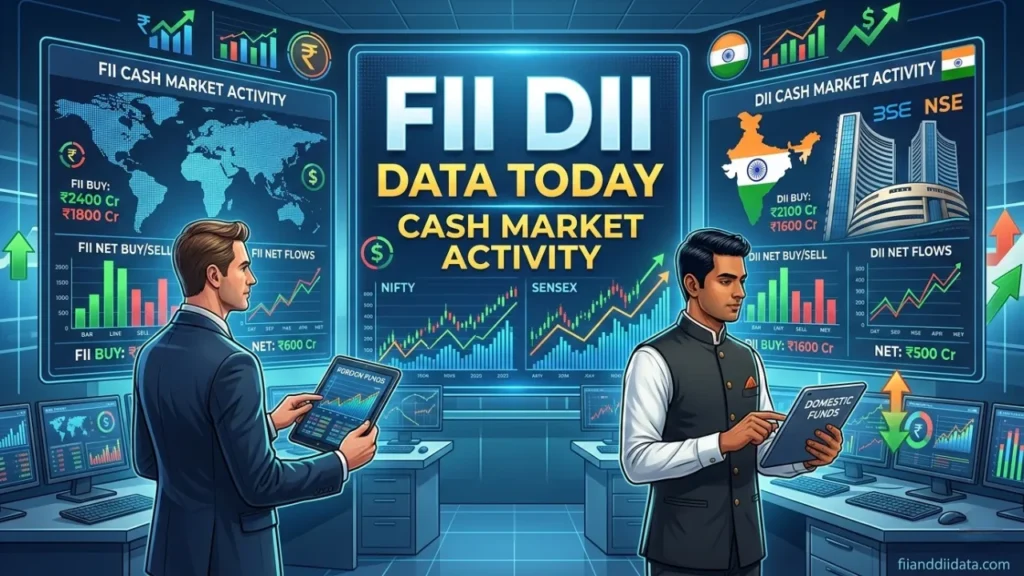
Why Tracking FII DII Data Today is Crucial
Retail investors often rely solely on technical indicators or news to plan their trades. However institutional data tells you where the smart money is flowing. Here is why you must check the FII DII Data Today before planning your next trading session:
- Trend Confirmation: If technical charts show a bullish breakout and the daily institutional data shows heavy FII buying the probability of a successful trade increases significantly.
- Identifying Market Reversals: Sometimes the market opens with a gap-up due to retail euphoria but FIIs might be silently offloading their shares. Catching this early can save you from market traps.
- Understanding Liquidity: Institutional buying injects massive liquidity into the market, driving up the prices of large-cap and mid-cap stocks.
- Market Sentiment: Continuous net selling by FIIs over several days is a strong indicator of bearish sentiment or global economic concerns warning retail investors to tighten their stop-losses.
Decoding FII DII Data Cash Market Activity
While institutional data is divided into Cash Market Index Futures Index Options and Stock Futures the most reliable indicator of long-term trend and conviction is the FII DII Data Cash Market Activity.
What is Cash Market Activity?
The cash market (or equity market) refers to the buying and selling of actual shares for delivery. When FIIs or DIIs buy in the cash market they are taking actual ownership of the stocks holding them in their demat accounts.
Unlike the derivatives (F&O) market which is heavily used for hedging and short-term speculation the cash market reflects genuine investment interest. If institutions are pouring thousands of crores into the cash segment it indicates a strong fundamental belief in the growth of those assets.
How to Interpret the Data
When you look at the daily stats on platforms like https://www.google.com/search?q=FiiAndDiiData.com you will see four main figures: FII Buy, FII Sell, DII Buy, and DII Sell. The most critical number to calculate is the Net Value (Buy Value minus Sell Value).
Example:
- Net Positive (Net Buyers): If FIIs bought shares worth ₹10,000 crores and sold shares worth ₹7,000 crores the net figure is +₹3,000 crores. This is a highly bullish signal.
- Net Negative (Net Sellers): If they sold more than they bought the net figure is negative indicating a bearish sentiment or profit booking.
The Historic Tug-of-War: FIIs vs. DIIs
Historically, FIIs have been the primary drivers of the Indian stock market. However in recent years the massive influx of retail money into Indian Mutual Funds through SIPs (Systematic Investment Plans) has empowered DIIs.
It is very common to see FII DII Data Cash Market Activity where FIIs are net sellers due to global cues (like rising US bond yields or geopolitical tensions) while DIIs act as strong net buyers absorbing the sell-off and preventing a market crash. When you see DII buying consistently matching FII selling it indicates a strong underlying domestic economy.
Strategies for Using Daily Institutional Data
How can you use this data practically for your daily trades? Here are a few professional strategies:
1. The Alignment Strategy (Double Engine Growth)
When you check the FII DII Data Today and notice that both FIIs and DIIs are net buyers in the cash market this is a golden scenario for swing traders. It signifies massive liquidity entering the market without any institutional resistance. In such environments buying the dip is usually the most profitable strategy.
2. The Divergence Strategy
If the Nifty 50 is hitting all-time highs, but the FII DII Data Cash Market Activity shows consistent net selling by FIIs over the past week it is a glaring red flag. This divergence suggests that the market is being propped up by retail emotions or short-covering rather than genuine institutional accumulation. Traders should become cautious and avoid aggressive long positions.
3. Sectoral Rotation Tracking
While the gross daily data gives a macroeconomic view tracking which specific sectors FIIs are buying into can help you find multibagger stocks. If institutions are heavily buying in the cash market that money is usually flowing into specific sectors like Banking, IT, or Auto.
Where to Find Accurate Institutional Data?
The National Stock Exchange (NSE) and Bombay Stock Exchange (BSE) release this data daily after market hours (usually between 5:30 PM and 6:00 PM IST). However sifting through raw exchange files can be tedious.
To save time and get a clear, visual representation of the numbers, you can rely on dedicated financial tracking websites. A well-structured dashboard allows you to instantly see the net buying and selling figures, helping you prepare your trading plan for the next day with absolute clarity.
Frequently Asked Questions (FAQs)
Q1: What time is the FII DII data released everyday?
The provisional cash market data for FIIs and DIIs is typically released by the NSE every trading day around 5:30 PM to 6:00 PM IST.
Q2: Which data is more important: Cash Market or F&O?
While F&O data gives insights into short-term market momentum and hedging, FII DII Data Cash Market Activity is considered far more important for understanding true market trends, as it involves taking actual delivery of stocks.
Q3: Can the market fall even if FIIs are buying?
Yes, the market can still fall. FII data is a macroeconomic indicator not an absolute guarantee. Global news sudden geopolitical events, or heavy DII selling can sometimes override FII buying sentiment on a particular day.
Q4: Does institutional selling always mean a market crash?
No. Often FIIs sell to book profits rebalance their global portfolios or move capital to other emerging markets. Continuous selling over weeks causes corrections but a single day of net selling is a normal part of market cycles.
Conclusion
Succeeding in the stock market requires you to think like an institution and you cannot do that without knowing what the institutions are doing. By making it a daily habit to check the FII DII Data Today you align your trades with the heavyweights of the financial world. Pay close attention to the FII DII Data Cash Market Activity look for trends over a period of days rather than isolated events and use this powerful data to manage your risk and spot high-probability trading opportunities.
Keep tracking the smart money and trade responsibly!