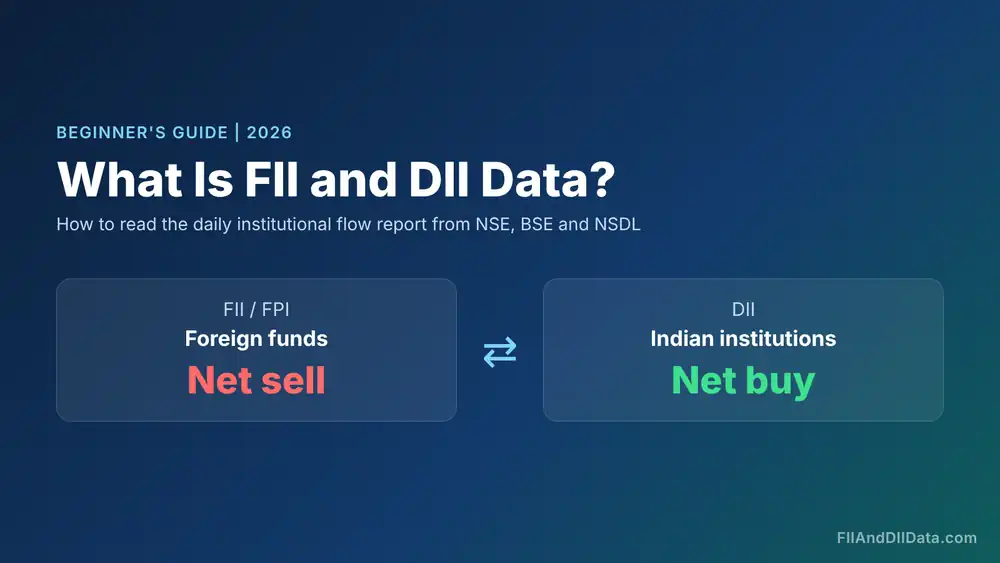
What is FII and DII data? It is the daily record of how much Indian stock foreign institutional investors (FIIs) and domestic institutional investors (DIIs) bought and sold, published by NSE and BSE after market close. On 23 October 2026, for example, FIIs were net buyers of ₹888 crore and DIIs net buyers of ₹3,235 crore in the cash market. These two numbers tell you which way big money is moving, and this guide shows you how to read them in five steps.
Key Takeaways
- FII and DII data shows gross buying, gross selling and net flow for foreign and domestic institutions every trading day.
- NSE releases provisional cash data around 6 PM IST; NSDL publishes final FPI figures the next working day.
- The signal comes from direction, size and streaks, read together with F&O positions, not from one day’s number.
- In October 2026 (to 23 Oct), FIIs sold ₹51,466 crore in the cash market while DIIs bought ₹59,110 crore.
- DIIs now own 19.6% of NSE-listed companies against 15.8% for FPIs, so domestic flows matter more than ever.
- What is FII and DII data?
- Who are FIIs and DIIs?
- What the daily FII and DII data report shows
- How to read FII and DII data in 5 steps
- What is FII and DII data showing in October 2026?
- Why FII and DII data matters more now
- 6 common mistakes and a daily checklist
- FAQs
- The Bottom Line
What Is FII and DII Data?
FII and DII data is an official summary of institutional trading in Indian equities. For each trading day, it lists how much FIIs and DIIs bought (gross purchase), how much they sold (gross sales) and the difference between the two (net value). A positive net value means net buying; a negative one means net selling.
Institutions trade in very large sizes, so their flows often set the direction of the Nifty 50 and Bank Nifty. Retail traders use the data to judge whether a rally has institutional support or a fall is being absorbed. We publish the numbers each evening on our FII and DII data today page. To read them well, you first need to know who is behind each label.
Who Are FIIs and DIIs?
Foreign Institutional Investors (FIIs)
FIIs are investment funds based outside India that buy Indian stocks, bonds and derivatives. They include global mutual funds, pension funds, hedge funds, insurance companies and sovereign wealth funds. Since SEBI’s 2014 regulations, these investors are formally called foreign portfolio investors (FPIs), but both terms describe the same group. Our guide on FII vs FPI explains the change.
Domestic Institutional Investors (DIIs)
DIIs are Indian institutions that invest pooled savings: mutual funds, insurance companies such as LIC, banks, and pension and provident funds. Their money comes largely from households, including monthly SIPs. In September 2026, SIP inflows hit a record ₹32,490 crore across about 10.06 crore accounts, as per AMFI data reported by 5paisa.
| Factor | FIIs (FPIs) | DIIs |
|---|---|---|
| Based in | Outside India | India |
| Examples | Global pension funds, hedge funds, sovereign funds | Mutual funds, LIC, banks, EPFO |
| Main money source | Global investors | Indian household savings and SIPs |
| Typical behaviour | Moves fast with global rates, dollar and oil | Steadier; often buys when FIIs sell |
| Share of NSE-listed firms | 15.8% (March 2026) | 19.6% (March 2026) |
With the two groups clear, here is what the report itself contains.
What the Daily FII and DII Data Report Shows
Cash Market Numbers
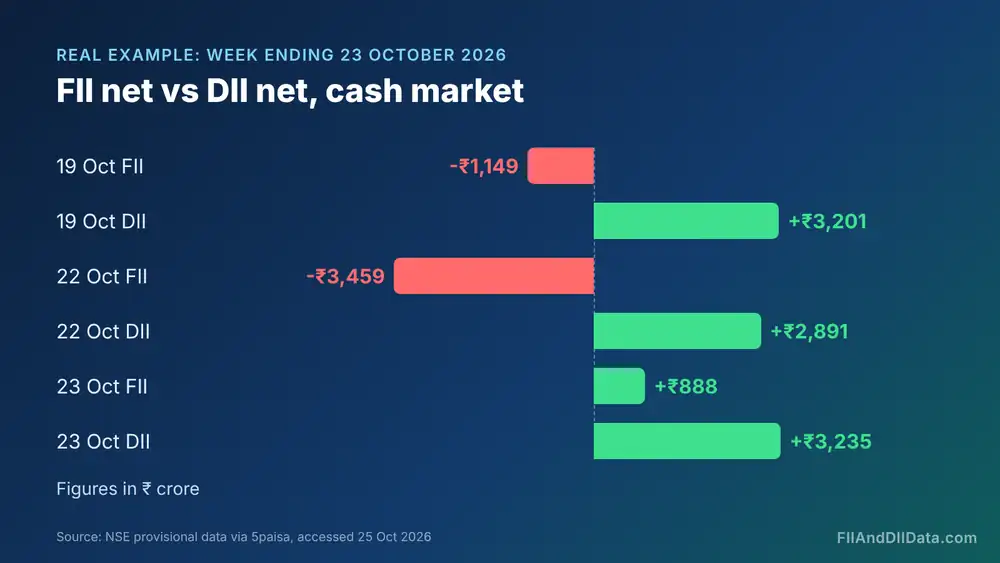
The cash market section covers actual buying and selling of shares. It has three numbers for each group: gross purchase, gross sales and net value. Here is a real example from Friday, 23 October 2026:
- FII gross purchase: ₹14,445.5 crore
- FII gross sales: ₹13,557.9 crore
- FII net: ₹14,445.5 crore minus ₹13,557.9 crore = +₹887.6 crore (net buying)
Derivatives (F&O) Positions
NSE’s participant-wise open interest report shows how many index futures and options contracts FIIs, DIIs, proprietary traders and clients hold. It reveals hedging and directional bets that cash data cannot. On 23 October 2026, FIIs held a net short of about 2.80 lakh contracts in index futures while clients were net long 2.15 lakh contracts, as per Quantsapp data. You can track this on our participant-wise open interest tracker and the FII DII F&O activity page.
When the Data Is Released
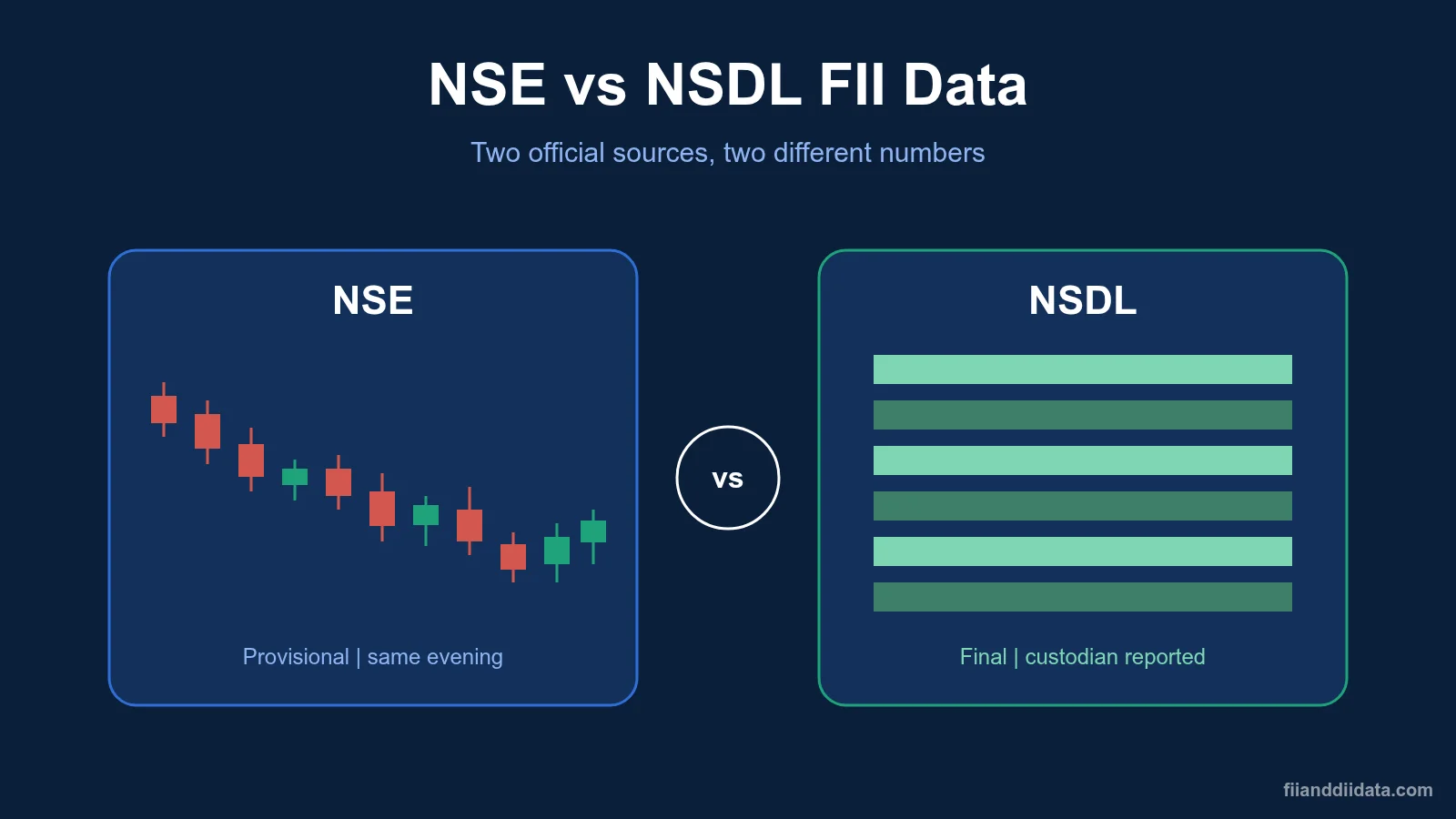
NSE publishes provisional FII and DII cash figures on its FII/DII report page around 6 PM IST on trading days. NSDL publishes final FPI figures on the NSDL FPI Monitor the next working day. NSDL numbers also include IPO and other primary market money, so they can differ from the exchange figure for the same day.
Knowing the numbers is half the job. The next section turns them into a signal.
How to Read FII and DII Data in 5 Steps
Use this method each evening once the provisional data is out.
Step 1: Check the Direction
Note whether FIIs and DIIs were net buyers or net sellers. Then place the day in one of four patterns:
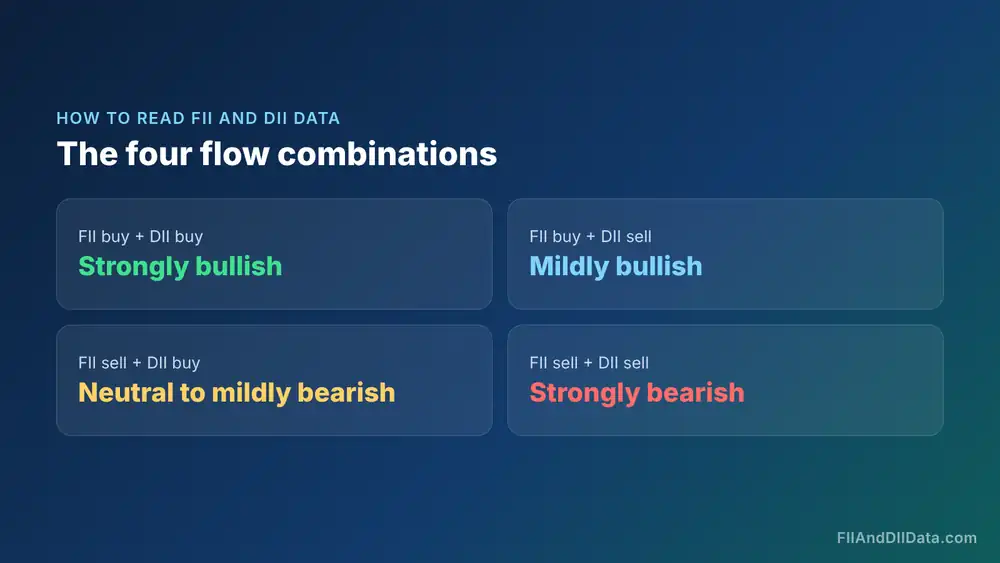
| FII | DII | What it usually means |
|---|---|---|
| Buy | Buy | Strongly bullish; both groups adding money |
| Buy | Sell | Mildly bullish; DIIs may be booking profits |
| Sell | Buy | Neutral to mildly bearish; DIIs absorbing FII selling |
| Sell | Sell | Strongly bearish; rare, often sharp falls |
Step 2: Compare the Size
Direction alone can mislead. If FIIs sell ₹3,459 crore and DIIs buy ₹2,891 crore, as on 22 October 2026, the net institutional flow is still about -₹568 crore. When FII selling is larger than DII buying, the index often falls even though DIIs were buyers.
Step 3: Look at the Streak
One day is noise. Add up the last five and ten sessions. In the week ending 23 October 2026, FIIs were net sellers on two days and net buyers on two, for a weekly total of -₹2,697 crore, while DIIs bought on every session for a total of +₹10,942 crore. That mixed FII pattern was a change from the one-way selling earlier in the month.
Step 4: Confirm With F&O Positions
A cash buying day means more when FIIs are also cutting index futures shorts. If they buy shares but stay heavily short in futures, they may simply be hedging. The FII long short ratio in index futures gives a quick read on this positioning.
Step 5: Add Context
Finally, ask why the money is moving. Crude oil, US bond yields, the rupee, RBI policy and big IPOs all change flows. Our analysis of why FIIs are selling Indian stocks shows how these factors played out in October 2026. Here is what those five steps reveal for the month so far.
What Is FII and DII Data Showing in October 2026?
| Date | FII net (₹ cr) | DII net (₹ cr) | Pattern |
|---|---|---|---|
| 19 Oct 2026 | -1,148.6 | +3,201.2 | FII sell, DII buy |
| 21 Oct 2026 | +1,022.3 | +1,614.3 | Both buy |
| 22 Oct 2026 | -3,458.7 | +2,891.3 | FII sell, DII buy |
| 23 Oct 2026 | +887.6 | +3,235.4 | Both buy |
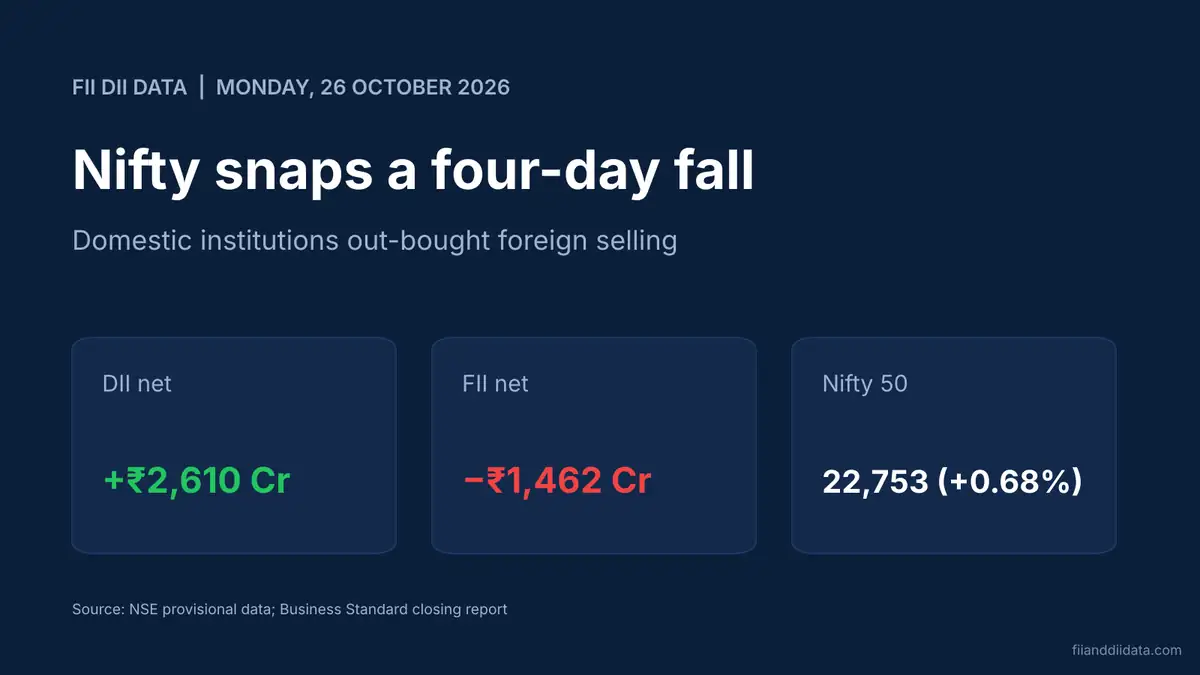
| 1 to 23 Oct 2026 | -51,466 | +59,110 | DIIs absorbed all FII selling |
On a depository basis, FPIs pulled ₹48,056 crore from Indian equities in October up to 23 October, taking the 2026 outflow to ₹3.08 lakh crore, as per CDSL data reported by Free Press Journal on 25 October. For month-by-month history, see our FII DII monthly data. The bigger story behind these flows is a shift in who owns Indian stocks.
Why FII and DII Data Matters More Now
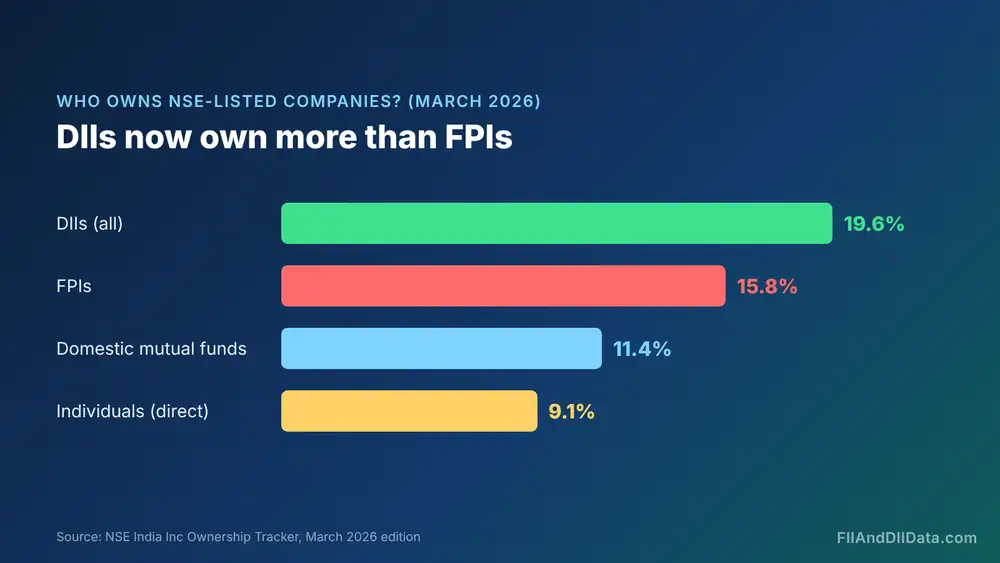
As of March 2026, FPI ownership of NSE-listed companies fell to 15.8%, a 17-year low, as per NSE data reported by ANI. DII ownership rose to a record 19.6%, with domestic mutual funds alone at 11.4%.
This means FII selling no longer decides the market on its own. Heavy foreign selling can now be met by equally heavy domestic buying, which is why you must read both columns together. For daily numbers, charts and all our free tools, visit our FII and DII data home page. Before you act on the data, avoid the traps below.
6 Common Mistakes and a Daily Checklist
- Trading on one day’s number. Use five- and ten-day totals.
- Ignoring DII flows. DIIs now own more of the market than FPIs.
- Skipping F&O data. Cash buying with a large futures short may be a hedge.
- Mixing up NSE and NSDL figures. One is provisional exchange data; the other is final and includes IPO money.
- Reading direction without size. Compare FII selling with DII buying in rupees.
- Acting before the release. Wait for the official evening figures, not intraday estimates.
Daily checklist (5 minutes after 6 PM IST):
- FII and DII net direction and pattern
- Net institutional flow (FII net plus DII net)
- Five-day running total for both groups
- Change in FII index futures net position
- One macro driver: crude, US yields, rupee or a large IPO
Frequently Asked Questions
What is FII and DII data in the stock market?
It is the daily report of gross buying, gross selling and net flow by foreign institutional investors (FIIs) and domestic institutional investors (DIIs) in Indian equities. NSE and BSE publish it after market close, and NSDL publishes final FPI figures the next working day.
What time is FII DII data released?
NSE releases provisional FII and DII cash market data around 6 PM IST on trading days. The participant-wise open interest report for F&O comes later in the evening, and NSDL publishes final FPI data the next working day.
Is FII selling always bad for the market?
Not always. When DIIs buy more than FIIs sell, the market can hold steady. In October 2026 up to the 23rd, FIIs sold ₹51,466 crore but DIIs bought ₹59,110 crore in the cash market.
What is the difference between FII and FPI?
They describe the same group of foreign investors. SEBI merged FIIs and related categories into a single foreign portfolio investor (FPI) category in 2014, but the term FII is still widely used in market data.
Where can I check FII DII data daily?
You can check it on the NSE FII/DII report page, the NSDL FPI Monitor for final FPI figures, or the daily cash market summary on FIIAndDIIData.com, which is updated after the official release.
The Bottom Line
FII and DII data is the simplest free window into what large institutions are doing in Indian stocks. Read it for direction, size and streaks, and confirm it with F&O positions before you draw a conclusion.
It is not a crystal ball. Flows can reverse quickly, and global events often move them. Your next step: run the five-step method each evening for one week on our FII DII data dashboard, and browse more guides on the blog.
Sources: NSE FII/DII report; NSDL FPI Monitor; NSE provisional cash data via 5paisa and NiftyTrader (accessed 25 Oct 2026); Quantsapp participant data (23 Oct 2026); ANI, NSE ownership data (22 May 2026); 5paisa, AMFI SIP data (13 Oct 2026); Free Press Journal, CDSL FPI data (25 Oct 2026). Data as of 26 October 2026.
Disclaimer: This article is for educational purposes only and is not investment advice. Please consult a SEBI-registered advisor before making investment decisions.